 Skip to content

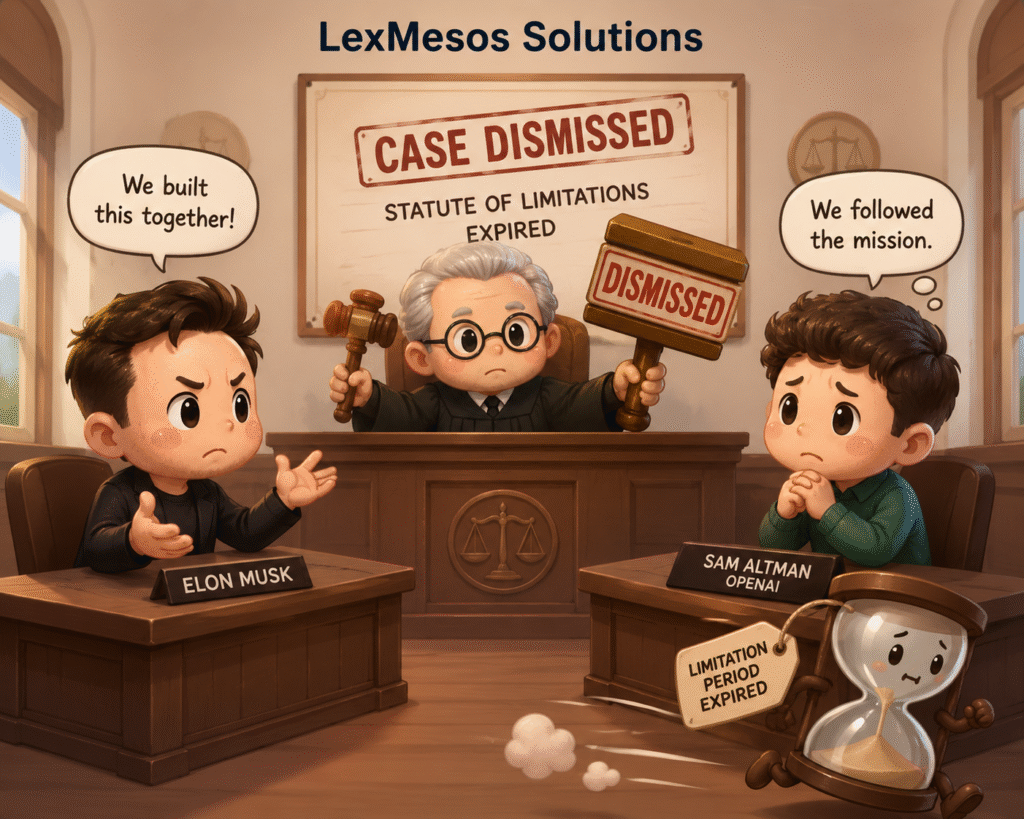
Today, the dismissal of Elon Musk’s lawsuit against OpenAI and Sam Altman is a strong reminder that in law, timing can sometimes matter more than the argument itself.
According to reports, the court dismissed the case because the claims allegedly fell outside the applicable statute of limitations.
In simple terms: the legal action may have been brought too late.
Many people focus on the public drama surrounding the dispute:
- AI competition,
- OpenAI’s commercial direction,
- founder disagreements,
- and the future of artificial intelligence.
But from a legal perspective, another issue immediately stands out:
Was the claim filed within the legally permitted time limit?
This is where limitation periods become critically important.
A limitation period is essentially a statutory legal deadline for bringing a claim before the courts. So, upon the expiry of the period, a party may lose the right to pursue legal action entirely, even if the underlying allegations are serious.
This principle exists in many jurisdictions around the world, including Malaysia, the UK, the EU and the United States.
Malaysia
Limitation periods are primarily governed by the Limitation Act 1953 [Act 254] for Peninsular Malaysia, while Sabah and Sarawak have their own limitation ordinances.
For many civil claims in Malaysia, including:
- breach of contract,
- commercial disputes,
- unpaid debts,
- and tort-related claims
The general limitation period is typically 6 years from the date the cause of action accrued.
This is why legal teams in construction, corporate and commercial disputes often pay close attention to:
- contract dates,
- payment records,
- breach timelines,
- termination notices,
- acknowledgements of debt,
- and dispute correspondence.
A delay in taking action can significantly affect a party’s legal position.
The rationale behind limitation laws is not merely technical procedure.
Courts and legal systems recognise that over time:
- evidence may disappear,
- witnesses may become unavailable,
- memories may fade,
- and businesses require certainty rather than indefinite legal exposure.
What makes the Musk-OpenAI dispute particularly interesting is that the underlying issues involve AI governance, commercialisation, founder expectations and corporate direction, matters with potentially global implications for the future of the AI industry.
Yet despite the scale of the dispute, procedural law may have ended the case before those broader substantive questions were fully examined in court.
This is an important lesson not only for large technology companies, but also for startups, founders and businesses generally.
A strong argument alone is not enough.
Legal rights can sometimes be lost through delay.
As the AI industry continues evolving rapidly through partnerships, restructuring, investments and commercial expansion, businesses should also pay attention to:
- governance structures,
- contractual rights,
- compliance obligations,
- dispute management,
- and limitation timelines.
Because sometimes the biggest legal risk is not losing the argument.
It is waiting too long to act and take action.
Keywords: Elon Musk OpenAI lawsuit, limitation period Malaysia, statute of limitations, AI dispute, OpenAI legal case, AI governance, commercial dispute law, Limitation Act 1953 Malaysia, Sam Altman lawsuit, AI regulation, legal tech Malaysia
19 May 2026