Platform work is growing fast, from ride-hailing to food delivery and freelance digital jobs. But one question remains:
👉 Are these workers employees or independent contractors?
🇪🇺 EU: Stronger Protection Through Law
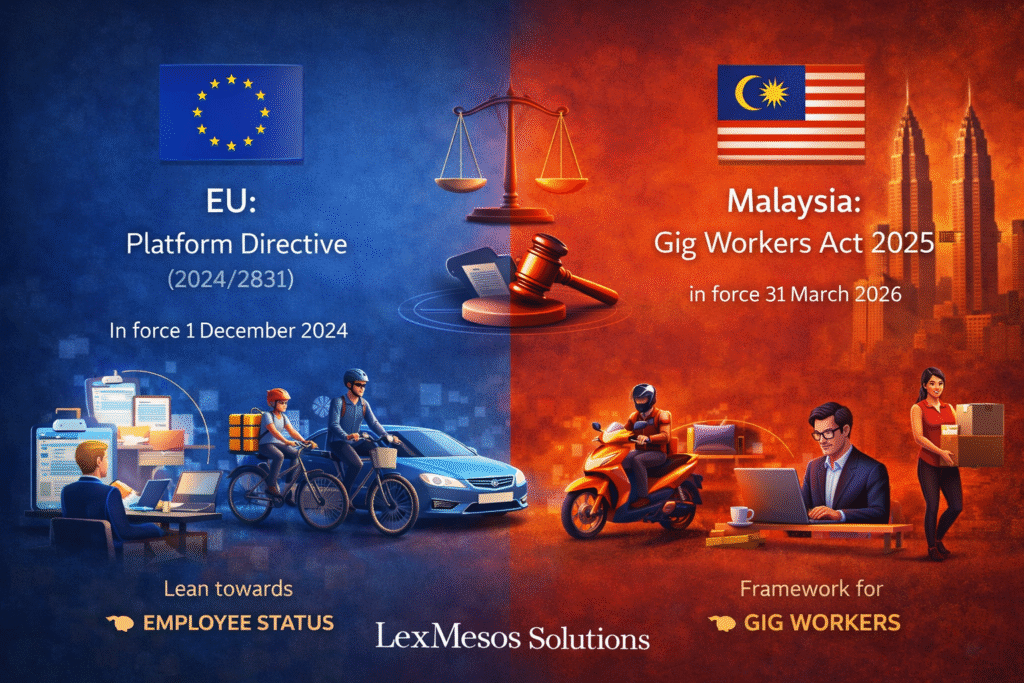
The EU has taken a major step with the Platform Work Directive (EU) 2024/2831, which came into force on 1 December 2024.
Its key idea is simple:
👉 If a platform controls how you work, you may be treated as an employee, not just a contractor.
This includes factors like:
• control over pricing
• performance monitoring
• restrictions on working freedom
The directive also addresses algorithmic management, requiring more transparency in how platforms use AI to manage workers.
👉 In short: more rights, more protection, more accountability.
🇲🇾 Malaysia: Moving Towards a Framework
Malaysia is also responding with the proposed Gig Workers Act 2025 which came into force on 31 March 2026.
The focus is slightly different:
• social protection (SOCSO, EPF contributions)
• basic welfare safeguards
• recognition of gig workers as a distinct category
Unlike the EU:
👉 Malaysia is not rushing to classify gig workers as employees
Instead, it is trying to:
👉 balance flexibility with protection
The Key Difference
• EU → leaning towards employee status and stronger legal rights
• Malaysia → creating a separate framework for gig workers
Final Thought
Platform work is no longer a grey area, it is becoming a regulated space.
But different regions are taking different paths:
👉 One focuses on reclassification
👉 The other focuses on adaptation
The real question going forward is not just protection,
but how to regulate work that is increasingly managed by algorithms.
Keywords: platform workers law, EU Platform Work Directive 2024/2831, gig workers act Malaysia 2025, platform economy regulation, gig economy law Malaysia, employee vs contractor platform workers, algorithmic management law, digital labour regulation, EU labour law AI platforms, Malaysia gig workers protection, platform workers rights EU, gig workers social protection
31 March 2026