 Skip to content

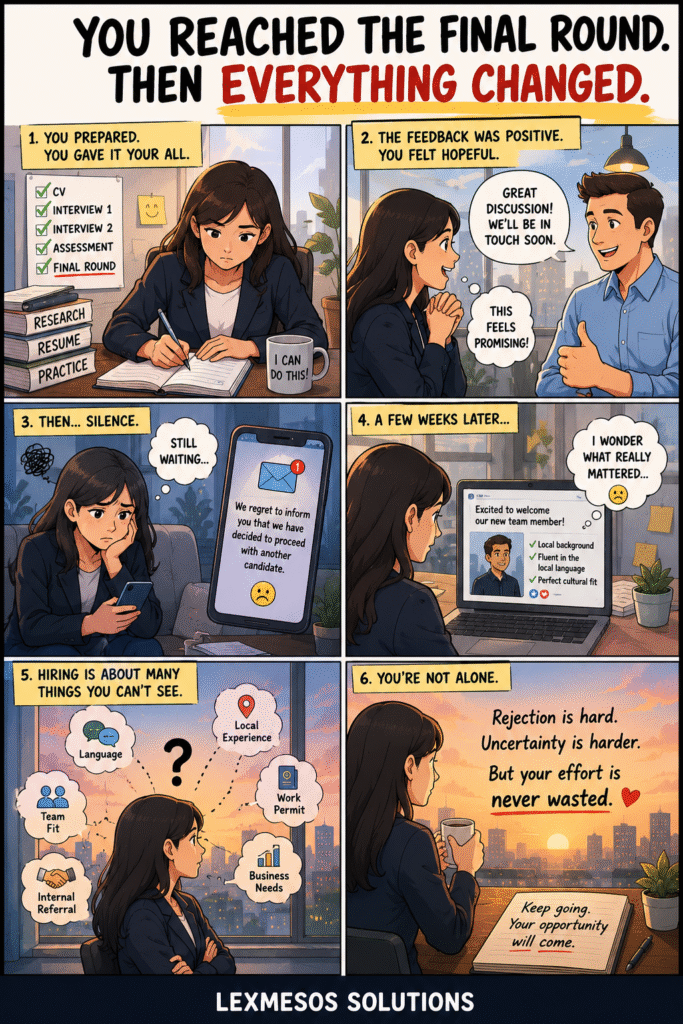
You passed the interviews.
You completed the assessments.
You met the team.
You were told the feedback was positive.
You reached the final round.
For a moment, it felt like the job was yours.
Then the call never came.
A few days later, you received the familiar email:
“We have decided to proceed with another candidate.”
The Questions That Follow
Most unsuccessful candidates eventually move on.
But some interviews stay in your mind.
You replay every conversation.
Every answer.
Every signal.
You start asking yourself:
What changed?
Sometimes The Better Candidate Wins
Let’s be honest.
Sometimes another candidate is simply stronger.
They may have more experience.
More relevant skills.
A better track record.
That happens.
And there is nothing wrong with that.
But Hiring Is Not Always About Qualifications Alone
The uncomfortable reality is that recruitment decisions are often influenced by factors candidates never see.
Perhaps the successful candidate already knew the industry.
Perhaps they had worked with a key client before.
Perhaps they required less onboarding.
Perhaps they already had local work rights.
Perhaps they spoke the language used by customers and colleagues every day.
Perhaps they were already part of the organisation.
None of these factors necessarily mean the decision was unfair.
But they can still be frustrating for candidates who believed they were the strongest applicant.
The Reality Of International Recruitment
For international candidates, the experience can be particularly difficult.
Many invest significant time and effort into applications abroad.
They attend multiple interviews.
Complete assessments.
Adjust to different time zones.
Research the country and organisation.
Only to discover that the final decision may involve considerations beyond qualifications alone.
Language.
Local experience.
Cultural familiarity.
Relocation practicalities.
Client expectations.
Team dynamics.
These factors are not always visible from the outside.
The Answer You Rarely Receive
Most employers will never tell candidates exactly why they were unsuccessful.
And in many cases, they cannot.
Recruitment decisions often involve multiple considerations.
The result is that candidates are left filling in the gaps themselves.
Sometimes they suspect bias.
Sometimes they suspect favouritism.
Sometimes they simply never know.
The Hardest Part
The hardest part is not always rejection.
It is uncertainty.
Not knowing whether you were genuinely close.
Not knowing what tipped the balance.
Not knowing what you could have done differently.
Final Thoughts
Most employers genuinely want the best person for the role.
But “best” does not always mean the person with the strongest CV.
Hiring decisions are often shaped by business needs, team requirements and practical considerations that candidates may never see.
For job seekers, that can be a difficult reality to accept.
Because sometimes the most frustrating answer is not that you were unqualified.
It is that you may never know why you were not chosen.
And that is why some jobs stay in your memory long after the rejection email arrives.
Keywords: final round job rejection, unsuccessful job application, recruitment decisions, hiring process, job interview, international candidates, workplace reality, recruitment bias, local experience, language requirements, hiring decisions, job seeker experience, employment opportunities, recruitment challenges, career development
24 June 2026