
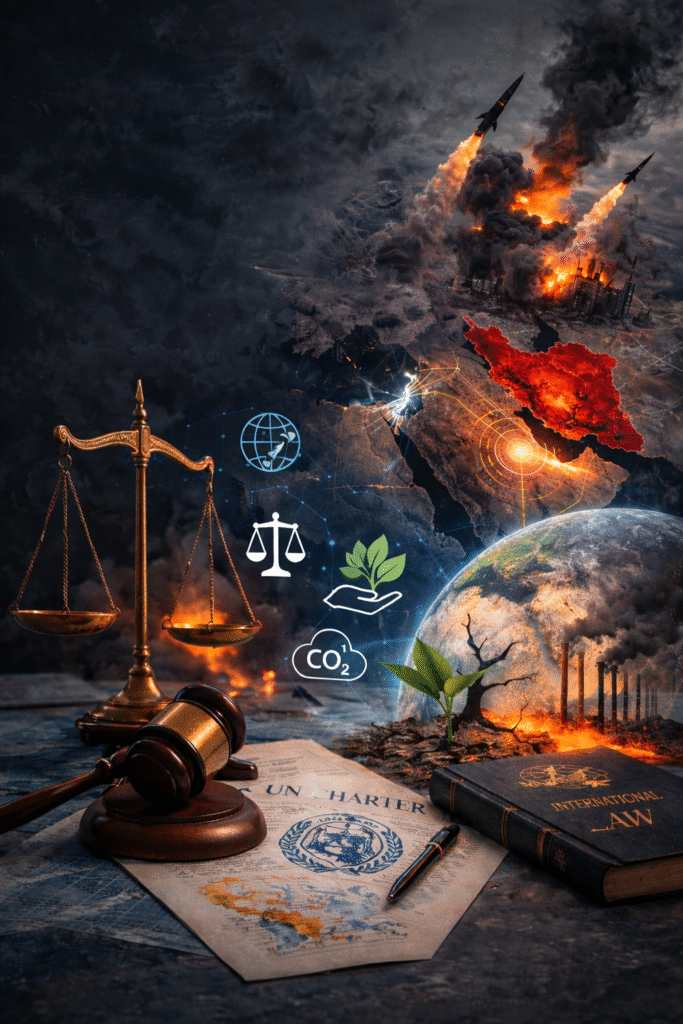
Armed conflict in this 21st century no longer concerns only territorial sovereignty or military proportionality. Modern warfare carries profound implications for human rights protection and climate governance. Recent escalations involving Iran, United States and Israel highlight not only questions of legality under the UN Charter, but also broader responsibilities relating to civilian protection, environmental harm and transboundary climate risk.
This article examines how international law frames state responsibility for war damage, including environmental and climate-related consequences, and whether such obligations survive changes of government.
I. Use of Force and the Foundation of Responsibility
The starting point is Article 2(4) of the United Nations Charter, which prohibits the threat or use of force against the territorial integrity or political independence of any state.[1] The International Court of Justice (ICJ) confirmed in Nicaragua v United States that this prohibition reflects customary international law.[2]
Where force is used in violation of Article 2(4) of the UN Charter, and no valid claim of self-defence under Article 51 or Security Council authorisation applies, the act constitutes an internationally wrongful act and engages the State’s responsibility, including the obligation to cease the breach and make full reparation for the harm caused. But even where force is arguably justified, conduct during hostilities must comply with international humanitarian law (IHL) and international human rights law.
II. State Responsibility and the Obligation of Reparations
The governing framework is the Articles on Responsibility of States for Internationally Wrongful Acts (ARSIWA), adopted by the International Law Commission.[3] Under Article 2 ARSIWA, an internationally wrongful act exists where:
1. Conduct is attributable to the state; and
2. The conduct breaches an international obligation.
Military operations by armed forces are attributable under Article 4.[4] Once breach is established, Article 31 imposes an obligation of full reparation.[5] The classical formulation derives from Factory at Chorzów, which established that reparation must, as far as possible, wipe out all the consequences of the illegal act and restore the situation that would likely have existed had the act not been committed.[6]
In practice, reparation may take several forms under international law, including restitution, compensation or satisfaction, depending on the nature of the breach and the damage suffered.[7]
Importantly, responsibility attaches to the state itself, rather than to a particular government or political regime. Accordingly, a change of government does not extinguish the state’s international responsibility for wrongful acts.
III. Human Rights in Armed Conflict
Contemporary jurisprudence recognises that human rights law does not disappear during armed conflict. The European Court of Human Rights in Al-Skeini v United Kingdom confirmed that jurisdiction may arise extraterritorially where a state exercises effective control over territory or individuals.[8] Thus, cross-border strikes that result in civilian deaths may engage:
• The right to life
• Investigatory obligations
• Procedural accountability duties
The ICJ has also recognised the concurrent applicability of human rights law and IHL.[9] This convergence strengthens the legal basis for reparations beyond purely inter-state claims.
IV. Environmental Damage and Climate Implications
War is increasingly recognised as an environmental and climate risk multiplier. Military strikes can:
• Destroy energy infrastructure
• Release toxic pollutants
• Trigger oil fires or industrial contamination
• Generate large-scale greenhouse gas emissions
The protection of the natural environment during armed conflict is addressed in:
• The Geneva Conventions and Additional Protocol I (Articles 35(3) and 55)[10]
• Customary IHL principles prohibiting widespread, long-term and severe environmental damage
Beyond IHL, environmental harm intersects with climate governance obligations under multilateral frameworks such as the Paris Agreement.[11] Although climate treaties do not directly regulate wartime emissions, the broader principle of due diligence to prevent transboundary environmental harm — recognised in Trail Smelter and affirmed by the ICJ — remains relevant.[12]
Destruction of oil facilities, power plants or chemical installations may therefore generate:
• Immediate humanitarian harm
• Long-term ecological degradation
• Regional climate consequences
The environmental dimension transforms war damage from a bilateral dispute into a matter of global commons governance.
V. Reparations for Environmental Harm
Environmental damage has previously been addressed through claims mechanisms. After Iraq’s invasion of Kuwait in 1990, the United Nations Compensation Commission processed environmental claims arising from oil well fires and contamination.[13]
This demonstrates that environmental and ecological injury can form part of compensable war damage. In future conflicts, climate-related harm, including carbon-intensive destruction, may become increasingly relevant in assessing compensation.
VI. Continuity of State Responsibility
International law rejects the notion that regime change erases responsibility. The doctrine of state continuity recognises that international obligations attach to the state itself rather than to a particular government or political regime.[14]
Accordingly, events such as:
• revolutions
• democratic transitions
• governmental collapse
do not extinguish the state’s international obligations.
This principle safeguards stability in international law and ensures that accountability survives political transformation.
Conclusion: From Battlefield to Biosphere
Addressing environmental damage in armed conflict will become increasingly important for international governance. Modern armed conflict must be analysed not only through the lens of sovereignty and military necessity, but through the interconnected frameworks of:
• State responsibility
• Human rights protection
• Environmental governance
• Climate risk management
Where cross-border force results in unlawful harm, whether to civilians, infrastructure or the environment, international law provides mechanisms for attribution and reparation. As climate vulnerability intensifies globally, the environmental consequences of warfare will increasingly shape both legal discourse and policy reform. War is no longer confined to territory. Its impact extends to ecosystems, atmospheric stability and intergenerational equity. The legal question is therefore not merely who fired first, but who bears responsibility for the long-term human and environmental consequences.
Keywords: international law, armed conflict, environmental law, climate governance, state responsibility, war damage, war compensation, human rights law
10 March 2026
Footnotes
[1] UN Charter art 2(4).
[2] Military and Paramilitary Activities in and against Nicaragua (Nicaragua v United States) [1986] ICJ Rep 14.
[3] International Law Commission, Articles on Responsibility of States for Internationally Wrongful Acts (2001).
[4] ARSIWA art 4.
[5] ARSIWA art 31.
[6] Factory at Chorzów (Germany v Poland)(1928) PCIJ Series A No 17.
[7] ARSIWA arts 34–37.
[8] Al-Skeini and Others v United Kingdom (2011) 53 EHRR 18.
[9] Legal Consequences of the Construction of a Wall in the Occupied Palestinian Territory (Advisory Opinion) [2004] ICJ Rep 136.
[10] Additional Protocol I (1977) arts 35(3), 55.
[11] Paris Agreement (2015).
[12] Trail Smelter Arbitration (United States v Canada) (1938/1941); Pulp Mills on the River Uruguay (Argentina v Uruguay) [2010] ICJ Rep 14.
[13] UN Compensation Commission, Governing Council Decisions (1991–2005).
[14] ARSIWA art 1; see also James Crawford, State Responsibility (Cambridge University Press 2013).