
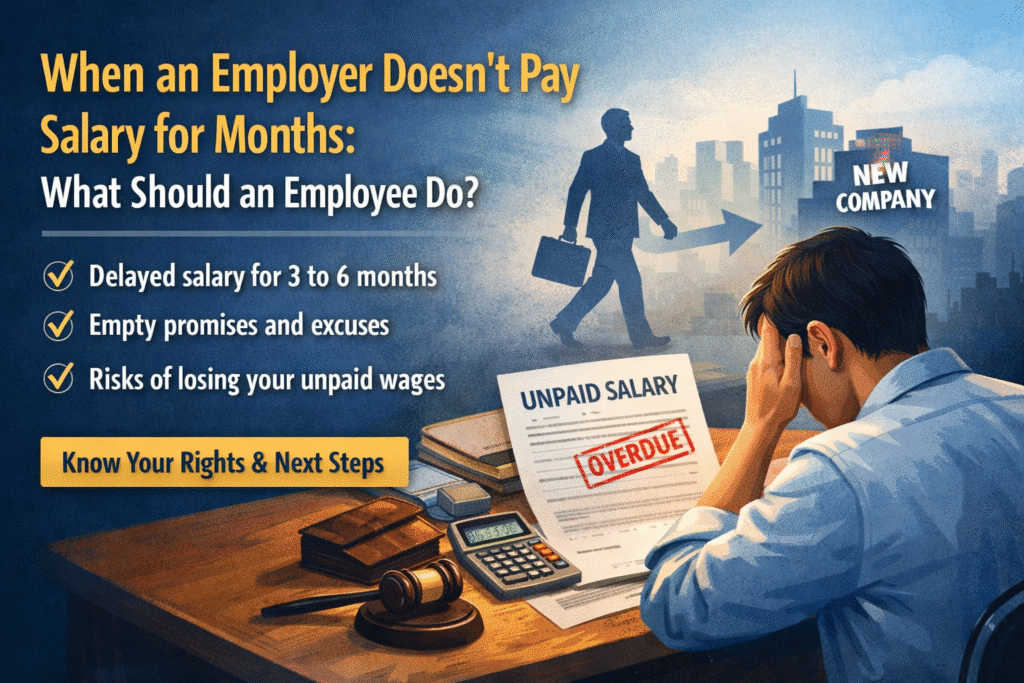
It starts with a delay.
Then a promise.
Then another promise.
Before you realise it, 3 to 6 months have passed and salary is still unpaid.
At this point, it is no longer about patience or loyalty.
It becomes a serious legal and financial risk for the employee.
1. Salary is not optional- it is a legal duty
Under the Employment Act 1955:
• Salary must be paid no later than the 7th day after the wage period
• Failure to pay is a breach of contract and a statutory offence
Once salary is unpaid, the employer is already in breach regardless of excuses.
2. The uncomfortable truth: employment contracts don’t always protect employees
Many employees assume:
“My employment contract will protect me.”
But in reality, most employment contracts are:
• drafted by the employer
• written in broad terms
• heavily favouring employer control
You will often see clauses like:
• “subject to company policy”
• “at the discretion of the employer”
• “performance-based determination”
3. How “employer discretion” is often used
When salary is delayed, some employers rely on these clauses to argue:
• payment depends on company performance
• bonus or allowances are discretionary
• employee performance is unsatisfactory
But here’s the key point:
Basic salary is NOT discretionary
An employer cannot:
• delay salary indefinitely
• refuse to pay wages already earned
• hide behind “discretion” to avoid legal obligations
4. If salary is unpaid for 3–6 months, this is serious
At this stage:
• You are effectively working without pay
• The company may be in financial distress
• Recovery becomes more uncertain over time
Waiting quietly becomes dangerous
5. A common hidden risk: employer shifts to a new company
In some situations, while delaying salaries, the employer may:
• set up a new entity
• move operations, clients, or revenue
• leave liabilities behind in the old company
This leaves employees:
chasing unpaid salary from a company with no assets
6. Should you continue working?
❌ Continue working as normal -> You carry the risk without pay.
❌ Stop work immediately -> Employer may accuse you of:
• misconduct
• poor performance
• abandonment
✅ The correct approach: protect yourself strategically
7. What should you do instead?
(a) Put everything in writing
Document clearly:
• unpaid salary
• months outstanding
• requests for payment
This becomes your evidence
(b) Continue work, but under protest
State clearly:
“I am continuing to perform my duties under protest due to non-payment of salary.”
(c) Do not rely on “discretion” clauses
Even if your contract says:
“subject to discretion”
It does not override the law.
(d) Act early! Don’t wait 6 months
File a complaint with:
Labour Department (Jabatan Tenaga Kerja Malaysia)
(e) Consider constructive dismissal
If the breach continues:
You may treat it as constructive dismissal.
But timing and documentation are critical.
8. Can employer refuse to pay due to “poor performance”?
No.
• Salary already earned must be paid
• Performance issues require proper process
• It cannot be used as an excuse to avoid payment
This is not just theory- these situations happen more often than people realise.
9. What happens in real life (actual situations employees face)
Case 1: “Just wait one more month”
A finance executive continued working for months after repeated promises that salary would be paid “next month”.
After 5 months:
- salary still unpaid
- company downsized
- he was asked to leave
When he chased payment, the employer claimed:
👉 “Your performance dropped.”
Case 2: “It’s at the employer’s discretion”
An employee relied on her contract which stated:
“Subject to employer’s discretion”
When salary was delayed, the employer argued:
- company performance was poor
- payment was discretionary
But in reality:
👉 basic salary is not discretionary under the law.
Case 3: The company quietly moves on
Employees noticed:
- salaries unpaid
- same business still running
But under a new company name.
What happened:
- operations moved
- old company left with debts
- employees left chasing unpaid salary
Case 4: Employee stops working and loses protection
After months of unpaid salary, one employee stopped working.
The employer then:
- issued warnings
- terminated him
- claimed he breached contract
👉 This weakened his legal position
Case 5: The employee who did it right
One employee:
- documented everything in writing
- stated she was working “under protest”
- filed complaint early
👉 She preserved her position and evidence
🔑 What these cases show
In most situations:
👉 The issue is not whether the employer is wrong
👉 The issue is whether the employee protects themselves properly
Final Thought
Employment contracts may give employers flexibility, but they do not give employers the right to avoid paying salary.
When salary is delayed for months:
👉 this is no longer a workplace issue
👉 it is a legal breach
Employees should not work for free, but they must act carefully, not emotionally.
The safest approach is always:
👉 Document everything
👉 Understand your rights beyond the contract
👉 Act early before the situation worsens
Keywords: employer not paying salary Malaysia, delayed salary legal rights Malaysia, Employment Act 1955 salary delay, unpaid wages Malaysia employee rights, constructive dismissal unpaid salary, employer breach employment contract Malaysia
Disclaimer: This article is for general information only and does not constitute legal advice. Each case depends on its specific facts and circumstances.
19 March 2026