
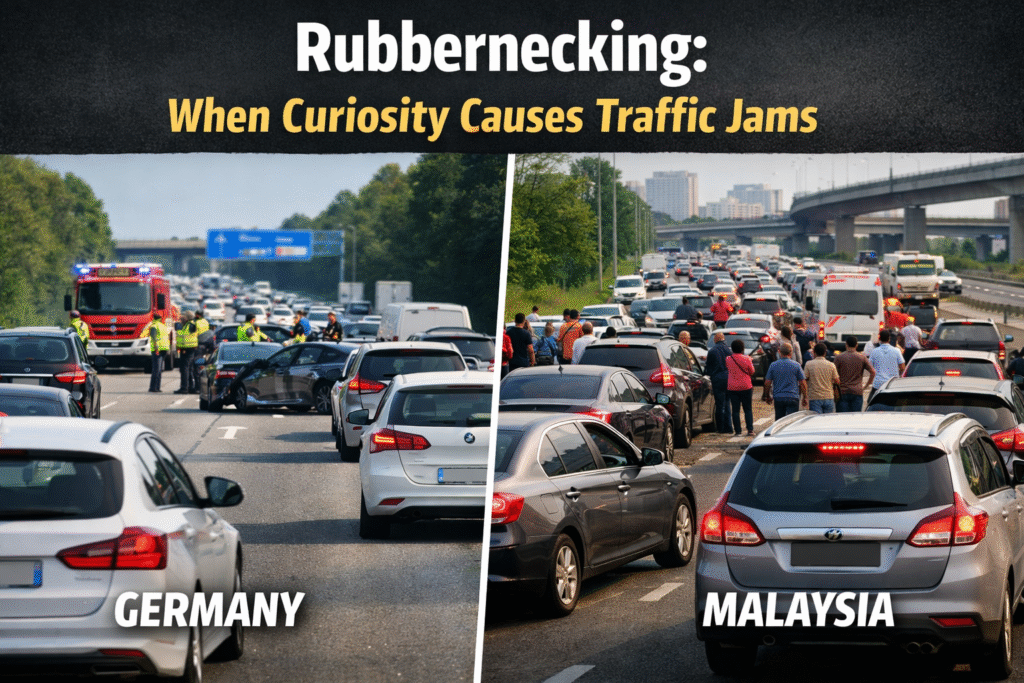
Traffic congestion caused by accidents is a common problem on highways around the world. However, in many cases the traffic jam after a road accident is not only caused by the crash itself but also by drivers slowing down to watch.
In Malaysia, it is common to see motorists reducing speed when they pass a car accident on the highway. Some drivers even take photos or record videos of the accident scene for social media. This behaviour, often called rubbernecking, can significantly worsen traffic congestion after an accident.
Interestingly, Germany has taken a much stricter legal approach to this issue.
Germany’s Strict Law on Filming Accident Scenes
In Germany, filming or photographing accident victims can be a criminal offence under the German Criminal Code (Strafgesetzbuch-StGB).
The law protects the privacy and dignity of accident victims. Recording people who are injured, unconscious or in a helpless situation at a road accident scene can lead to fines or even imprisonment.
Germany also actively penalises drivers who slow down unnecessarily on highways to observe an accident. This behaviour, widely known as rubbernecking, is considered dangerous because it disrupts traffic flow and increases the risk of secondary accidents on highways.
For this reason, German authorities discourage drivers from turning an accident scene into a spectacle.
Traffic Behaviour in Malaysia
In Malaysia, there is currently no specific law that directly prohibits drivers from filming a road accident or recording accident scenes for social media.
As a result, it is common for drivers to slow down significantly when passing an accident site. Many motorists may take out their phones to capture photos or videos of the highway accident scene.
While this behaviour may appear harmless, it often causes severe traffic jams after accidents, especially on busy highways.
The accident itself may involve only a few vehicles, but the slowdown created by curious drivers can result in long traffic congestion stretching for kilometres.
Safety Risks of Rubbernecking
Beyond traffic delays, rubbernecking can also create serious road safety risks.
When vehicles suddenly slow down on highways to observe an accident, it increases the likelihood of rear-end collisions and secondary crashes.
These additional accidents may sometimes be more dangerous than the original crash.
Germany’s strict enforcement against filming accident scenes and slowing down unnecessarily is intended to reduce these risks and ensure that emergency services can respond quickly to road accidents.
Should Malaysia Consider Stricter Rules?
The German approach raises an important question for Malaysia: should stricter rules be introduced to discourage drivers from filming accident scenes or slowing down unnecessarily on highways?
While public awareness campaigns are important, legal deterrence can sometimes influence road behaviour more effectively.
Encouraging drivers to continue moving and allowing emergency responders to manage accident scenes may help reduce both traffic congestion and road safety risks.
Sometimes the most responsible thing a driver can do when passing a road accident is simply to keep moving and avoid turning the incident into a spectacle.
Keywords: road accident, traffic jam after accident, filming accident scene, highway accident, rubbernecking traffic, drivers slowing down accident, road safety, accident victims privacy, secondary accidents on highway, traffic congestion accident, filming accident social media
14 March 2026