
Workplace communication is often treated as a simple operational matter, let’s say just pick a tool and use it.
But in reality, it is closely linked to compliance, accountability and how a company responds when things go wrong.
Across Malaysia and Europe, the difference is not just about tools like Slack, Teams or WhatsApp.
The real difference lies in how communication is managed, controlled and documented.
Daily Communication: Structured vs Practical
In many European companies, communication is more structured. Platforms like Microsoft Teams or Slack are used as official channels, not just convenience tools. Conversations are organised by department or project, and messages are often treated as part of company records.
This means:
• Discussions are traceable
• Decisions can be tracked
• Communication aligns with internal policies
In Malaysia, companies tend to adopt a more practical and flexible approach. Tools such as Skype, Google Chat, email and sometimes WhatsApp are used interchangeably depending on convenience.
This flexibility supports speed, but it often leads to:
• Fragmented communication
• Limited documentation
• Difficulty tracking decisions afterwards
Compliance and Internal Policy Gaps
In Europe, particularly under regulatory frameworks like GDPR, communication is treated as part of compliance. Companies usually have clearer internal rules covering:
• Approved platforms for official communication
• Restrictions on sharing sensitive information
• Retention of messages and records
• Defined escalation responsibilities
In Malaysia, policies may exist, but enforcement is often inconsistent. It is still common for business discussions to take place across multiple platforms without clear control or audit trail.
From a compliance perspective, this creates exposure in:
• Audits
• Disputes
• Internal investigations
Emergency Communication: The Practical Reality
This is where many companies overlook a key issue.
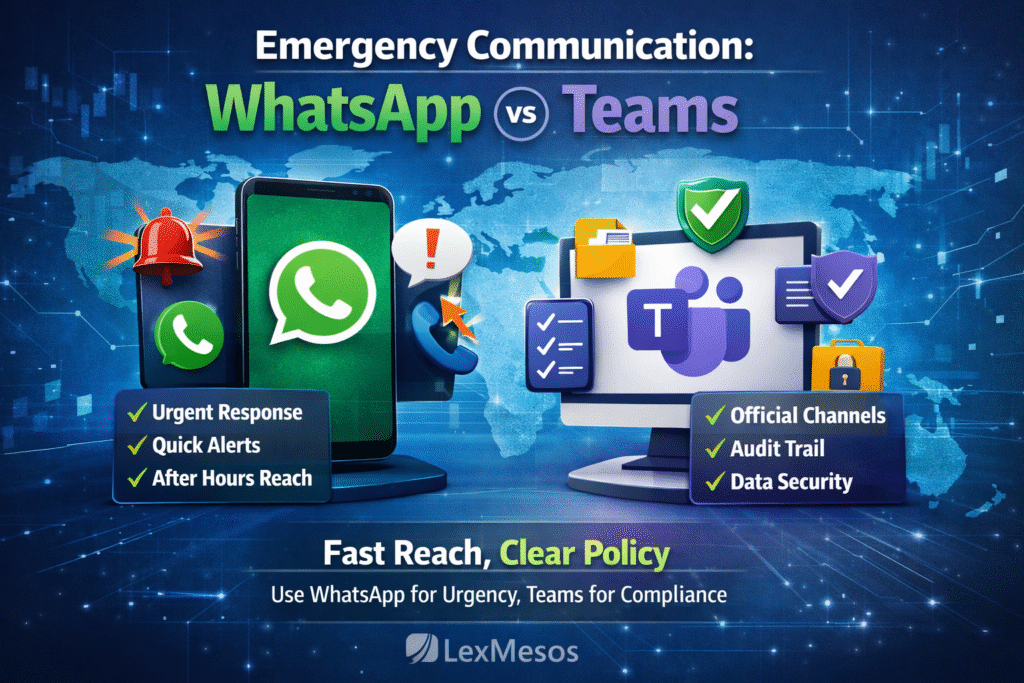
In real situations, employees do not always check internal systems after working hours. Notifications from Slack, Teams or similar platforms are easily missed.
In contrast, mobile-based communication, especially WhatsApp or direct phone calls has a much higher response rate.
This is why, even in Europe, many teams still rely on WhatsApp for:
• Urgent updates
• Crisis coordination
• Immediate response situations
This is not a weakness. It is a practical reality.
The issue is not the use of WhatsApp.
The issue is when companies fail to recognise and regulate its role.
A Balanced Approach: Policy Over Preference
Instead of forcing reliance on internal systems alone, companies should adopt a more realistic and controlled approach.
A proper communication policy should:
1. Recognise emergency tools
Allow WhatsApp or phone calls for urgent situations where immediate response is required.
2. Define clear boundaries
Set rules on:
• What can be shared
• Who can initiate emergency communication
• When such tools should be used
3. Require documentation
Any key decision made through informal channels must be:
• Recorded in official systems (email, Teams and etc.)
• Properly documented for audit and reference
4. Align with data protection requirements
Particularly in Europe:
• Sensitive or personal data should not be shared via unsecured platforms
• Employees must understand their legal obligations
Practical Recommendation
Companies should:
• Treat WhatsApp messages as potential business records
• Require important discussions to be recorded or summarised in official systems
• Avoid sharing sensitive or confidential information casually
• Implement a clear communication and retention policy
Conclusion
Workplace communication is no longer just about convenience. It is part of a company’s risk management and compliance framework.
Companies should stop assuming that internal platforms alone are sufficient.
In real emergencies, people respond to their phones, not system notifications.
The solution is not to avoid tools like WhatsApp, but to govern them properly through clear internal policies.
Strong organisations understand that:
• Structured platforms are essential for daily operations
• Informal tools are necessary for urgent situations
• Effective communication requires both, supported by clear rules and accountability
WhatsApp messages are not informal in the eyes of the law — they can and do become evidence.
The real risk is not using WhatsApp, but failing to properly manage and retain those communications.
Need a Clear Communication Policy for Your Company?
Most companies rely on multiple tools:
Slack, Teams, WhatsApp
but without a proper policy, communication becomes a risk.
Miscommunication, missing records and unmanaged WhatsApp discussions can lead to serious issues during audits, disputes or internal investigations.
Many companies only realise the importance of communication policies when disputes arise. By then, it is already too late.
Not sure how to customise the template?
Let our AI-assisted drafting guide you step-by-step.
Guided and customised policy generated based on your business needs.
Disclaimer: This service provides structured drafting support and does not constitute legal advice. For formal legal review, please consult a licensed legal practitioner.
Keywords: workplace communication policy, emergency communication workplace, WhatsApp business communication, Microsoft Teams workplace use, Slack vs WhatsApp workplace, internal communication compliance, corporate communication policy Malaysia, workplace communication Europe vs Malaysia, GDPR communication policy, business communication tools, internal communication audit trail, company handbook communication policy, crisis communication workplace, digital communication compliance, employee communication guidelines
25 March 2026