 Skip to content
Artificial intelligence (AI) is becoming part of everyday business operations.
Companies use AI to draft documents, analyse data, screen job applicants, generate content and support decision-making.
Yet many businesses assume that if an AI tool is legal to use in one country, it must be legal everywhere.
That assumption may become increasingly risky.
The Global AI Rulebook Does Not Exist
Unlike areas such as international trade or aviation, there is currently no single global law governing AI.
Instead, countries and organisations are developing their own frameworks, standards and regulations.
For example:
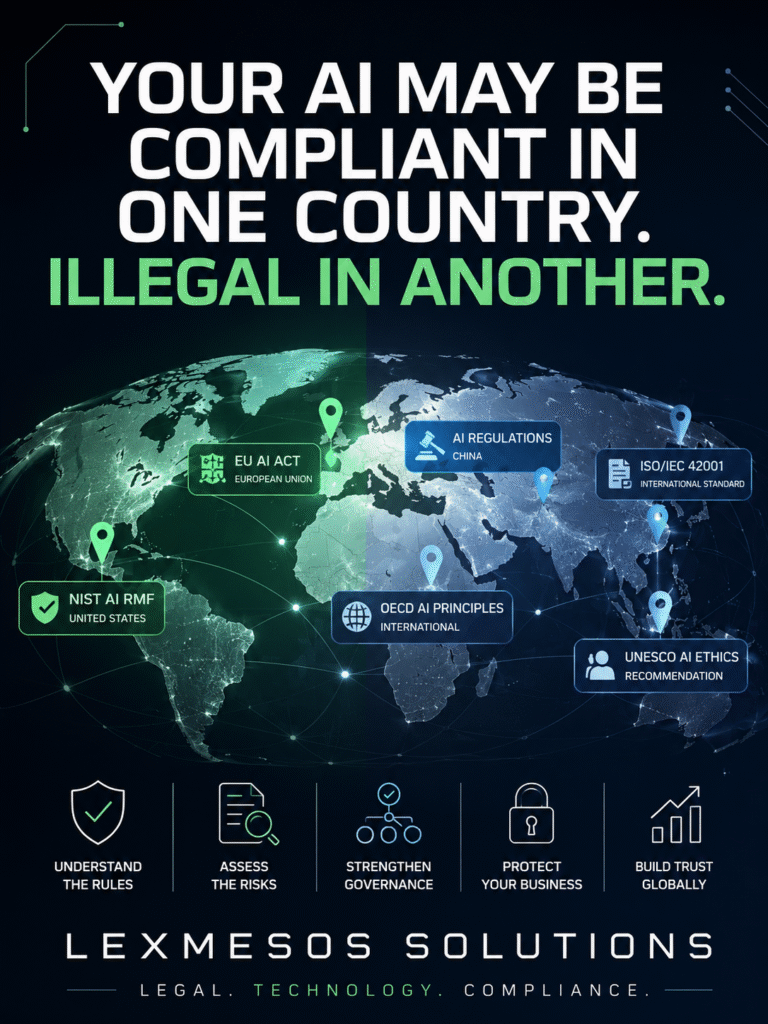
- The European Union has the EU AI Act.
- The United States promotes the NIST AI Risk Management Framework.
- China has introduced various AI regulations covering recommendation algorithms, generative AI and content governance.
- The OECD has published AI Principles adopted by many countries.
- ISO/IEC 42001 provides an international AI management system standard.
- UNESCO has issued recommendations on AI ethics.
While these frameworks share common themes such as transparency, accountability and risk management, they are not identical.
The result is a growing patchwork of AI governance requirements.
One AI Tool. Different Legal Expectations.
Imagine a business uses the same AI-powered recruitment platform across multiple countries.
In one jurisdiction, the system may be considered a useful efficiency tool.
In another, regulators may require additional assessments, documentation or safeguards before it can be used.
The technology may remain unchanged.
The legal expectations may not.
This creates a challenge for businesses operating across borders, serving international customers or working with multinational partners.
The Real Risk Is Not The Technology
Many discussions focus on what AI can do.
The bigger issue may be how organisations manage AI.
Questions increasingly being asked include:
- Who is responsible for AI-generated outcomes?
- What data is being used?
- How are risks assessed?
- Can decisions be explained?
- Is there human oversight?
- Are appropriate governance measures in place?
For many organisations, these governance questions are becoming just as important as the technology itself.
Why SMEs Should Pay Attention
Some small and medium-sized businesses believe AI governance only affects large corporations.
That may no longer be true.
Large organisations increasingly expect suppliers, contractors and service providers to demonstrate responsible AI practices.
In some sectors, businesses may find themselves completing questionnaires about AI usage, data handling and risk management before winning contracts.
Clients are starting to ask questions.
Investors are starting to ask questions.
Regulators are starting to ask questions.
Compliance With What?
One of the most common claims made by AI vendors is that their product is “compliant”.
The obvious follow-up question is:
Compliant with what?
A particular framework?
A specific country’s regulations?
An industry standard?
Or simply the vendor’s own internal policies?
Businesses should understand that compliance is rarely a universal concept.
A solution that satisfies one framework may not automatically satisfy another.
The Future May Be Interoperability
Many experts believe the future of AI governance will not involve a single global AI law.
Instead, the focus may shift towards interoperability, finding practical ways for different frameworks and standards to work together.
This approach may help organisations navigate varying requirements while promoting responsible AI use across borders.
However, achieving interoperability remains a significant challenge.
Final Thoughts
AI governance is no longer just a legal or regulatory issue.
It is becoming a business issue, a procurement issue and a risk management issue.
The question is no longer whether organisations use AI.
The question is whether they understand the governance expectations that may come with it.
Because in today’s world, your AI may be compliant in one country.
But that does not necessarily mean it will be compliant everywhere.
Is Your Organisation Ready for AI Governance?
As AI regulations and governance frameworks continue to evolve worldwide, organisations may face increasing expectations from clients, regulators and business partners. Understanding potential risks is often the first step towards responsible AI adoption.
Keywords: AI governance, AI compliance, EU AI Act, ISO 42001, NIST AI RMF, AI risk management, artificial intelligence regulation, AI policy, responsible AI, global AI governance
22 June 2026