 Skip to content

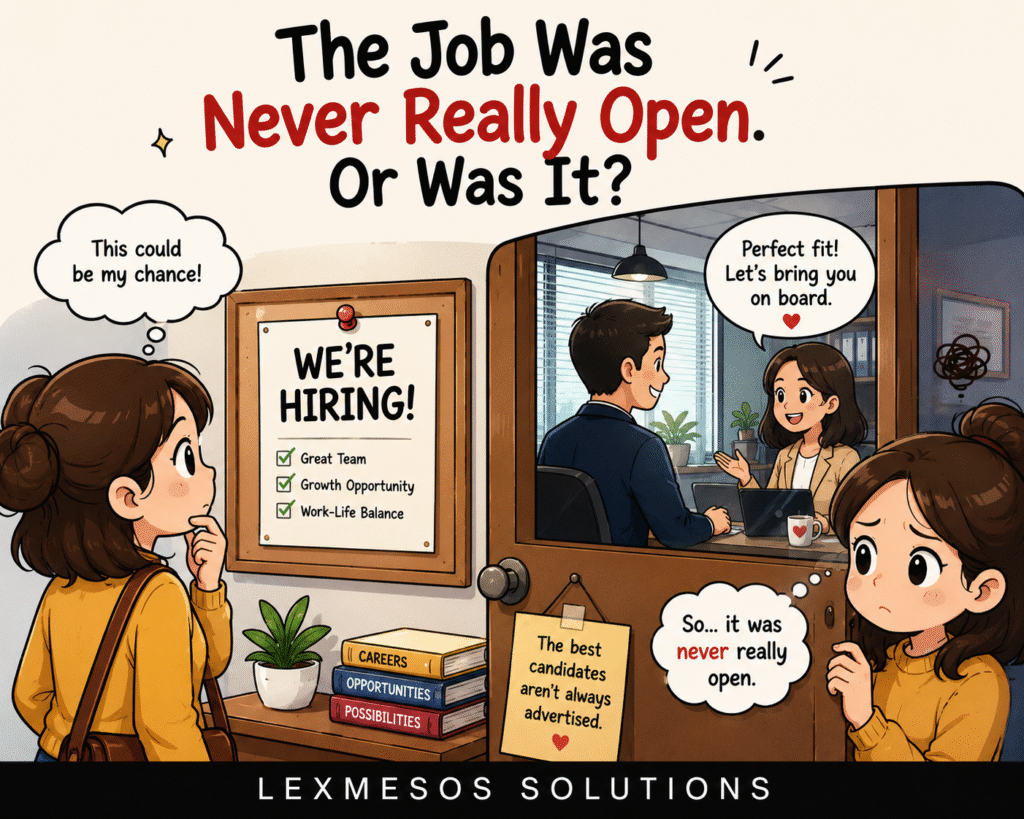
You submit your application.
You wait.
You attend the first interview.
Then the second.
Perhaps even a third.
You complete assessments.
Prepare presentations.
Take annual leave from your current job.
Invest hours researching the company.
Weeks pass.
Then the email arrives.
“Thank you for your interest. We have decided to proceed with another candidate.”
No explanation.
No feedback.
No indication of what went wrong.
For many job seekers, this experience is not unusual.
The question that often follows is:
Was I genuinely considered?
Or was the outcome already decided?
The Question Many Candidates Quietly Ask
Most candidates understand they will not receive every job they apply for.
Competition exists.
Employers have choices.
Different organisations look for different qualities.
Rejection is part of the process.
Yet after investing significant time and effort, many candidates are left wondering whether they were truly competing for an open position.
Particularly when the process involves multiple rounds of interviews and extensive assessments.
The longer the process, the greater the expectation that candidates are being seriously considered.
When The Feedback Never Comes
Most candidates can accept rejection.
What many struggle to accept is uncertainty.
Was it:
- experience?
- qualifications?
- technical skills?
- salary expectations?
- language proficiency?
- team dynamics?
- cultural fit?
- another stronger candidate?
Without feedback, candidates are left guessing.
And guessing often creates frustration.
Many employers understandably avoid detailed feedback due to legal, practical or resource constraints.
However, from the candidate’s perspective, silence often feels like another unanswered question.
The Internal Candidate Dilemma
Many organisations promote from within.
There is nothing inherently wrong with this.
Internal promotions can reward loyalty, retain talent and preserve institutional knowledge.
However, external candidates may sometimes feel discouraged when they discover that an internal candidate was ultimately selected.
Particularly after investing considerable time in the recruitment process.
The concern is not necessarily that the internal candidate was chosen.
The concern is whether external candidates were given a realistic opportunity from the beginning.
The perception of fairness often matters almost as much as fairness itself.
The Overqualified Problem
Another challenge rarely discussed openly is overqualification.
A candidate may possess:
- advanced qualifications;
- extensive experience;
- international exposure;
- specialist expertise.
Yet still struggle to secure employment.
Employers may have legitimate concerns.
Will the candidate remain long-term?
Will they become dissatisfied?
Will salary expectations exceed the available budget?
Will the role provide sufficient challenge?
Unfortunately, these concerns are not always communicated.
The candidate simply receives another rejection.
And another unanswered question.
When Job Hunting Becomes A Full-Time Job
Many professionals today submit hundreds of applications.
Some submit thousands.
They attend interviews.
Complete assessments.
Prepare presentations.
Network extensively.
Upskill continuously.
Yet success remains elusive.
At some point, the challenge becomes more than finding employment.
It becomes maintaining confidence.
Friends, family and colleagues often offer advice:
“Try international companies.”
“Keep applying.”
“Something will come up.”
While well-intentioned, such advice may feel disconnected from the reality experienced by candidates who have already exhausted countless opportunities.
What Fair Recruitment Really Means
Many organisations promote values such as fairness, equality and non-discrimination.
These principles are important.
However, candidates often assess fairness differently.
They look at:
- transparency;
- communication;
- respect for their time;
- professionalism throughout the process.
Fair recruitment is not simply about conducting interviews.
It is also about ensuring candidates feel respected, even when they are unsuccessful.
Final Thought
Most candidates do not expect employers to justify every hiring decision.
Most candidates do not expect every application to succeed.
What many candidates hope for is something much simpler.
Clarity.
A sense that their time was respected.
A sense that they were genuinely considered.
Because sometimes the most difficult part of job hunting is not rejection.
It is never knowing why.
And when enough unanswered rejections accumulate, candidates inevitably begin asking themselves a question that no employer wants to hear:
Was the job ever really open in the first place?
Keywords: job interviews, recruitment process, hiring practices, internal candidates, overqualified candidates, job rejection, recruitment fairness, candidate experience, hiring transparency, employment opportunities, workplace equality, recruitment challenges, interview feedback, job search frustration, recruitment process transparency
20 June 2026