 Skip to content

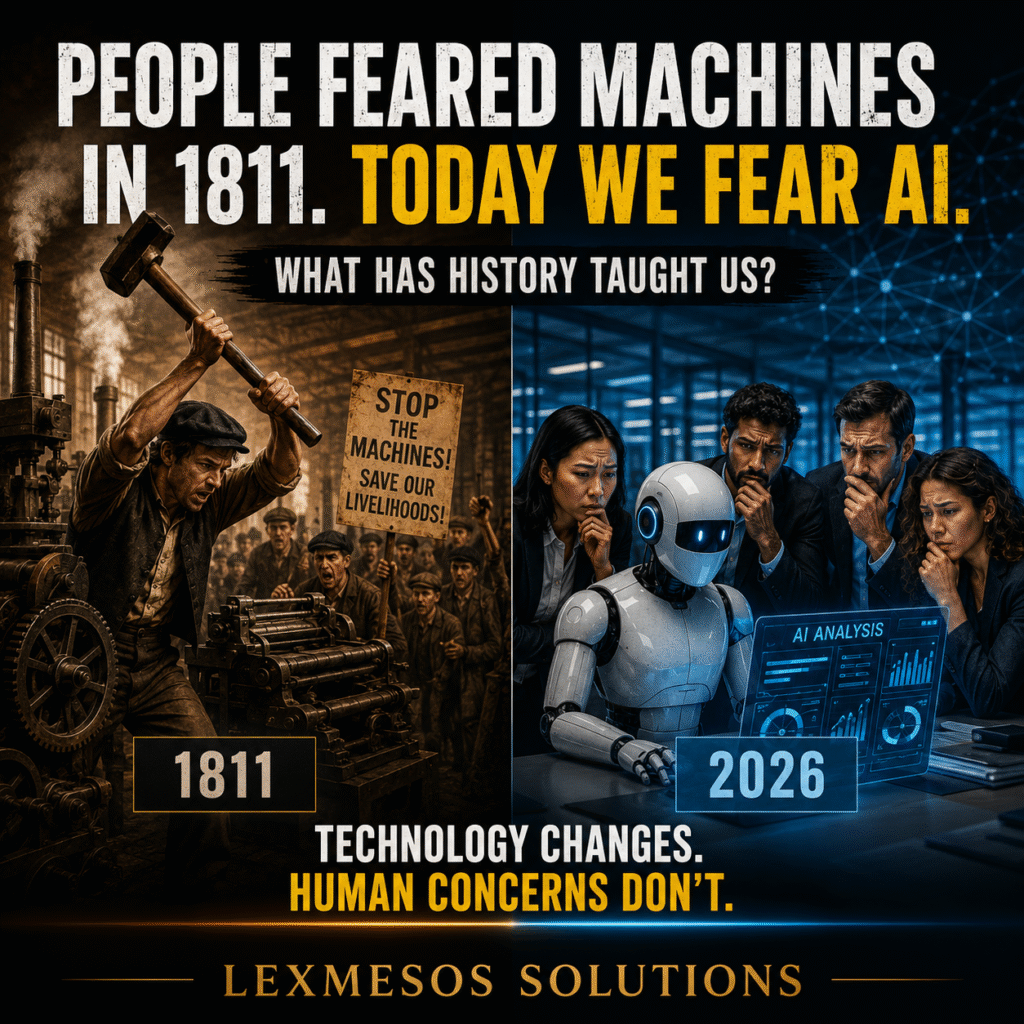
In 1811, workers smashed machines because they believed technology was taking away their livelihoods.
More than 200 years later, many employees fear Artificial Intelligence (AI) for exactly the same reason.
Different technology.
Same anxiety.
Today, headlines are filled with predictions that AI will replace jobs, automate tasks, reduce hiring and transform entire industries.
Some people see opportunity.
Others see uncertainty.
But history suggests this is not the first time society has faced such fears.
The Original Fear of Technology
During the Industrial Revolution, new machines dramatically changed how goods were produced.
For factory owners, the machines increased productivity and reduced costs.
For many workers, however, the experience looked very different.
Handloom weavers who had spent years mastering their craft suddenly found themselves competing against machines that could produce cloth faster and cheaper.
Historical records show that wages for handloom weavers in parts of England fell significantly as industrialisation accelerated.
At the same time, the expansion of railways displaced thousands of workers whose livelihoods depended on canals and older forms of transportation.
Many people genuinely believed technology was destroying their future.
For them, this was not a theoretical debate.
It was about survival.
The Luddites: Anti-Technology or Simply Afraid?
Secret groups known as the “Luddites” became famous for destroying machinery they believed was replacing human labour.
To some observers, they were enemies of progress.
To others, they were workers reacting to rapid economic change.
The reality was probably somewhere in between.
The Luddites were not afraid of technology simply because it was new.
They were afraid of what technological change meant for their jobs, incomes, families and communities.
That fear sounds remarkably familiar today.
Fast Forward to the AI Revolution
Instead of textile machines, we are now talking about AI.
Employees worry that AI will:
- replace jobs,
- reduce hiring,
- automate professional tasks,
- lower demand for certain skills, and
- make some careers less valuable.
Writers worry.
Designers worry.
Accountants worry.
Lawyers worry.
Customer service teams worry.
Financial professionals worry.
Relationship managers worry.
Recruiters worry.
Consultants worry.
Sales professionals worry.
Even software developers worry.
For decades, many people believed that careers built on expertise, judgment, trust, communication and human relationships would be difficult to automate.
AI is now challenging that assumption.
AI Is Not Only Replacing Tasks. It Is Changing Relationships.
This is one of the biggest differences between the Industrial Revolution and the AI Revolution.
The Industrial Revolution mainly affected physical labour.
AI is affecting both physical and intellectual work.
It is beginning to influence how people:
- communicate,
- analyse information,
- prepare reports,
- conduct research,
- provide advice,
- negotiate deals, and
- make decisions.
In banking, relationship managers wonder whether AI will eventually handle routine client interactions.
In finance, analysts see AI producing reports and forecasts in seconds.
In legal services, document review and drafting can now be partially automated.
In sales and customer service, AI assistants increasingly handle enquiries that previously required human interaction.
The concern is no longer limited to factory workers.
It now extends to professions that once seemed relatively protected from technological disruption.
Were the Luddites Wrong?
Not entirely.
This is where many people misunderstand history.
The Luddites were not irrational.
Some jobs genuinely disappeared.
Certain skills became less valuable.
Entire industries transformed.
Workers experienced real economic hardship.
In that sense, their concerns were justified.
However, history also tells another story.
While technology eliminated some jobs, it created many others.
The Industrial Revolution eventually gave rise to:
- railway engineers,
- machine operators,
- factory supervisors,
- telecommunications specialists,
- mechanics,
- technicians, and
- countless professions that previously did not exist.
The economy changed.
People adapted.
New opportunities emerged.
What Makes AI Different?
AI is developing at a speed that many previous technological revolutions never experienced.
A machine in the 1800s might replace one specific task.
AI can assist with hundreds of tasks across multiple industries simultaneously.
For the first time, technology is not only affecting manual labour.
It is affecting knowledge work as well.
This is why AI feels different.
Many white-collar professions that once seemed insulated from automation are now being forced to rethink their future.
Yet one lesson from history remains relevant:
Technology rarely removes all work.
It changes the type of work people perform.
The Real Risk May Not Be AI
The greatest risk may not be AI itself.
The greatest risk may be failing to adapt.
Workers who refused to learn new skills during previous technological revolutions often struggled.
Those who adapted generally benefited from new opportunities.
The same principle may apply today.
The question is not:
“Will AI change the workplace?”
That answer is already so clear.
The more important question is:
“How prepared are we for that change?”
What Can Businesses Learn?
Companies face a similar challenge.
Some organisations view AI purely as a cost-cutting tool.
Others see it as a productivity tool that can help employees work more effectively.
The businesses most likely to succeed may be those that focus on both technology and people.
Implementing AI is relatively easy.
Helping employees adapt is much harder.
Training, governance, communication and workforce transition strategies may become just as important as the technology itself.
Because history shows that resistance often grows when people feel excluded from change.
Final Thoughts
In 1811, workers feared machines.
In 2026, many workers fear AI.
History does not tell us that every concern is unfounded.
Some jobs will change.
Some roles will disappear.
New ones will emerge.
The lesson from the Industrial Revolution is not that people should stop worrying.
The lesson is that every technological revolution creates both winners and losers.
The challenge is ensuring that people are prepared for what comes next.
Because while technology continues to evolve, one thing has remained remarkably consistent for more than 200 years:
People do not fear machines.
They fear being left behind.
The Industrial Revolution taught machines how to do physical work.
The AI Revolution is teaching machines how to perform parts of intellectual work.
That is why today’s debate feels different.
And perhaps that is why it feels so personal.
How LexMesos Solutions Can Help
Technology changes.
Human concerns often remain the same.
Whether it was machines in 1811 or AI today, the challenge has never been technology alone.
It has always been how people adapt to change.
For more practical insights on AI, governance, compliance and workplace developments, explore our latest articles and resources.
Keywords: Artificial Intelligence (AI), AI Revolution, Industrial Revolution, Luddites, technological disruption, automation, job displacement, future of work, workplace transformation, AI and employment, digital transformation, workforce adaptation, AI governance, AI risk management, knowledge workers, financial services, legal industry, relationship management, business innovation, LexMesos Solutions
Disclaimer: This article is for general informational purposes only and does not constitute legal advice.
7 June 2026