 Skip to content

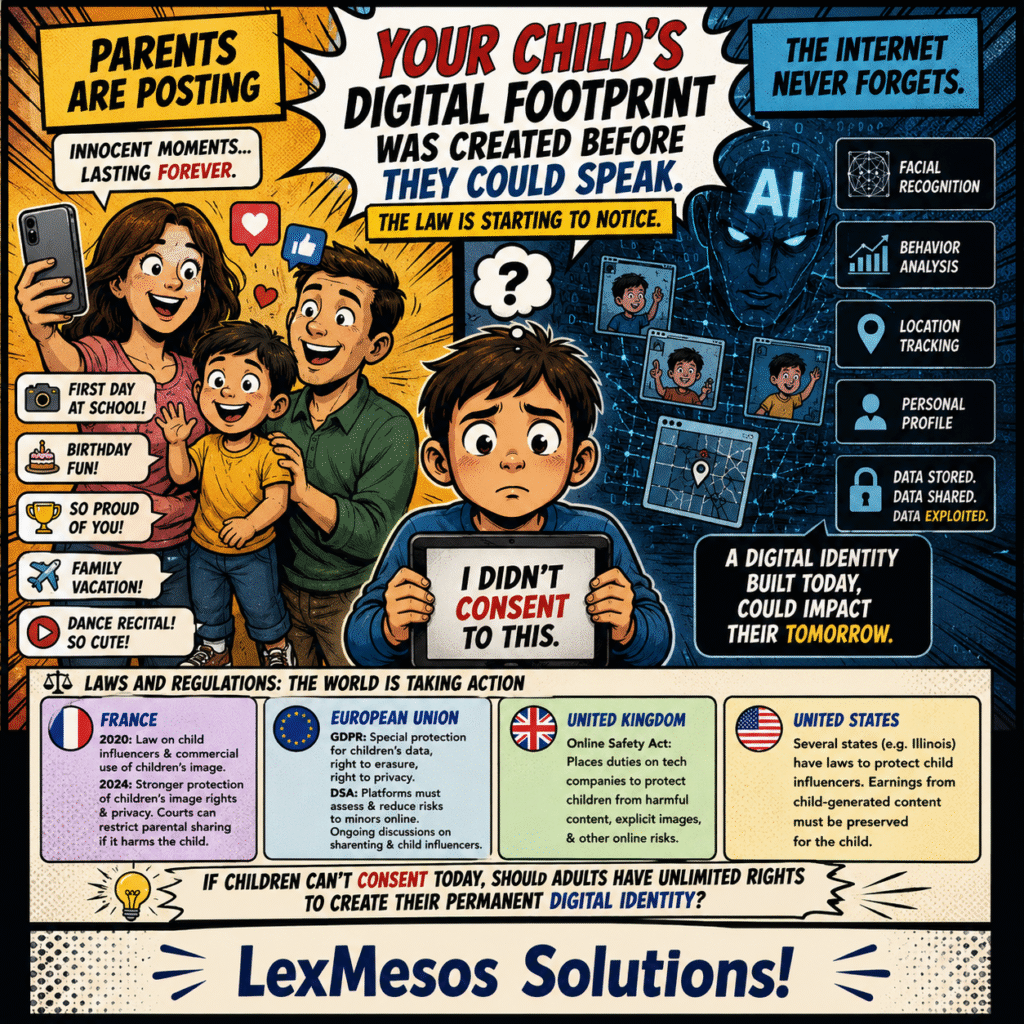
Governments Want to Protect Children Online. But Some Are Asking a New Question.
For years, governments have focused on protecting children from online harms such as cyberbullying, explicit content, online predators and harmful algorithms.
Today, a different issue is emerging:
What happens when a child’s online identity is created not by the child, but by parents, influencers, advertisers and platforms?
This debate is no longer theoretical. Several countries and regulators are already taking action.
France: The First Major Push Against Excessive “Sharenting”
In 2020, France introduced rules regulating child influencers and the commercial use of children’s images on online platforms.
In 2024, France went further by strengthening protection of children’s image rights and privacy. The law emphasises that parents must consider a child’s right to privacy when posting content online. In serious cases, courts may intervene if parental sharing harms the child’s interests.
The message is clear:
Being a parent does not automatically mean having unlimited rights over a child’s digital identity.
European Union: Children’s Data Is Already Protected, But Is It Enough?
The EU does not currently have a dedicated “Sharenting Directive.”
However, several laws already touch on the issue:
GDPR
The GDPR treats children’s personal data as deserving special protection.
Photos, videos, biometric information and online profiles may all constitute personal data.
Children also benefit from rights such as:
- Right to erasure (“right to be forgotten”)
- Right to privacy
- Protection against unlawful processing of personal data
Digital Services Act (“DSA”)
The DSA requires large online platforms to assess and reduce risks to minors.
Platforms must consider:
- Children’s safety
- Age-appropriate design
- Harmful content exposure
- Protection of minors’ rights
Ongoing EU Discussion
Members of the European Parliament have recently raised concerns about:
- Sharenting
- Child influencers
- Commercial exploitation of children’s online presence
- Long-term impacts on children’s privacy
The discussion is moving beyond platform responsibility and towards the role of adults.
United Kingdom: Strong Child Safety Focus
The UK’s Online Safety Act places significant responsibilities on technology companies to protect children from harmful content.
Recent discussions have included:
- Age verification
- Explicit image sharing
- Child online safety
- Platform accountability
While the UK has not yet adopted a specific anti-sharenting law, concerns about children’s digital footprints are increasingly part of wider online safety discussions.
United States: Child Influencers Enter the Legal Debate
Several US states have started addressing child influencers and family content creators.
The concern is simple:
If adults earn money from content featuring children, should those children receive financial and legal protections similar to child actors?
States such as Illinois have already introduced protections requiring earnings generated from child influencer content to be preserved for the child.
Why AI Changes Everything
Ten years ago, a family photo online was mostly a family photo.
Today, AI can:
- Analyse facial features
- Track behavioural patterns
- Build digital profiles
- Generate deepfakes
- Identify individuals across multiple platforms
A child whose life has been documented online since birth may enter adulthood with thousands of searchable images and years of personal information already available online.
The child never agreed.
The data already exists.
The Next Privacy Debate
Governments are telling technology companies to protect children.
Technology companies are being asked to improve safety measures.
But an uncomfortable question remains:
If children are too young to meaningfully consent to many online activities, should adults have unlimited rights to create a permanent digital identity on their behalf?
France has already started answering that question.
The rest of the world may not be far behind.
Keywords: Sharenting, child digital identity, children’s privacy rights, GDPR, Digital Services Act, Online Safety Act, France child privacy law, child influencers, children’s image rights, AI and children, digital footprint, parental consent, online child protection, data protection, children’s rights
9 June 2026