 Skip to content
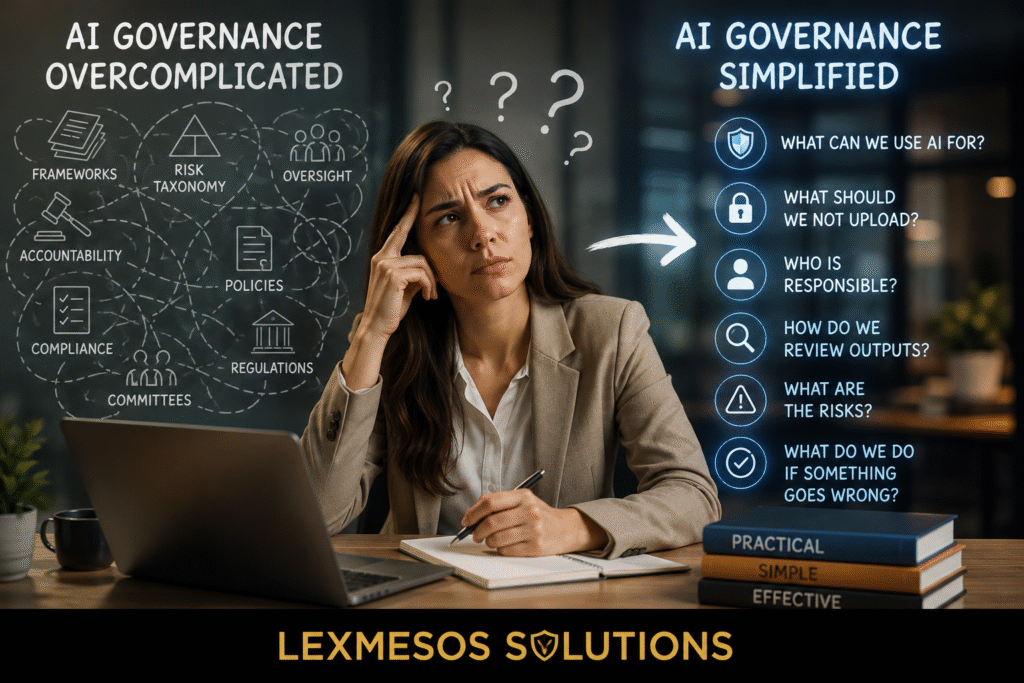
Every week, there seems to be a new AI governance framework, certification, webinar or book.
The message is often the same:
“Your organisation needs AI governance.”
That may be true.
But many SMEs are still trying to answer much simpler questions.
Can employees use ChatGPT at work?
Can customer information be uploaded into AI tools?
Do we need an AI policy?
Who is responsible if AI gets something wrong?
For many businesses, the challenge is not understanding why AI governance matters.
The challenge is understanding what to do next.
The Gap Between Theory and Reality
Many AI governance discussions focus on:
- Governance frameworks
- Risk classifications
- Oversight structures
- Accountability models
- Regulatory compliance
These topics are important.
However, most business owners are not looking for a 100-page framework.
They are looking for practical guidance they can apply immediately.
For example:
Instead of explaining AI governance principles for an hour, many businesses simply need answers to questions such as:
- What information should never be uploaded into AI tools?
- Which AI tools are suitable for workplace use?
- Who should approve AI-related decisions?
- How should AI-generated outputs be reviewed?
- What happens if AI produces incorrect information?
These are practical business questions.
Good Governance Should Simplify, Not Complicate
One common misconception is that AI governance requires large budgets, dedicated committees and extensive documentation.
For some organisations, that may be necessary.
For many SMEs, it is not.
Good AI governance should help businesses:
- Use AI more confidently
- Reduce unnecessary risks
- Establish clear responsibilities
- Create practical rules that employees can follow
In other words, governance should make AI easier to manage, not harder to understand.
The Future of AI Governance
As AI regulations continue to develop around the world, businesses will increasingly need policies, procedures and controls.
However, compliance should not become an exercise in collecting documents that nobody reads.
The goal is not to impress regulators with complicated terminology.
The goal is to help people make better decisions.
Final Thoughts
AI governance is important.
But businesses do not need more jargon.
They need practical answers.
Sometimes the most effective AI governance framework is not the most complicated one.
It is the one people can actually understand and use.
Looking for a practical starting point? Our Practical AI Governance Toolkit is designed for SMEs that want straightforward guidance without the complexity of large enterprise frameworks.
Keywords: AI Governance, AI Policy, SME Compliance, AI Risk Assessment, Responsible AI, AI Compliance, Business AI Strategy, AI Governance Framework, Practical AI Governance, AI Risk Management, Legal Tech, AI for SMEs, Workplace AI Policy, AI Accountability
10 June 2026