 Skip to content

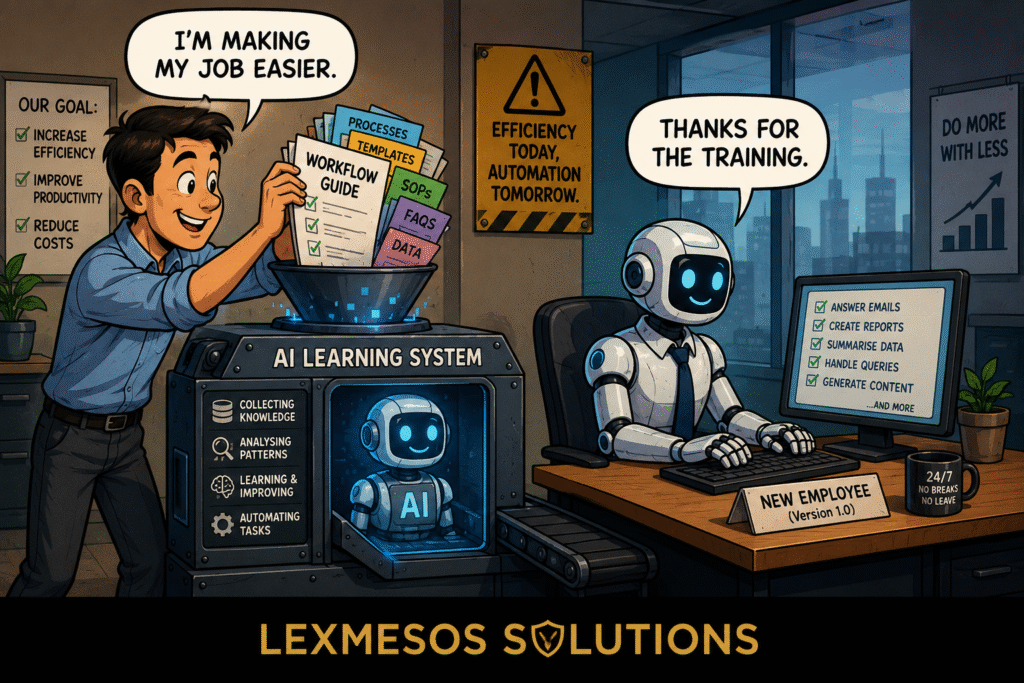
Every time an employee documents a workflow, creates a knowledge base, records a process, labels data, reviews AI outputs or teaches an AI system how to handle a task, they may be doing more than improving efficiency.
They may be helping AI learn.
That does not automatically mean their job will disappear.
But it does raise an uncomfortable question:
If AI learns from employees, who benefits most from that knowledge?
For decades, companies have relied on employees to build expertise, improve processes and share institutional knowledge.
Today, AI is accelerating that process.
The more information a business collects about how work is performed, the easier it becomes to automate parts of that work.
This is already visible across many industries.
Customer service teams train chatbots.
Writers train content tools.
Developers train coding assistants.
Support staff help create internal AI knowledge systems.
The goal is usually efficiency.
The concern is what happens next.
Many organisations describe AI as a tool that will “augment” employees rather than replace them.
In many cases, that is true.
Recent studies suggest that AI is more likely to reshape jobs than eliminate them entirely, with many roles changing significantly as AI takes over routine tasks. (BCG)
At the same time, demand for highly repetitive work is already declining, while demand for AI-related skills continues to grow. (HBS Working Knowledge)
The issue is not whether AI will replace every worker.
The issue is whether workers understand how their knowledge is being captured, reused and scaled.
Imagine an employee spends 6 months helping an organisation build an AI-powered knowledge system.
The employee remains employed.
The business becomes more productive.
But the company may now need fewer people to perform the same work.
This is not science fiction.
It is a business decision.
And business decisions are usually driven by efficiency.
The reality is that AI does not learn in isolation.
It learns from data.
It learns from processes.
And very often, it learns from people.
That is why the conversation should not focus only on whether AI can replace jobs.
A more important question may be:
When employees help train AI, are they simply improving their tools, or are they helping create a future version of their own role?
The answer will likely differ from one organisation to another.
But it is a question more businesses and employees may soon need to consider.
The future of work may not be defined by AI replacing humans. It may be defined by how much human knowledge is transferred to AI in the first place.
Keywords: AI replacing jobs, AI in the workplace, future of work, AI automation, workplace AI, employee knowledge, AI training, job displacement, AI governance, business automation, AI productivity, human and AI collaboration
11 June 2026