 Skip to content
The EU AI Act Is Here. The Copyright Question Remains.
The world is moving quickly to regulate Artificial Intelligence (AI).
The European Union has introduced the EU AI Act, one of the most comprehensive AI regulatory frameworks in the world.
Platforms such as Meta are also increasingly encouraging users to disclose AI-generated content.
Governments, regulators and technology companies are debating transparency, safety and accountability.
Yet one surprisingly basic question remains unanswered:
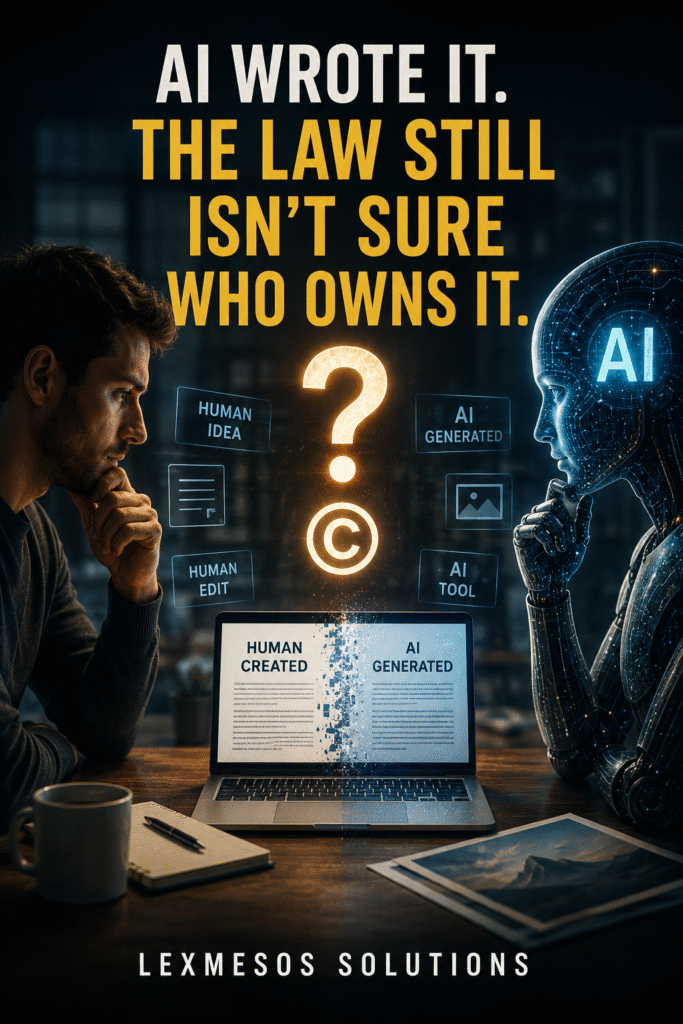
If AI creates something, who owns it?
For businesses already using ChatGPT, Claude, Gemini, Midjourney or other AI tools, this is no longer a theoretical discussion. It is a practical business issue.
A Scenario Happening Every Day
Imagine this situation.
An employee uses ChatGPT to draft a blog article.
The employee reviews the draft, edits some paragraphs and adds a few examples.
The company publishes the article on its website.
Who owns the copyright?
The employee?
The employer?
The AI provider?
Or does nobody own it at all?
Now replace the blog article with:
- Marketing materials
- Social media posts
- Website content
- Internal policies
- Client reports
- AI-generated images
The question remains the same.
The Rise of Hybrid Content
One challenge is that content today is rarely created entirely by humans or entirely by AI.
Many businesses now use a combination of both.
A person may:
- Write the prompt
- Generate the first draft using AI
- Edit the output
- Add original ideas
- Rearrange the content
- Review and approve the final version
At what point does AI assistance become human authorship?
And how much human involvement is enough?
The answer is not always clear.
The EU AI Act Does Not Solve This Problem
The EU AI Act introduces various obligations relating to transparency, risk management and governance.
However, it does not provide a simple answer to copyright ownership of AI-generated outputs.
This means businesses may comply with AI regulations while still facing uncertainty about ownership of the content they create using AI tools.
In other words, regulation is advancing, but the copyright debate remains far from settled.
Why Businesses Should Care
Many SMEs assume that if they paid for an AI tool, they automatically own everything produced by it.
That assumption may not always be correct.
Businesses increasingly rely on AI-generated content for:
- Marketing campaigns
- Product descriptions
- Website content
- Training materials
- Presentations
- Customer communications
If ownership becomes disputed in the future, organisations may find themselves relying on content whose legal status is less certain than expected.
The Bigger Question
The discussion around AI often focuses on safety, misinformation and compliance.
Those issues are important.
But there is another question businesses should not ignore:
If AI is helping create a growing portion of your company’s content, intellectual property and brand assets, how confident are you that you actually own them?
The technology is evolving rapidly.
The legal answers are still catching up.
And for many organisations, that may be one of the most important AI governance questions of all.
Keywords: AI copyright, ChatGPT copyright, AI-generated content ownership, EU AI Act, AI governance, AI compliance, intellectual property, copyright law, generative AI, business use of AI, AI regulation, AI content ownership
12 June 2026