 Skip to content

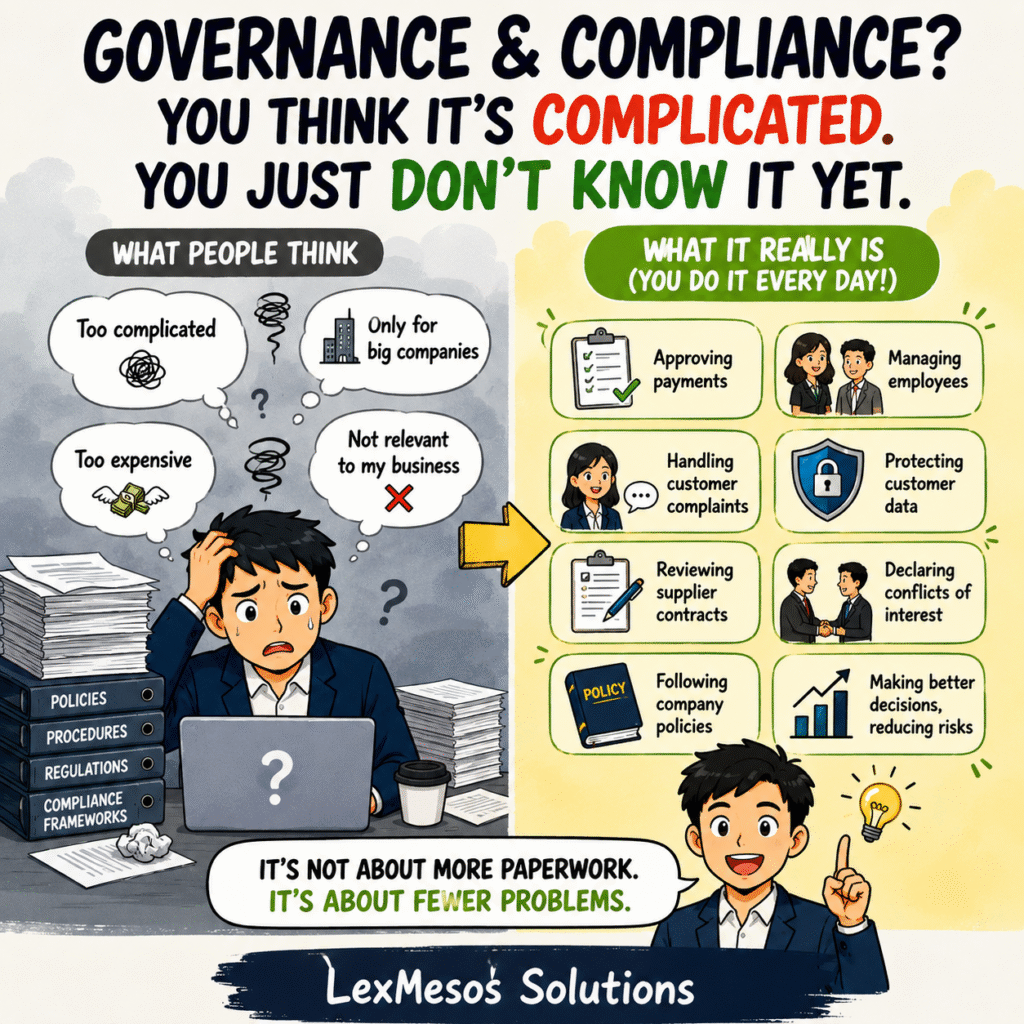
When people hear the words governance, compliance or risk management, many immediately think of large corporations, banks, listed companies or government agencies.
For many SMEs, these terms sound complicated, expensive and far removed from daily business operations.
As a result, many business owners simply ignore them.
Not because they do not care.
But because nobody has explained them in a way that feels relevant.
The truth is that most SMEs are already dealing with governance and compliance every day.
They just call it something else.
Governance and Compliance Are Already Part of Your Business
Consider the following examples:
- Deciding who can approve payments.
- Setting rules for employee conduct.
- Managing customer complaints.
- Protecting customer information.
- Reviewing supplier contracts.
- Handling conflicts of interest.
- Approving refunds and discounts.
Most business owners would describe these as normal business activities.
In reality, they are also examples of governance and compliance in action.
You do not need to be a multinational corporation to face risks.
Every business faces risks.
The only difference is whether those risks are identified and managed before they become problems.
The Biggest Misconception
Many SMEs believe:
“We’ve never had a problem before, so we’re probably fine.”
That may be true.
Until it isn’t.
A data breach.
A fraudulent payment.
An employee dispute.
An AI-related mistake.
A regulatory inquiry.
A customer complaint that escalates unexpectedly.
Most businesses do not suddenly become interested in governance and compliance because they enjoy policies and procedures.
They become interested when something goes wrong.
Unfortunately, that is often the most expensive time to start paying attention.
Governance Is Not About Paperwork
One reason governance and compliance are often misunderstood is because they are frequently presented through lengthy policies, technical language and complex frameworks.
This creates the impression that governance is about paperwork.
It is not.
Good governance is simply about making better decisions.
Good compliance is simply about reducing avoidable risks.
A clear process for approving payments is governance.
A policy on how employees use AI tools is compliance.
A conflict-of-interest declaration is governance.
A whistleblowing process is compliance.
These are practical business tools, not corporate buzzwords.
Why This Matters More Than Ever
Businesses today face risks that did not exist a decade ago.
AI tools.
Data privacy obligations.
Cybersecurity threats.
Online scams.
Digital payments.
Cross-border transactions.
The business environment is becoming more complex, even for small businesses.
Ignoring governance and compliance does not make these risks disappear.
It simply means dealing with them later, often when the consequences are more serious.
Final Thoughts
The biggest compliance problem for many SMEs is not non-compliance.
It is believing governance and compliance only apply to someone else.
Most businesses are already practising governance and compliance in some form.
The real opportunity is understanding how to do it more effectively, before a problem arises.
Because at the end of the day, governance and compliance are not about creating more work.
They are about helping businesses avoid unnecessary problems and make better decisions.
Keywords: Governance and Compliance for SMEs, SME Compliance, Corporate Governance, Risk Management, Business Compliance, Internal Controls, Compliance Framework, Governance Framework, SME Risk Management, Business Governance, Compliance Awareness, Legal Tech
12 June 2026