 Skip to content

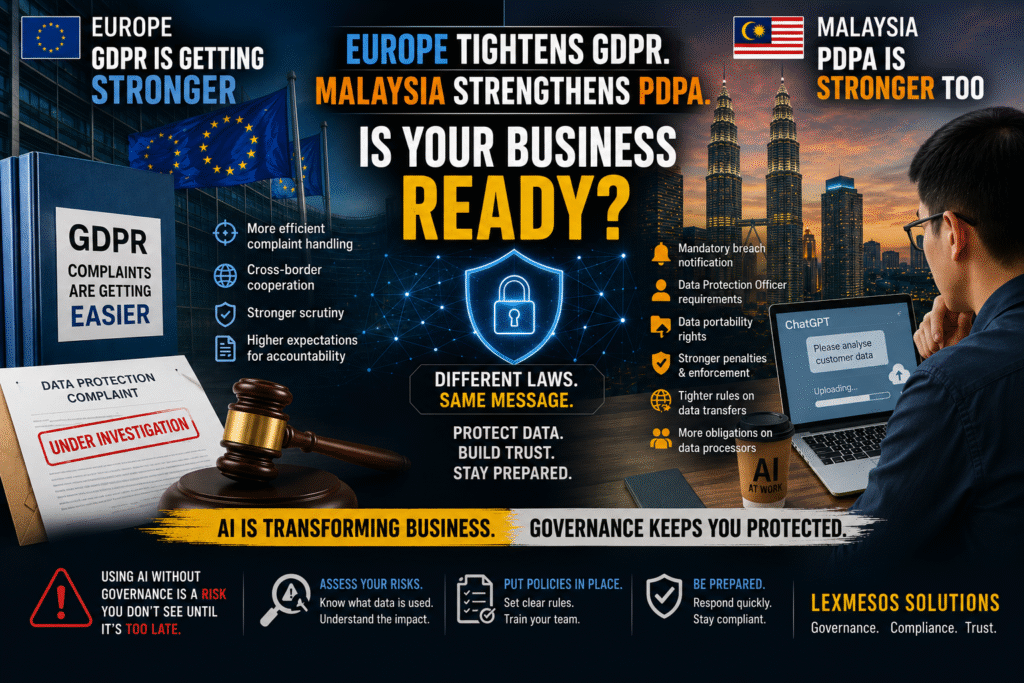
Most Malaysian SMEs already used AI tools such as ChatGPT. Few know whether employees are uploading customer, employee or confidential business information into those systems. As PDPA requirements evolve and AI adoption grows, businesses should understand the risks before regulators, customers,or incidents expose them.
For years, many businesses viewed data protection compliance as something only large corporations needed to worry about.
That mindset is becoming increasingly risky.
Across Europe, regulators continue to strengthen GDPR enforcement and improve complaint handling mechanisms.
At the same time, Malaysia has introduced significant amendments to the Personal Data Protection Act 2010 (PDPA), bringing new obligations for organisations that collect, process or store personal data.
While the specific legal requirements may differ, the message is the same:
Businesses are expected to take data governance seriously.
Why This Matters More Than Ever
Today, organisations rely heavily on digital tools, cloud platforms, AI systems, customer databases, HR software and third-party vendors.
Every employee using AI tools, every customer record stored online and every spreadsheet containing personal information creates potential compliance risks.
The question is no longer whether your business uses data.
The question is whether you know:
- What data is being collected.
- Where it is stored.
- Who can access it.
- Whether AI tools are processing it.
- What happens if a breach occurs.
Many organisations struggle to answer these questions.
What Is Changing?
Europe (GDPR)
Regulators continue to focus on:
- More efficient complaint handling.
- Stronger accountability requirements.
- Greater cooperation between authorities.
- Increased scrutiny of organisations handling personal data.
Malaysia (PDPA)
Recent amendments introduce important changes, including:
- Mandatory breach notification requirements.
- Data Protection Officer (DPO) requirements.
- Data portability rights.
- Increased responsibilities for data processors.
- Stronger enforcement and penalties.
For many SMEs, these obligations may be entirely new.
The AI Connection
Data protection and AI governance are no longer separate discussions.
Employees are already using AI tools to draft documents, analyse information, summarise reports and improve productivity.
But many organisations still have no:
- AI usage policy.
- Data classification framework.
- AI risk assessment process.
- Employee guidance on AI tools.
- Governance structure for AI adoption.
This creates legal, operational and reputational risks.
Compliance Is Not About Fear
Good governance is not about creating more paperwork.
It is about understanding risks before they become problems.
Organisations that implement proper governance frameworks often benefit from:
- Better customer trust.
- Stronger internal controls.
- Reduced compliance risk.
- More responsible AI adoption.
- Better preparation for future regulatory changes.
Where Should Businesses Start?
Start with visibility.
Understand what personal data your organisation handles, how AI tools are being used, and where your biggest compliance gaps may exist.
A simple risk assessment today may prevent a much larger problem tomorrow.
Not sure where your organisation stands?
Need a practical starting point? Choose the option that best fits your organisation’s current stage:
- AI Risk Assessment for SMEs.
- Practical AI Governance Toolkit.
- Compliance and governance support discussions.
Start identifying your compliance and AI governance risks before regulators, customers or incidents do it for you.
Technology is moving quickly.
Regulators are catching up.
The businesses that succeed will not necessarily be those using the most AI.
They will be the ones using it responsibly.
Different laws. Same message. Protect data. Build trust. Stay prepared.
Keywords: GDPR, PDPA Malaysia, personal data protection, AI governance, AI compliance, data privacy, data breach notification, DPO requirements, AI risk assessment, compliance toolkit, SME compliance, data protection law
13 June 2026