 Skip to content
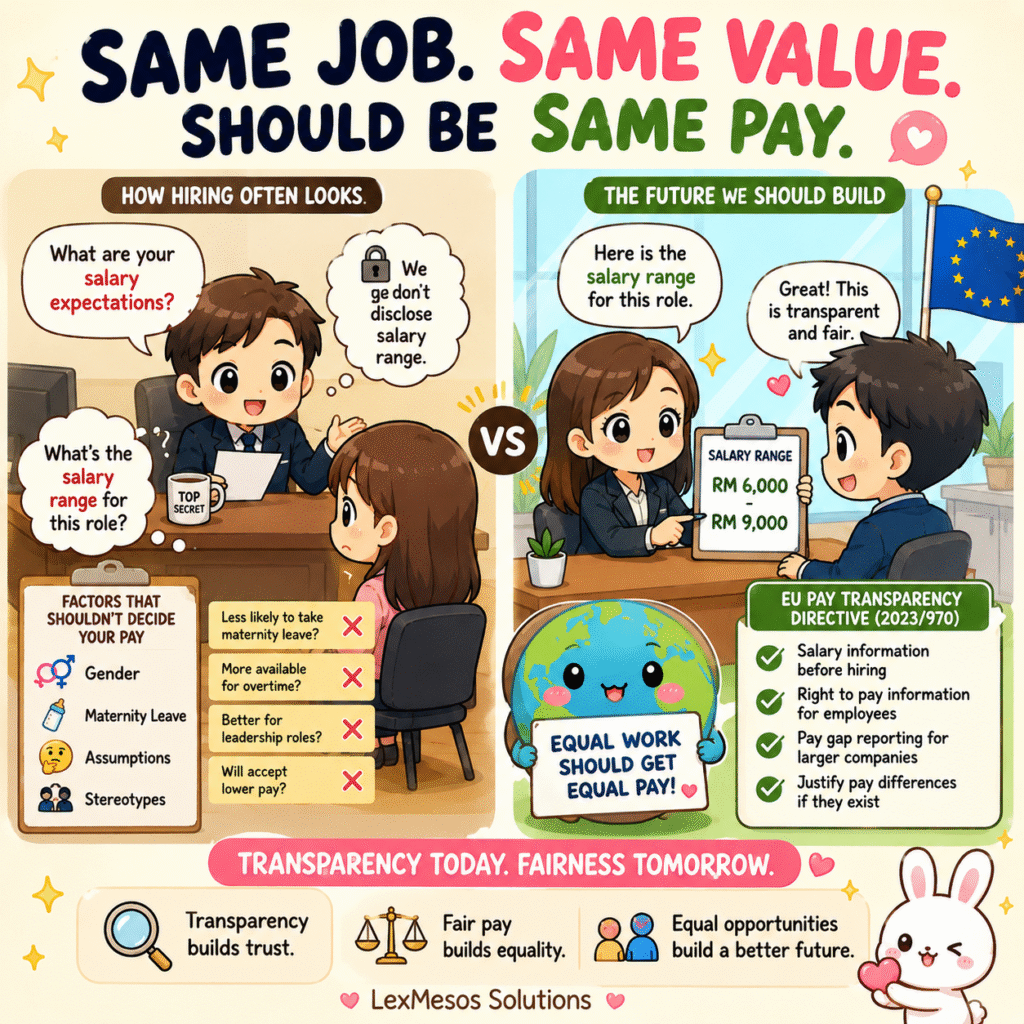
“What are your salary expectations?”
Most job seekers have heard this question countless times.
Far fewer have heard:
“Here is the salary range for this position. Does it meet your expectations?”
Whether in Europe, Asia or elsewhere, salary discussions are often surprisingly one-sided.
Candidates are expected to reveal their expectations first.
Employers frequently keep their budgets confidential.
Many people accept this as normal.
But should it be?
Europe Is Trying to Change the Conversation
The European Union has taken a significant step through the EU Pay Transparency Directive.
The Directive aims to strengthen equal pay between men and women by introducing greater transparency in pay practices.
Among other measures, employers may be required to provide information about salary levels or salary ranges before employment begins, and larger organisations may face additional reporting obligations relating to pay gaps.
The idea is simple.
If employees and job applicants have more information about pay, it becomes easier to identify and challenge unjustified differences.
However, implementing legal reform is often easier said than done.
This shows that even advanced economies can face challenges when introducing greater transparency into existing employment practices.
The Reality Behind Hiring Decisions
The debate is often presented as a gender issue.
In reality, it is also a transparency issue.
Across many countries, job applicants continue to encounter the same experience.
The employer asks:
“What salary do you expect?”
The candidate answers.
The employer rarely discloses the actual budget for the position.
As a result, candidates often negotiate without knowing whether they are asking for too much, too little or exactly what the employer was already prepared to offer.
This information imbalance is one reason why salary transparency continues to attract attention.
What About Malaysia?
Malaysia does not currently have legislation equivalent to the EU Pay Transparency Directive.
Many employers are still free to decide how much salary information they wish to disclose during recruitment.
At the same time, concerns about pay disparities and workplace equality continue to arise.
Some employees believe factors unrelated to performance may influence pay and promotion decisions.
Others point to assumptions that men may be more available for overtime, less likely to take extended leave or more suited to leadership roles.
Whether these assumptions are fair or accurate is open to debate.
The more important question is whether greater transparency would help create greater trust.
Equal Pay Starts With Transparency
The discussion is not only about gender.
It is about fairness.
It is about trust.
And it is about information.
If two people are doing similar work, can the employer explain why they are paid differently?
If a company asks candidates for salary expectations, should candidates also know the salary range being offered?
The EU believes transparency is part of the answer.
Many other countries are still deciding where they stand.
One thing is clear.
The salary question employers love asking may soon become a question they are increasingly expected to answer.
Keywords: EU Pay Transparency Directive, salary transparency, equal pay, gender pay gap, Germany pay transparency, Malaysia employment law, salary disclosure, workplace equality, recruitment practices, pay transparency legislation, hiring process, employee rights
14 June 2026