 Skip to content
Introduction
AI is no longer just a tool. It is now a content creator.
From drafting contracts to generating images and articles, generative AI systems are reshaping how content is produced. But behind this rapid development lies a critical legal question:
Whose content is AI really using and who owns the output?
A recent study by the European Union Intellectual Property Office titled “The Development of Generative Artificial Intelligence from a Copyright Perspective” highlights a growing tension between AI innovation and copyright law.
This article explores what the EU is doing and how Malaysia compares.
1. The EU’s Approach: Trying to Adapt an Old System
The EU study makes one thing clear:
Generative AI is challenging the foundations of copyright law.
The study focuses on three key areas:
- Use of copyrighted content in AI training
- Legal treatment of AI-generated outputs
- Economic impact (including licensing markets) (Nexa Center for Internet & Society)
1.1 AI Training and Copyright: Not Just “Reading Data”
AI systems are trained using vast amounts of data, much of which is copyright-protected.
Under EU law, this is addressed through the Directive (EU) 2019/790.
This Directive allows Text and Data Mining (TDM), meaning:
– AI systems can analyse large datasets
– BUT only if rights holders do not opt out
However, the study highlights a deeper issue:
AI training is not just analysis, it may involve reproduction of protected works.
This creates legal uncertainty because TDM was originally designed for research and analysis, not for generating new content.
1.2 The Opt-Out Problem
The EU currently uses an opt-out system:
– If creators do nothing → their content may be used
– If they object → they must actively reserve their rights
This creates a practical problem:
- Most creators are unaware their works are being used
- There is no universal system to manage opt-outs
In effect, the system risks treating silence as consent.
1.3 AI Outputs: Who Owns Them?
The EU position remains tied to a traditional principle:
– Copyright requires human originality.
This means:
- Pure AI-generated content → likely not protected
- Human-assisted content → may qualify
But the study confirms:
- There is still no clear, harmonised rule across the EU
1.4 A New Direction: Licensing AI Training Data
One of the most important developments is economic, not legal.
The EU is moving towards:
– A licensing market for AI training data
Instead of unrestricted scraping:
- AI developers may need licences
- Creators may receive compensation
This reflects growing political pressure, including discussions at the European Parliament level that current copyright rules may be insufficient for AI. (potomaclaw.com)
1.5 Transparency and Technology
The study also explores technical solutions such as:
- Watermarking AI-generated content
- Digital fingerprinting
- Tracking training data sources
These are becoming critical due to increasing obligations under the EU AI Act.
2. Malaysia’s Position: Still Operating Under Traditional Copyright
In contrast, Malaysia has no AI-specific copyright framework.
The current law is the Copyright Act 1987.
2.1 Human Authorship Remains Central
Similar to the EU:
– Copyright protection requires human authorship.
This means:
- AI-generated works (without human input) → unlikely to be protected
- Ownership issues remain unclear
2.2 No Clear Rules on AI Training Data
Unlike the EU:
❌ Malaysia does not have explicit provisions on:
- Text and Data Mining (TDM)
- Use of copyrighted content for AI training
- Opt-out or licensing frameworks
This creates a legal gap.
Businesses using AI tools may unknowingly rely on datasets that include copyrighted material without clear legal guidance.
2.3 No Transparency Obligations
Malaysia also lacks:
- Requirements to disclose training data
- Rules on identifying AI-generated content
Compared to the EU, this places Malaysia at an early-stage regulatory position.
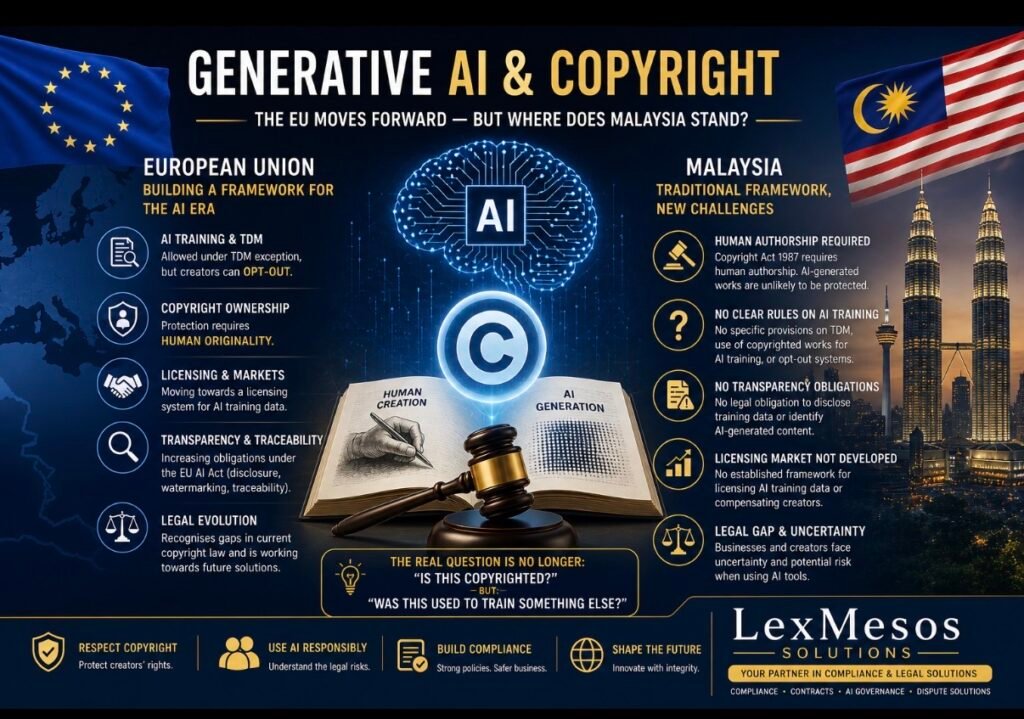
3. EU vs Malaysia: Key Differences
| Issue | European Union | Malaysia |
| AI training data | Regulated via TDM rules (with opt-out) | No clear regulation |
| Copyright ownership of AI output | Based on human originality (uncertain) | Same principle, but no AI-specific guidance |
| Licensing model | Emerging market for training data | Not developed |
| Transparency requirements | Increasing under AI Act | No specific requirements |
| Legal maturity | Developing regulatory framework | Early-stage / reactive |
4. The Bigger Issue: Law vs Technology
The EU study highlights a deeper concern:
Copyright law was designed for human creativity, not machine learning
Generative AI does not simply copy content.
It learns patterns and generates new outputs based on them.
This raises a fundamental question:
Is AI training a form of learning or a form of copying?
The answer is still unclear.
5. Why This Matters for Businesses
This is not just a “European issue”.
It affects:
- Companies using AI tools
- Content creators and freelancers
- Legal tech platforms
- Marketing and design industries
Because most AI systems are trained on global datasets.
Hidden Risks
Businesses today may face:
- Copyright infringement claims
- Uncertainty over ownership of AI-generated work
- Contractual disputes over content usage
6. What Comes Next?
The direction is becoming clearer:
– More regulation
– More licensing
– More accountability
The EU is not finalising the solution yet, but it is signalling:
The current system is not enough.
Conclusion
Generative AI is forcing copyright law to evolve.
The EU is actively trying to adapt through TDM rules, licensing discussions and transparency requirements.
Malaysia, however, is still relying on traditional frameworks.
The gap is not just legal, it is strategic.
Final Thought
AI does not create in isolation.
It learns from existing works, many of which belong to someone else.
The real question is no longer:
👉 “Is this copyrighted?”
But:
👉 “Was this used to train something else?”
Keywords: AI copyright EU, generative AI copyright law, EUIPO AI study, Malaysia copyright AI, AI training data legal issues
4 May 2026