 Skip to content
When people talk about wealth, they often assume the biggest problem is earning money.
But in reality, for the ultra-wealthy, the real problem begins after death.
The recent Samsung case in South Korea proves exactly that.
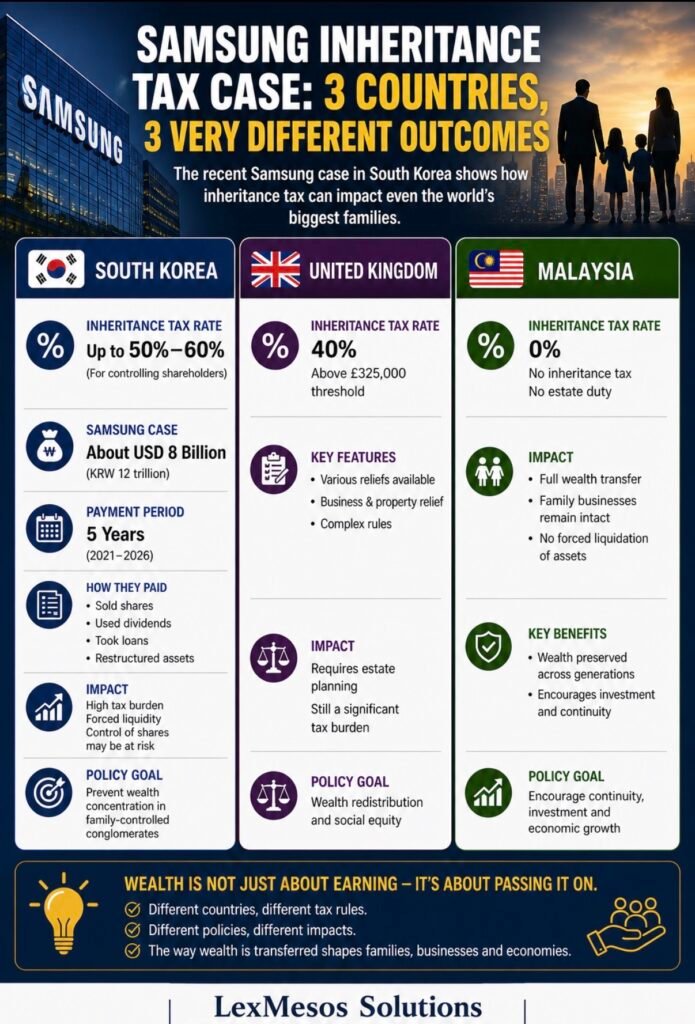
The Samsung Case: A $8 Billion Problem
When the late Samsung chairman Lee Kun-hee passed away in 2020, he left behind an estate worth around 26 trillion won (≈ USD 20+ billion).
The inheritance tax?
👉 Around 12 trillion won (≈ USD 8 billion). (Korea Joongang Daily)
That is:
- One of the largest inheritance tax bills in history
- Nearly 50% of the estate value (Ked Global)
The family, including Lee Jae-yong did not pay this in one go.
Instead:
👉 They paid it over 5 years in 6 instalments (2021–2026). (The Korea Times)
To fund this, they had to:
- Sell shares
- Use dividends
- Take loans
- Restructure assets
This wasn’t just tax planning.
This was corporate survival planning.
Why Is Korea So Harsh?
South Korea has one of the highest inheritance tax rates globally:
- Up to 50% standard rate
- Up to 60% for controlling shareholders (The Straits Times)
This is intentional.
The policy goal:
👉 Prevent concentration of wealth in family-controlled conglomerates (chaebols)
But the side effect?
👉 Even billionaires may need to sell control just to pay tax.
The UK Isn’t Much Better
The UK also imposes inheritance tax:
- 40% tax rate
- Applies above £325,000 threshold
- Additional rules for property and business relief
So yes, not as extreme as Korea, but still heavy enough to impact family wealth.
Malaysia: The Complete Opposite
Now compare this with Malaysia.
👉 No inheritance tax. No estate duty.
When assets pass:
- From parents to children
- Between spouses
- Within family
👉 No tax triggered.
This creates a very different environment:
- Wealth is preserved across generations
- No forced liquidation of assets
- Family businesses remain intact
So… Is the Government the Problem?
That Malaysia’s China Press today’s caption actually raises a deeper question:
👉 “Is the biggest headache for the rich… the government?”
The answer is not so simple.
In Korea:
- Government actively redistributes wealth
- But risks weakening family-controlled businesses
In the UK:
- Government moderates wealth transfer
- But still allows planning strategies
In Malaysia:
- Government steps back completely
- But allows wealth concentration to grow unchecked
The Real Insight (What People Miss)
The Samsung case is not just about tax.
It shows:
👉 Wealth is not just about accumulation
👉 It is about transition
And transition is where:
- Law
- Policy
- Tax
- Corporate control
👉 All collide.
Final Thought
For ordinary people, inheritance is emotional.
For wealthy families, inheritance is strategic, political and financial survival.
And sometimes like in Samsung’s case, it takes 5 years just to pay the price of succession.
Keywords: Samsung inheritance tax Korea, inheritance tax comparison Malaysia UK Korea, Samsung family tax case, estate duty Malaysia, global inheritance tax law
4 May 2026