 Skip to content
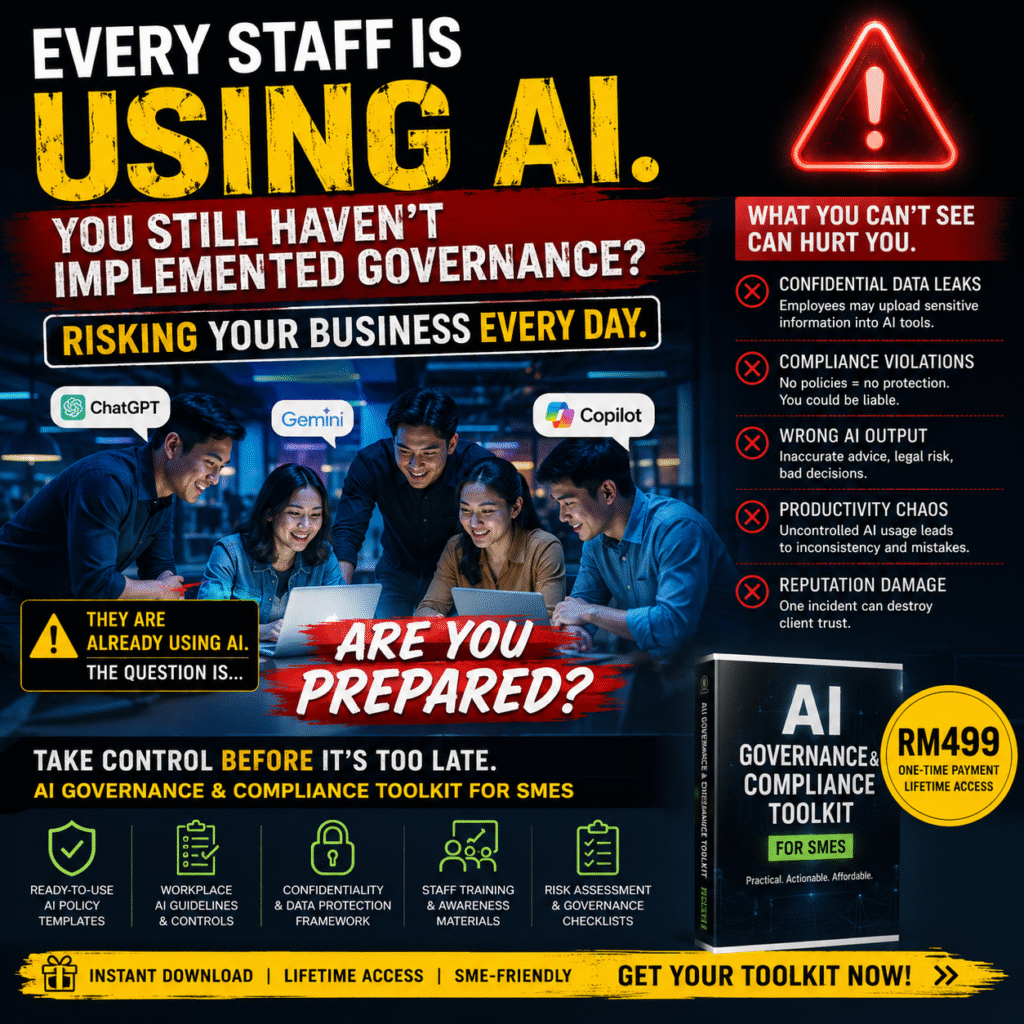
Artificial intelligence is already inside many workplaces.
Employees use AI tools to:
- draft emails
- summarise meetings
- generate reports
- prepare presentations
- analyse information
- draft contracts
- automate workflows
The focus is usually on one thing:
“Productivity.”
Faster work.
Less manual effort.
More efficiency.
But there is another question many businesses still avoid asking:
Who becomes responsible when AI-generated outputs are wrong?
If an employee relies heavily on AI-generated information and:
- confidential information is exposed,
- inaccurate reports are circulated,
- clients receive incorrect information,
- biased hiring decisions occur,
- operational decisions are influenced by flawed AI outputs,
…where does accountability sit?
With the employee?
Management?
The company?
Or the AI system itself?
This is where AI governance discussions become increasingly important.
AI governance is not only about regulation or large corporations.
In practical workplace terms, governance may involve:
- internal awareness,
- confidentiality safeguards,
- approval workflows,
- human oversight,
- operational accountability,
- responsible AI usage practices.
Many SMEs are already using AI informally without structured internal guidance or oversight.
The issue is no longer whether AI exists inside the workplace.
The issue is whether businesses understand:
- how AI is being used,
- who is responsible,
- what internal safeguards exist, and
- how operational risks are managed.
As AI adoption continues to grow, accountability discussions may become just as important as productivity discussions.
Businesses exploring practical AI governance, operational oversight and workplace AI readiness may access the:
Keywords: AI governance, AI accountability, workplace AI, AI compliance, ChatGPT workplace risks, AI operational risks, SME AI governance, AI oversight, AI workplace governance, AI risk management, artificial intelligence compliance, AI business risks
29 May 2026