 Skip to content

Malaysia’s identity card system has long been considered one of the more technologically advanced systems in the region.
For many Malaysians, the MyKad is not just an identification card. It became a symbol of a highly integrated digital identity ecosystem.
The system evolved far beyond basic identification, incorporating:
- biometric verification,
- Touch ’n Go integration,
- government-related digital functions,
- identity authentication features, and
- smart chip technology.
At one point, many people viewed Malaysia’s smart IC infrastructure as being technologically advanced compared to various countries in the region.
Ironically, despite increasingly advanced technology worldwide, governments and companies still continue facing:
- identity fraud,
- fake documents,
- insider abuse,
- corruption,
- data leaks,
- weak governance, and
- compliance failures.
This raises an uncomfortable question:
If systems are becoming more advanced, why do governance problems still continue?
The answer may be simpler than many expect.
Technology can improve systems.
But technology alone cannot automatically fix human behaviour.
Advanced Systems Still Depend On Human Decisions
Many people assume:
- AI,
- biometrics,
- facial recognition,
- digital identity systems,
- smart IDs, and
- automated approvals
will eventually eliminate fraud and corruption completely.
Reality is often far more complicated.
Even highly advanced systems still rely on:
- human approvals,
- internal controls,
- governance processes,
- oversight, and
- integrity.
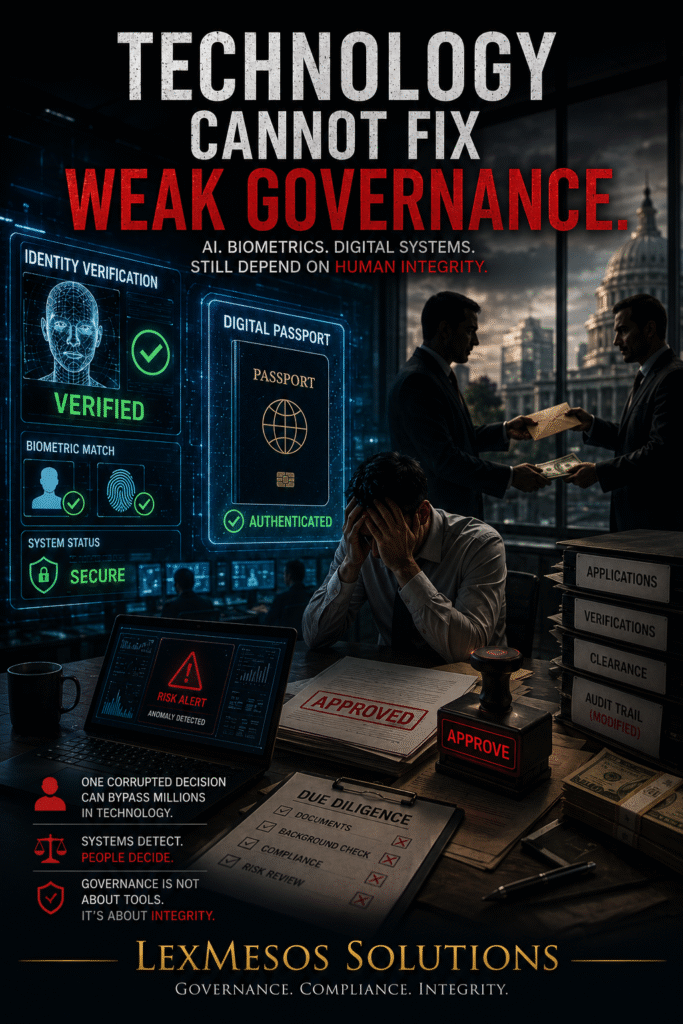
One compromised approval.
One insider bypass.
One manipulated process.
One corrupted officer.
One weak governance culture.
That may sometimes be enough to undermine millions invested into technology infrastructure.
This problem does not only affect governments.
The same issue increasingly appears inside companies and SMEs as well.
The Same Governance Problem Exists Inside Companies
Today, many businesses are rapidly adopting:
- AI tools,
- automated systems,
- compliance software,
- digital verification,
- workflow automation, and
- internal governance platforms.
But behind the scenes, many organisations still struggle with:
- weak internal controls,
- poor segregation of duties,
- lack of compliance oversight,
- untrained employees,
- unchecked AI usage, and
- and informal decision-making culture.
Some companies now rely heavily on AI tools without:
- proper governance,
- AI literacy,
- confidentiality safeguards, and
- or operational policies.
Employees may casually upload:
- confidential contracts,
- HR investigations,
- internal reports,
- client data, and
- commercially sensitive information into AI systems
without understanding the long-term risks involved.
Again, the problem is often not the technology itself.
It is the absence of governance, accountability and operational discipline around the technology.
Why Europe Often Takes A Different Approach
Compared to Malaysia’s highly integrated smart card ecosystem, many European countries historically adopted a more fragmented identity structure.
For example, in countries like Germany:
- healthcare cards,
- residence permits,
- tax IDs,
- banking systems,
- transport systems, and
- digital identities
are often separated across multiple platforms or documents.
Many European systems also place extremely strong emphasis on:
- privacy,
- data minimisation,
- decentralisation, and
- governance oversight.
This is partly why European discussions around:
- biometric systems,
- facial recognition,
- AI governance,
- digital identity, and
- surveillance technology
often become highly sensitive politically and legally.
The focus is not only:
“Can the technology work?”
But also:
“Who controls the technology?”
“How can the system be abused?”
“What happens if governance fails?”
This governance-focused mindset became even stronger with developments such as the General Data Protection Regulation and the European Union Artificial Intelligence Act.
Technology Changes Fast. Governance Often Does Not.
Malaysia’s identity systems, like many other countries, have undergone multiple updates and evolutions over time.
Technology itself changes rapidly:
- chips,
- biometrics,
- AI verification,
- cybersecurity,
- digital authentication, and
- online services.
But governance maturity, institutional integrity and organisational culture often take far longer to evolve.
That is why globally, even highly digital systems may still experience:
- fake approvals,
- internal manipulation,
- corruption risks,
- data breaches,
- insider misconduct, and
- operational failures.
The biggest vulnerability in many systems is still not the chip, the AI or the database.
It is human behaviour.
AI And Digital Governance Will Only Increase This Pressure
As AI adoption accelerates globally, both governments and companies will increasingly face pressure to balance:
- efficiency,
- automation,
- digitalisation,
- governance,
- privacy,
- compliance, and
- accountability.
The future challenge may no longer be:
“Can technology become smarter?”
But rather:
“Can governance and human accountability keep up with increasingly powerful technology?”
Because no matter how advanced a system becomes, weak governance may still quietly undermine it from within.
Final Thoughts
AI, smart IDs, biometric systems and digital governance tools are powerful.
But technology alone cannot automatically create integrity.
Strong governance still depends heavily on:
- accountability,
- operational discipline,
- ethical leadership,
- compliance culture, and
- responsible human behaviour.
Without those foundations, even the most advanced systems may remain vulnerable to the oldest risk of all:
human decisions.
Prepared by LexMesos Solutions– practical insights on governance, compliance, AI and operational risk across different jurisdictions.
Keywords: AI governance, smart ID systems, MyKad, biometric verification, digital identity, weak governance, corruption risks, AI compliance, Malaysia IC system, Europe identity systems, governance failures, human integrity, digital governance, compliance risks, AI and corruption
26 May 2026