 Skip to content
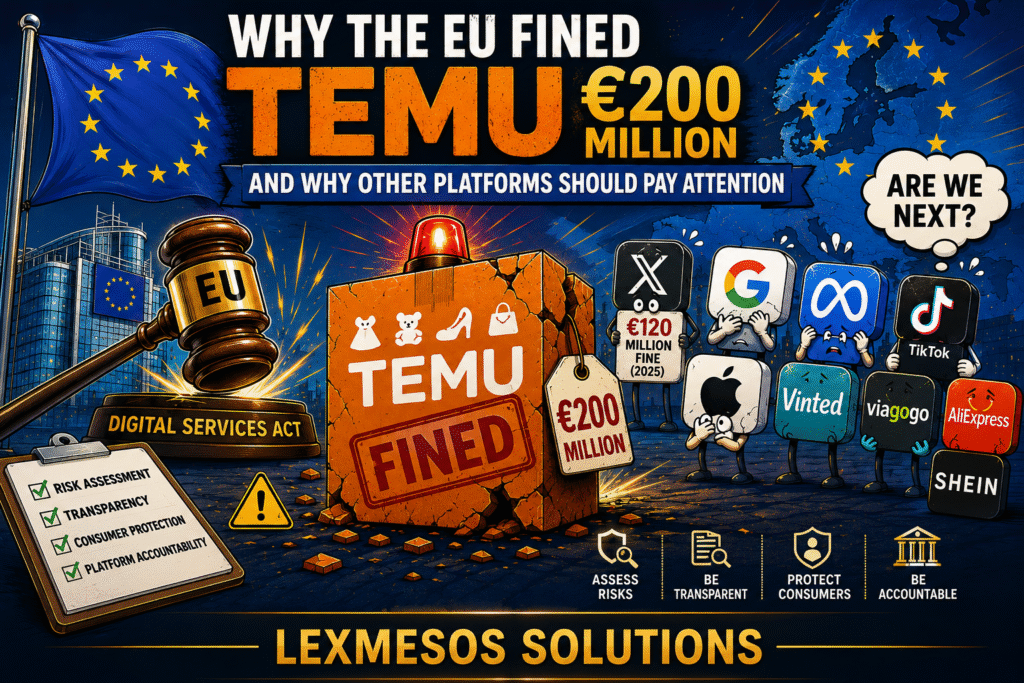
Temu’s €200 million fine under the EU Digital Services Act (“DSA”) is no longer just another regulatory headline.
It reflects something much bigger happening across Europe.
Increasingly, large digital platforms are no longer being treated as “neutral marketplaces” simply connecting buyers and sellers.
European regulators are now placing growing emphasis on platform accountability, systemic risk management, governance processes and consumer protection obligations.
According to the European Commission, Temu failed to properly assess and manage systemic risks linked to illegal or unsafe products sold on its platform. The findings included concerns involving unsafe chargers, baby toys and platform mechanisms that could potentially amplify the dissemination of problematic products.
But the broader significance goes far beyond one platform.
The Growing Shift Towards Platform Accountability
The Temu case appears to form part of a wider European regulatory trend.
Earlier in 2025, the European Commission also imposed a €120 million fine on X (Twitter) under the Digital Services Act relating to transparency obligations.
Separately, companies such as Google, Meta (Facebook and Instagram) and TikTok have also faced consumer complaints in Europe linked to the handling of online financial scam risks and platform responsibilities.
Meanwhile, European regulators and consumer protection authorities have also carried out investigations, enforcement actions or coordinated measures involving various digital platforms and marketplaces, including Apple, Vinted, Viagogo, AliExpress, SHEIN and others.
While the underlying issues differ across platforms, the overall direction increasingly appears consistent:
As digital platforms grow larger within European markets, expectations surrounding governance, transparency, risk management and operational oversight are also becoming significantly higher.
No Longer Just About Growth
For years, many platforms were largely viewed as intermediaries facilitating transactions, content sharing or digital interactions.
That perception is gradually changing.
Under the Digital Services Act, regulators increasingly expect very large online platforms to actively identify, assess and mitigate systemic risks associated with their own services, recommender systems, algorithms and platform ecosystems.
The issue is no longer simply whether illegal or unsafe products exist somewhere online.
The focus is increasingly shifting towards whether platforms themselves are implementing adequate governance structures, monitoring systems and risk controls to manage these risks responsibly.
A Wider Governance Trend
The broader discussion also extends beyond eCommerce marketplaces.
Questions surrounding platform accountability are increasingly emerging across:
- social media platforms,
- AI systems,
- recommender algorithms,
- influencer promotion mechanisms,
- online advertising systems, and
- digital ecosystems more generally.
As digital platforms continue expanding globally, governance expectations are evolving alongside them.
The Temu decision may therefore represent more than a single enforcement action.
It may also reflect a broader regulatory message:
rapid platform growth is increasingly being accompanied by increasing governance responsibility.
Disclaimer: This article is intended for general informational and commentary purposes only and does not constitute legal advice.
Keywords: Temu EU fine, Digital Services Act, DSA, platform accountability, EU platform governance, Temu illegal products, EU consumer protection, online marketplace regulation, platform risk management, digital platform compliance, EU governance, systemic risk assessment, platform transparency, AliExpress EU, SHEIN EU investigation, X DSA fine, TikTok EU complaints, Meta EU regulation, Google EU complaints
31 May 2026