 Skip to content

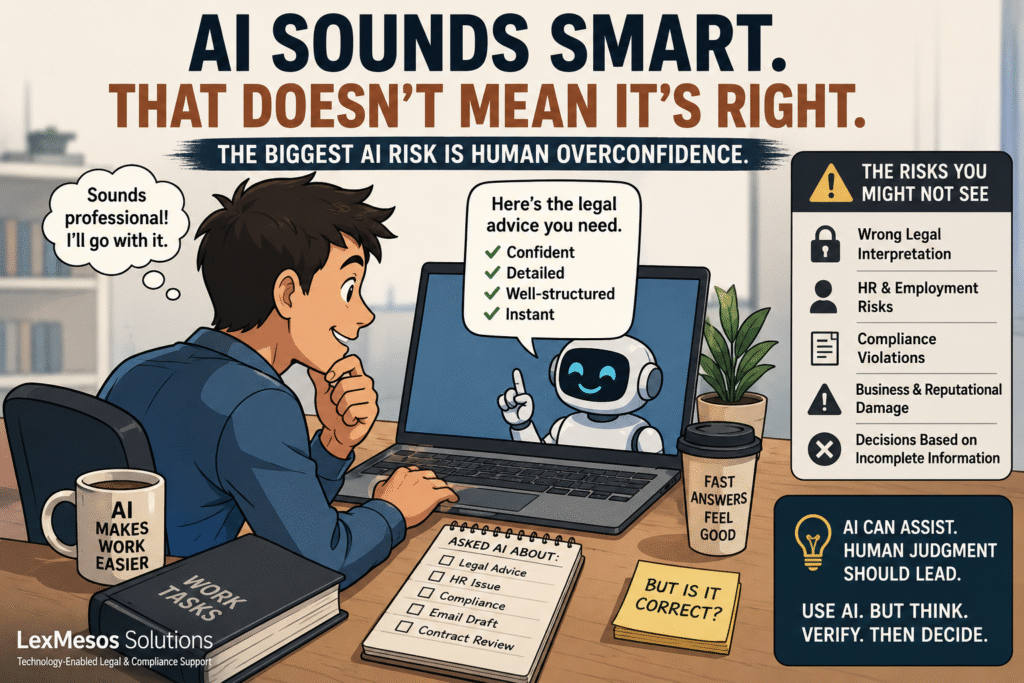
The Biggest AI Risk Is Human Overconfidence.
Artificial intelligence (“AI”) is becoming part of everyday work faster than many businesses expected.
Employees now use AI tools to:
- draft emails
- summarise meetings
- prepare reports
- review contracts
- answer HR questions
- interpret compliance issues
- generate workplace documents
- respond to customers and clients
In many workplaces, AI is no longer just a productivity tool.
It is quietly becoming an unofficial workplace advisor.
The problem is not necessarily the technology itself.
The bigger risk may be how quickly humans become overconfident when using it.
AI systems can generate polished answers within seconds. They often sound professional, structured and convincing. But confident wording does not automatically mean the answer is accurate, complete, legally correct or suitable for a specific business situation.
This is where the real danger begins.
Many people now rely on AI-generated responses for matters involving:
- legal questions
- HR issues
- compliance concerns
- internal workplace disputes
- policy drafting
- business communications
without fully understanding the limitations behind the output.
An AI-generated answer may sound intelligent while still:
- missing important context
- using outdated information
- misunderstanding local laws
- oversimplifying risks
- generating inaccurate conclusions
This becomes especially risky when businesses assume:
“If the AI sounds confident, it must be correct.”
But AI does not truly understand workplace politics, human relationships, business strategy or legal consequences in the same way humans assume it can.
For example, AI can draft a professional-looking warning letter in seconds.
But can it fully assess:
- employment law exposure?
- internal HR sensitivities?
- discrimination concerns?
- cultural context?
- reputational risks?
- company-specific obligations?
Not necessarily.
The same applies to compliance and governance issues.
Many businesses are rapidly adopting AI tools before establishing:
- internal AI policies
- verification processes
- confidentiality safeguards
- approval workflows
- employee guidance
- governance structures
As a result, some organisations may unintentionally create new risks while trying to improve efficiency.
Another growing concern is the illusion of expertise.
AI can make almost anyone sound knowledgeable. This has contributed to the rise of:
- misleading online advice
- fake “AI experts”
- overconfident decision-making
- low-quality professional content presented as authoritative information
The issue is not whether AI should be used.
AI can be extremely useful when applied responsibly.
The real question is whether businesses and individuals still maintain critical thinking, human review and proper judgment when using these tools.
Because productivity without accountability can eventually become a business risk.
The future of AI in workplaces may not depend solely on how intelligent the technology becomes.
It may depend more on whether humans remain careful enough to recognise its limitations.
AI can assist human decisions.
But it should not automatically replace human responsibility.
Keywords: AI workplace risks, AI governance, AI compliance, workplace AI usage, AI legal risks, AI HR risks, AI business risks, AI overconfidence, AI-generated decisions, AI policy, business governance, compliance risks, human oversight in AI, responsible AI use, workplace technology risks
1 June 2026