 Skip to content
Why Northern Europe Treats Recovery Differently From Many Asian Workplaces?
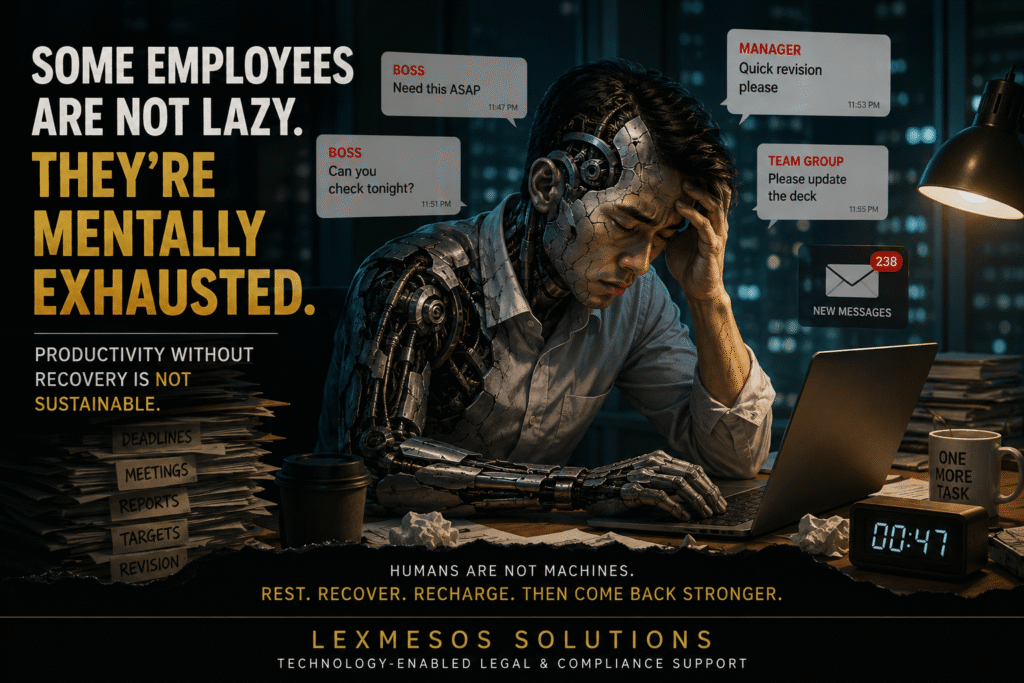
Many employees today are not refusing to work.
They are simply tired.
Not “Monday tired.”
Mentally exhausted…even demotivated.
Yet in many workplaces, exhaustion is increasingly treated as normal professionalism.
If you are constantly available, always online, replying late at night and sacrificing personal time for work, you are often viewed as:
- hardworking
- committed
- ambitious
- reliable
But the moment someone asks for:
- extended leave
- study leave
- career breaks
- entrepreneurial leave
- mental recovery
- work-life flexibility
the reaction may quietly change.
Suddenly, questions appear:
- “Why so long?”
- “Are you still committed?”
- “What if productivity drops?”
- “Why should employees disappear for months?”
In some highly competitive Asian workplaces, long leave periods may still feel like a threat to productivity rather than part of human sustainability.
And many employees already know this reality.
Some Employees Feel Like Productivity Machines
In many modern workplaces, employees are expected to:
- stay reachable after work
- multitask constantly
- answer messages immediately
- remain productive despite exhaustion
- continue performing under understaffed conditions
The pressure becomes even heavier when companies simultaneously demand:
- higher efficiency
- lower costs
- faster performance
- AI-level productivity
while expecting humans to function without meaningful recovery.
Some employees are no longer burning out because they are lazy.
They are burning out because they are expected to operate like machines.
Northern Europe Often Approaches Work Differently
In several Northern European countries, workplace systems increasingly recognise that recovery, education, family responsibilities and personal growth may contribute to long-term workforce sustainability.
For example, Sweden recognises forms of extended leave such as tjänstledighet, which under certain legal conditions may allow employees time away from work for:
- studies
- entrepreneurship
- personal development
Norway also mandates various statutory leave rights under labour law, although these are generally tied to:
- parental responsibilities
- welfare
- caregiving
- educational purposes
rather than unrestricted career breaks.
In Finland, employees do not have a statutory right to a general, state-funded sabbatical. However, Finnish law provides for up to 2 years of unpaid study leave under certain conditions. In addition, many collective agreements allow voluntary employer-approved sabbaticals that are often governed by the employment contract itself.
These systems do not mean Northern European employees “do not work hard.”
In fact, many Nordic countries remain highly productive economies.
The difference is often philosophical.
Some Northern European workplace systems increasingly recognise that:
exhausted humans are not sustainable long-term productivity models.
Meanwhile, In Many Asian Workplaces…
Many Asian employees may still feel afraid to:
- slow down
- request flexibility
- prioritise recovery
- take long leave
- explore entrepreneurship
- pursue further education mid-career
This is because workplace culture may still reward:
- constant visibility
- long hours
- uninterrupted availability
- physical presence
- silent endurance
In some environments, rest may still be quietly viewed as:
- weakness
- low ambition
- poor loyalty
- lack of discipline
Even burnout itself is sometimes normalised.
Employees continue:
- attending meetings
- replying emails
- hitting deadlines
- appearing “functional”
while mentally exhausted for months or even years.
Productivity Without Recovery Is Not Sustainable
Modern companies increasingly talk about:
- AI efficiency
- digital transformation
- automation
- productivity growth
But fewer conversations focus on whether human beings can realistically sustain nonstop performance over the long term.
Technology evolves quickly.
Human recovery does not.
And ironically, workplaces that continuously pressure exhausted employees may eventually face:
- burnout
- disengagement
- high turnover
- quiet quitting
- declining creativity
- reduced loyalty
- long-term productivity loss
The danger is not hard work itself.
The danger is when exhaustion becomes normalised as professionalism.
The Future Workplace May Need A Different Conversation
The future of work may no longer focus only on:
- salaries
- KPIs
- efficiency
- AI productivity
- business output
It may increasingly focus on whether workplaces still understand that employees are human beings, not permanent productivity systems.
Because some employees are not asking to avoid responsibility.
They are simply asking for enough recovery to remain functional human beings over the long term.
And as workplace burnout continues rising globally, more employees may eventually begin questioning not only:
“How much can I work?”
But also:
“How long can human beings realistically function without meaningful recovery?”
Keywords: employee burnout, workplace exhaustion, work-life balance, Northern Europe work culture, Asian workplace culture, mental exhaustion at work, productivity pressure, burnout in Asia, Sweden tjänstledighet, Finland study leave, Norway leave of absence, entrepreneurship leave, sabbatical leave, workplace wellbeing, employee recovery, toxic productivity culture, modern workplace burnout, sustainable productivity, corporate burnout, workplace mental health, work culture comparison
1 June 2026