 Skip to content

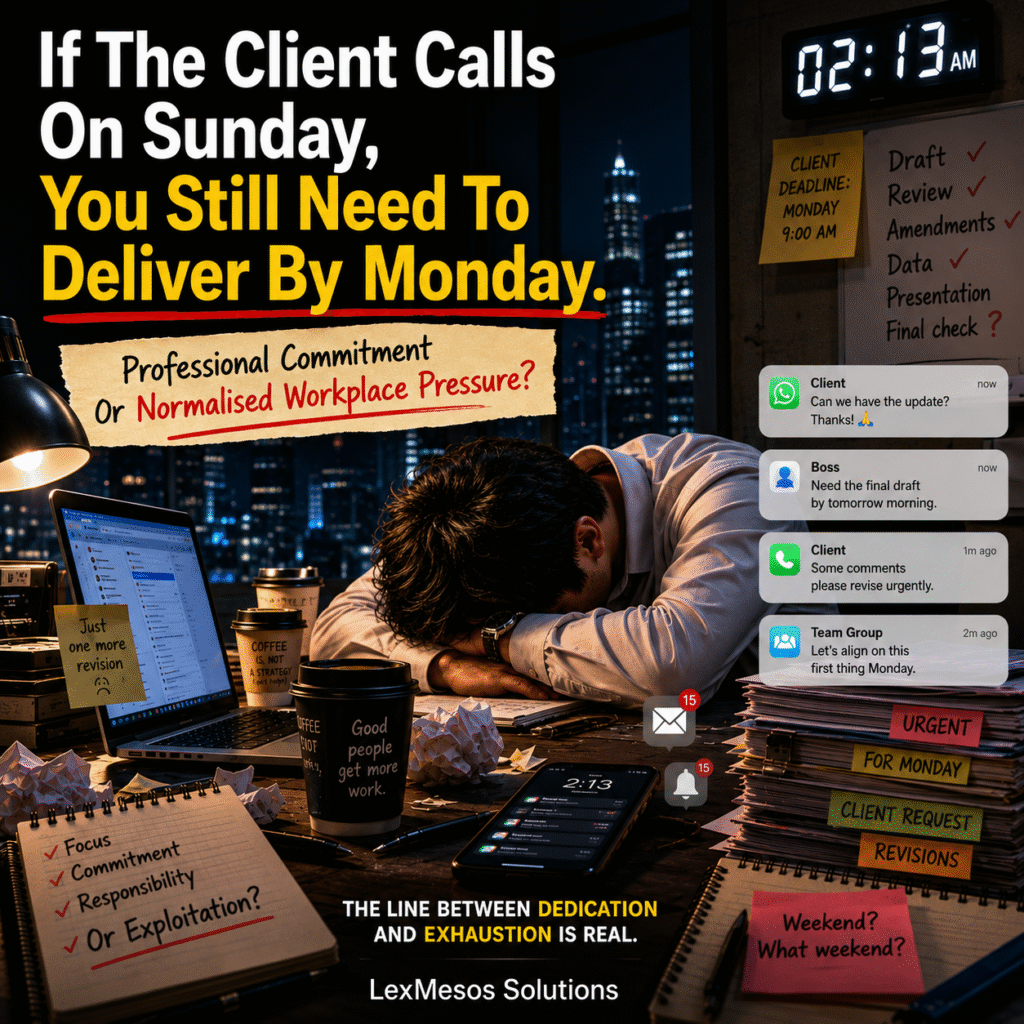
Professional Commitment Or Normalised Workplace Pressure?
In many industries, this sentence is still treated as normal professionalism.
Especially in:
- law firms
- consulting
- agencies
- construction
- accounting
- client-service businesses
The logic often sounds simple:
“The client is paying.”
“We must deliver.”
“This is commitment.”
“This is responsibility.”
“This is our professional obligation.”
And for many older professionals, this mindset was deeply tied to survival, reputation and career growth.
They were taught:
- hard work builds trust
- sacrifice creates opportunity
- clients come first
- commitment means availability
- young people must endure hardship or so-called “no pain, no gain” (Chinese slang: 肯吃苦)
Some genuinely believe their success came from years of endurance, sacrifice and even saying “yes” no matter how difficult the request was.
But younger generations are increasingly asking a different question:
Where is the line between professionalism and normalised exhaustion?
Hard Work And Endless Availability Are Not The Same Thing
Being hardworking is not the problem.
The problem begins when constant availability quietly becomes an expectation instead of an exception.
In many workplaces today, employees are expected to:
- reply immediately
- stay reachable after work
- sacrifice weekends
- accept last-minute urgency
- remain emotionally available for work at all times
And over time, boundaries slowly disappear.
Some employees no longer know where work ends.
Because once a workplace repeatedly teaches:
“If you truly care about your job, you should always be available,”
employees may begin feeling guilty for:
- resting
- turning off notifications
- protecting weekends
- saying “not today”
- having personal boundaries
Some Employees Feel Trapped Between Commitment And Fear
Many employees are not refusing responsibility.
They are afraid.
Afraid of:
- disappointing clients
- appearing uncommitted
- losing opportunities
- negative performance evaluations
- being viewed as “lazy”
- becoming replaceable
In some workplace cultures, visible sacrifice itself becomes proof of dedication.
Not necessarily:
- efficiency
- quality
- sustainability
- healthy performance
But suffering.
Employees who constantly sacrifice personal time are often viewed as:
- hardworking
- loyal
- committed
- dependable
Meanwhile, employees who establish boundaries may quietly be viewed as:
- less ambitious
- difficult
- not serious enough
- not committed enough (Chinese slang: 没有用心工作)
That emotional pressure is real in many workplaces.
Some Workplaces No Longer Teach Employees How To Work Hard.
They Teach Employees How To Tolerate Unhealthy Availability.
There is also another uncomfortable reality.
Sometimes client urgency slowly becomes employee sacrifice.
A client sends something late on Sunday.
Management immediately pushes pressure downward.
Employees absorb the stress.
The cycle repeats so often that unhealthy urgency slowly becomes normal company culture.
Over time, some professionals may begin confusing:
exploitation with professionalism.
Because saying “yes” constantly is often rewarded more visibly than protecting long-term sustainability.
Burnout Is Not Always Dramatic
Many mentally exhausted employees still:
- attend meetings
- meet deadlines
- reply emails
- complete tasks
- appear “functional”
while emotionally drained for months or even years.
Modern workplaces increasingly celebrate:
- hustle culture
- nonstop productivity
- high responsiveness
- multitasking
- “always online” behaviour
But fewer conversations focus on:
- recovery
- boundaries
- sustainable productivity
- long-term mental wellbeing
The danger is not hard work itself.
The danger is when exhaustion becomes normalised as professionalism.
Some Countries Are Beginning To Question This Culture
In several Northern European countries, workplace conversations increasingly recognise:
- work-life balance
- study leave
- parental leave
- recovery
- employee wellbeing
- long-term sustainability
as part of workforce health.
For example:
- Sweden recognises forms of extended leave such as tjänstledighet under certain legal conditions.
- Norway mandates several statutory leave rights tied to welfare, parental responsibilities, caregiving and education.
- Finland provides statutory unpaid study leave rights in certain circumstances, while some collective agreements also allow voluntary sabbaticals.
These systems do not mean employees “do not work hard.”
The difference is often philosophical.
Some workplace cultures increasingly recognise that:
humans are not machines.
Meanwhile, in many highly competitive Asian workplaces, long-term availability, sacrifice and endurance may still be treated as signs of professionalism and loyalty.
The Future Workplace Conversation May Become More Uncomfortable
Technology is increasing productivity expectations even further.
AI tools now allow:
- faster replies
- faster drafting
- faster reporting
- faster turnaround expectations
But human recovery does not evolve at the same speed as technology.
And younger generations are increasingly questioning whether endless availability should still be considered normal professionalism in modern workplaces.
Because many employees are no longer asking:
“How can I work less?”
They are asking:
“How long can human beings realistically function without meaningful recovery?”
Keywords: workplace burnout, client pressure culture, workplace exhaustion, toxic productivity, work-life balance, employee burnout, constant availability culture, hustle culture, workplace boundaries, professional commitment, workplace pressure, burnout culture, employee wellbeing, Sunday work culture, overtime expectations, workplace mental health, modern workplace culture, Asian work culture, Northern European work culture, sustainable productivity, corporate burnout, employee exhaustion, work pressure, professionalism vs exploitation, unhealthy work culture, employee loyalty pressure, workplace stress, burnout in professional industries, legal industry burnout, modern corporate culture
2 June 2026