 Skip to content
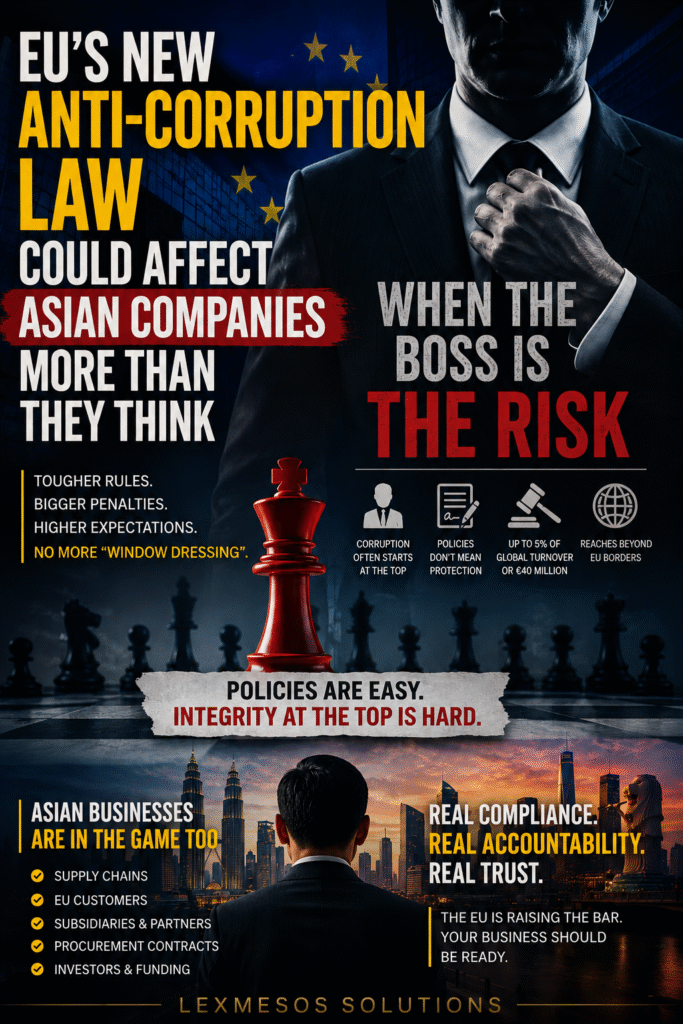
The European Union has officially adopted a new Anti-Corruption Directive in 2026, introducing stricter anti-corruption rules, broader corporate liability and tougher penalties for companies linked to corruption-related offences.
For many Asian businesses, this may still sound like “another EU regulation” that only affects European companies.
But that assumption could become a serious mistake.
Today, many Asian companies are directly or indirectly connected to Europe through:
- supply chains,
- distributors,
- procurement contracts,
- construction projects,
- manufacturing partnerships,
- technology services,
- multinational groups, or
- European customers and investors.
As the EU continues tightening its compliance expectations, businesses outside Europe may increasingly face pressure to demonstrate stronger governance and anti-corruption controls as well.
However, the biggest issue may not actually be the law itself.
The real problem is something many employees already know but rarely say openly:
What happens when the people at the top are involved in the misconduct themselves?
Many organisations today already have:
- anti-bribery policies,
- ethics declarations,
- whistleblowing channels,
- compliance training, and
- mandatory acknowledgements signed by employees.
On paper, everything looks compliant.
But inside some organisations, reality can look very different.
Employees are often expected to strictly follow internal procedures, while powerful individuals may still influence:
- procurement decisions,
- vendor selection,
- contract awards,
- entertainment expenses,
- third-party dealings, or
- even internal investigations themselves.
This creates one uncomfortable reality in corporate governance:
Compliance systems often become weakest when they must investigate the people with the most power.
One criticism frequently raised in anti-corruption discussions is that corruption does not always start from lower-level employees.
In some situations, the greatest challenge appears when senior executives, directors, politically connected individuals or decision-makers themselves are involved.
Policies may exist.
Training sessions may be conducted.
Declarations may be signed every year.
But enforcement becomes far more difficult when allegations concern those who control budgets, promotions, investigations or even the compliance function itself.
This is why the EU’s new Anti-Corruption Directive is attracting global attention.
The Directive does not only focus on punishment after corruption occurs. It also pushes for stronger prevention measures, harmonised corruption offences across EU Member States and more effective corporate compliance frameworks.
Importantly, recent discussions surrounding the Directive have also highlighted concerns about “window dressing” compliance.
In simple terms, companies may no longer be able to rely only on:
- beautifully drafted policies,
- PowerPoint presentations,
- compliance slogans, or
- signed declarations
if actual enforcement inside the organisation is weak.
This may become especially important in situations where:
- whistleblower reports were ignored,
- misconduct warnings were buried,
- investigations were selectively handled, or
- powerful individuals were protected internally.
For Asian businesses, this discussion is highly relevant…
In many parts of Asia, workplace culture can still be heavily influenced by hierarchy and seniority. Employees may hesitate to report misconduct involving powerful individuals due to fear of retaliation, career consequences, workplace politics or losing future opportunities.
This does not mean corruption only exists in Asia.
But it does show why enforcing anti-corruption policies in real life can be far more difficult than simply drafting documents.
The uncomfortable truth is this:
Most companies already have policies.
The real test begins when those policies must be applied to someone influential.
A company can conduct annual ethics training while misconduct quietly continues behind closed doors.
It can publicly promote “zero tolerance” policies while internally protecting certain individuals.
It can require employees to sign anti-corruption declarations while selectively enforcing rules only against lower-level staff.
This is why genuine compliance culture matters far more than corporate slogans.
The EU’s new Anti-Corruption Directive may therefore send a message that goes beyond Europe itself:
Compliance is no longer judged only by what is written in a handbook.
It may increasingly be judged by whether a company is genuinely willing to enforce its own policies when difficult situations arise.
For companies connected to EU markets, the next few years may not simply be about preparing more compliance documents.
It may be about proving that compliance applies equally to everyone, including senior management.
Because in today’s business landscape, compliance is no longer just about having policies.
It is about whether those policies can survive real-world pressure.
As global compliance expectations continue rising, businesses may need stronger governance frameworks before problems become far more costly later.
Keywords: EU Anti-Corruption Directive 2026, EU corporate compliance, anti-corruption law, Asian companies, whistleblowing, governance, fake compliance, corporate corruption, senior management misconduct, compliance culture, EU business regulation, anti-bribery policies, corporate accountability, compliance risk
Sources:
- Council of the European Union – Council adopts new EU-wide law to combat corruption
- Transparency International EU – EU finalises Anti-Corruption Directive: TI EU reaction
- Latham & Watkins LLP – EU Anti-Corruption Directive: What Companies Need to Know
- Thomson Reuters Practical Law – EU Anti-Corruption Directive Overview
- Brussels Times – EU launches tougher anti-corruption rules to restore democracy and public trust
- eucrim Journal – Academic analysis on the EU Anti-Corruption Directive
Disclaimer: This article is for general informational purposes only and does not constitute legal advice.
2 June 2026