 Skip to content

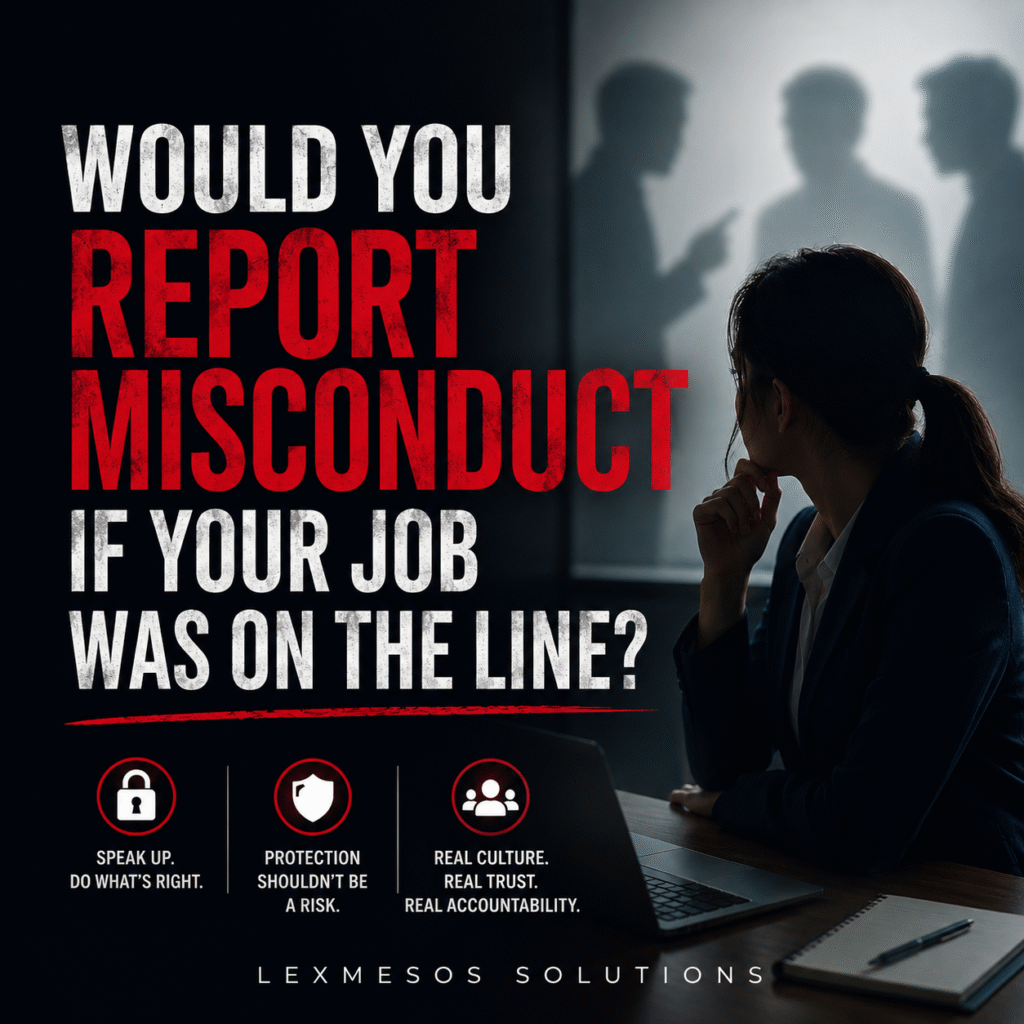
Most companies today have a whistleblowing policy.
Many organisations encourage employees to report:
- fraud,
- corruption,
- harassment,
- conflicts of interest,
- safety concerns,
- financial misconduct, or
- unethical behaviour.
On paper, the process sounds simple.
See something wrong.
Report it.
The company investigates.
The issue gets resolved.
Problem solved.
But real life is rarely that straightforward.
The Question Many Employees Quietly Ask
Imagine you discover something suspicious at work.
Perhaps you notice:
- unusual payments,
- questionable expenses,
- missing company funds,
- procurement irregularities,
- suspicious transactions,
- abuse of authority, or
- behaviour that clearly violates company policies.
The whistleblowing policy says you should report it.
But then reality sets in.
What if the person involved is your manager?
What if it is a director?
What if it is someone who influences your promotion, bonus or future opportunities?
Would you still report it?
For many employees, the fear is not the reporting process itself.
The fear is what happens afterwards.
Why People Stay Silent
Most people do not stay silent because they support misconduct.
They stay silent because they are worried about the consequences.
Common concerns include:
- Losing their job.
- Damaging workplace relationships.
- Being labelled a troublemaker.
- Missing future promotions.
- Being excluded from important projects.
- Becoming isolated by colleagues.
- Facing legal threats or retaliation.
Even where legal protections exist, many employees still worry that speaking up may create personal or professional risks.
Public confidence in whistleblower protection is often shaped by real-world cases. When individuals who expose wrongdoing appear to suffer negative consequences, employees may become reluctant to report concerns, regardless of what company policies say.
As a result, some choose the safer option:
Do nothing.
The Governance Problem Nobody Likes Discussing
Many corporate scandals do not begin with external investigations.
They often begin with someone inside the organisation noticing that something is wrong.
The challenge is that whistleblowing systems are often tested most severely when allegations involve senior individuals.
It is relatively easy to investigate junior employees.
It becomes much harder when concerns involve:
- managers,
- executives,
- directors,
- influential stakeholders, or
- individuals with decision-making authority.
This creates a difficult question:
Can a whistleblowing system truly be effective if employees do not trust the organisation to act independently?
A reporting channel is only useful if people feel safe using it.
What Is Europe Doing Differently?
In recent years, the European Union has placed increasing emphasis on whistleblower protection as part of broader efforts to strengthen corporate governance, transparency and accountability.
The EU Whistleblower Protection Directive (Directive (EU) 2019/1937) requires Member States to establish protections for individuals who report certain breaches of EU law.
The framework aims to:
- encourage internal reporting,
- strengthen confidentiality protections,
- prohibit retaliation against whistleblowers, and
- promote a culture where concerns can be raised without fear.
The message is simple:
Employees should not have to choose between doing the right thing and protecting their careers.
Of course, legislation alone cannot eliminate fear.
Even where legal protections exist, many employees may still worry about workplace politics, future opportunities or informal retaliation.
However, the EU’s approach reflects a growing recognition that effective governance depends not only on policies and controls, but also on whether people feel safe enough to speak up.
Policies Alone Are Not Enough
Many organisations invest significant time creating:
- whistleblowing policies,
- compliance manuals,
- ethics programmes,
- training materials, and
- reporting mechanisms.
These are important.
However, documents alone do not create trust.
Employees often pay closer attention to actions than words.
If previous reports were ignored, people notice.
If whistleblowers were treated unfairly, people notice.
If senior individuals appear protected from scrutiny, people notice.
If investigations seem selective, people notice.
Over time, workplace culture can become more influential than the written policy itself.
What Can Asia Learn?
Many Asian businesses already have whistleblowing policies and reporting channels.
The challenge is often not the absence of procedures.
It is building enough trust for employees to actually use them.
In many workplaces, hierarchy and seniority remain powerful influences.
Employees may hesitate to report concerns involving influential individuals due to fears of retaliation, career consequences, workplace politics or being viewed as disloyal.
As regulators around the world place greater emphasis on governance, compliance, anti-corruption measures and accountability, organisations may increasingly be judged not only by the policies they publish, but by how they respond when concerns are raised.
A whistleblowing system is only effective if employees believe it works.
Why This Matters
Recent developments such as the EU’s new Anti-Corruption Directive have renewed discussions about accountability, internal reporting and whether organisations are genuinely prepared to investigate misconduct when it occurs.
Whether the issue involves:
- fraud,
- corruption,
- financial misconduct,
- AML concerns,
- conflicts of interest, or
- abuse of authority,
organisations often rely on individuals who are willing to speak up when something appears wrong.
Yet many people still face a difficult personal calculation:
“Is reporting this worth the risk?“
Until organisations can answer that question with confidence, whistleblowing policies may remain stronger on paper than in practice.
Final Thoughts
Whistleblowing is often presented as a simple compliance process.
In reality, it is often a question of trust.
Most employees already know how to report misconduct.
The real question is whether they believe they will be protected if they do.
Because the effectiveness of a whistleblowing system is not measured by how many pages are in the policy.
It is measured by whether people feel safe enough to use it.
In conclusion, whistleblowing policy cannot create trust on its own. Trust exists when employees genuinely believe they can report concerns without risking their careers, reputations or personal wellbeing.
How LexMesos Solutions Can Help
Strong governance starts with more than policies alone.
We support businesses with:
- governance frameworks,
- compliance support,
- risk awareness initiatives,
- policy development, and
- practical compliance-related guidance.
A whistleblowing policy is important.
Building trust in that policy is even more important.
Keywords: Whistleblowing policy, whistleblower protection, EU Whistleblower Directive, corporate governance, compliance culture, workplace misconduct, anti-corruption, internal reporting, retaliation, AML compliance, ethics and compliance, corporate accountability, risk management, governance framework, employee protection
Disclaimer: This article is for general informational purposes only and does not constitute legal advice.
4 June 2026