 Skip to content

Most people never think about citizenship.
You are born, receive an identity card or passport, and simply assume you belong.
Until one day, a court decision or a news headline reminds us that citizenship is not always that straightforward.
Recent developments in Germany and Malaysia have sparked discussions about who gets citizenship, who can lose it and what citizenship really means in modern society.
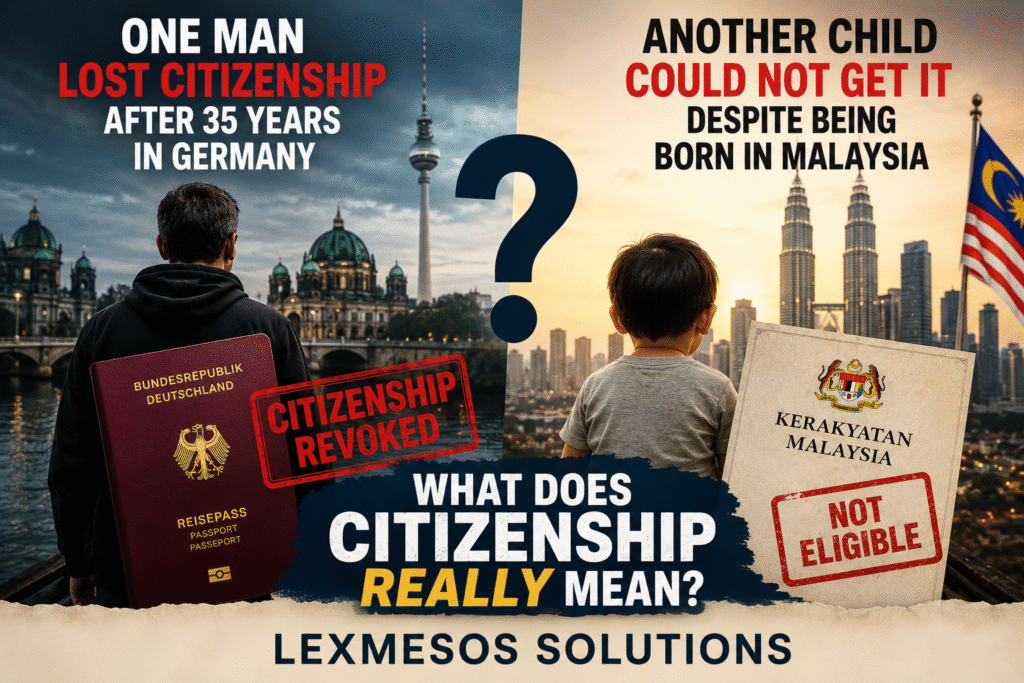
A Man Who Spent Almost His Entire Life in Germany
In Germany, a case involving a man known as Abdallah A. has attracted significant public attention (jacobin).
According to reports, he arrived in Germany as a baby and spent virtually his entire life there. He eventually obtained German citizenship through naturalisation.
However, his citizenship was later revoked, and the decision is now being challenged through legal proceedings.
The details of the case remain subject to legal debate.
Supporters of the revocation argue that citizenship should not be granted if important information was withheld during the application process.
Others argue that a person who has lived almost their entire life in a country should not lose citizenship so easily.
Regardless of where one stands, the case raises an important question:
If someone grows up, studies, works and builds a life in a country, when does that country truly become their home?
A Child Born in Malaysia
Meanwhile, a recent decision by Malaysia’s Court of Appeal reminded many people that being born in a country does not automatically mean becoming its citizen.
The case involved a child, identified as LWO, whose biological parents could not be identified (freemalaysiatoday).
Although the child was born in Malaysia, the court ruled that citizenship was not automatically granted simply because of the place of birth.
For many people, this result may seem surprising.
After all, if a child is born in a country, speaks its language and grows up within its society, shouldn’t that child belong there?
The court’s decision highlights that citizenship rules can be more complicated than many people realise.
Two Different Countries. But Just One Similar Question.
At first glance, these two cases appear completely unrelated.
One concerns a person who obtained citizenship and later lost it.
The other concerns a child who could not automatically obtain citizenship.
Yet both cases ask the same fundamental question:
What makes someone belong to a country?
Is it where they were born?
Is it where they grew up?
Is it their family background?
Is it a legal document?
Or is it something more?
Citizenship Is More Than A Passport
Many people view citizenship as just another government document.
In reality, citizenship affects almost every aspect of a person’s life.
It can determine:
- The right to live in a country permanently
- Access to education
- Access to healthcare
- Employment opportunities
- Voting rights
- Freedom to travel
- Legal protection
For some people, citizenship is something they never have to think about.
For others, it becomes one of the biggest challenges of their lives.
A Question Every Country Faces
As the world becomes increasingly connected, questions about citizenship are becoming more common.
People move across borders.
Children are born in different countries.
Families come from different nationalities.
Traditional ideas about citizenship are being tested in ways previous generations rarely experienced.
Germany and Malaysia may have very different laws.
However, both countries are currently facing a similar challenge:
How do we define belonging in a modern world?
Final Thoughts
One man reportedly spent almost his entire life in Germany and later lost citizenship.
Another child was born in Malaysia but could not automatically obtain it.
Different facts.
Different countries.
Different legal systems.
Yet both stories remind us of the same reality:
Citizenship is not just about paperwork.
It is about identity.
It is about belonging.
And sometimes, it is about answering one of the most difficult questions any society can ask:
Who truly belongs?
Keywords: citizenship, citizenship rights, citizenship law, Germany citizenship, Malaysia citizenship, naturalisation, citizenship revocation, birthright citizenship, stateless children, child citizenship, nationality law, identity and belonging, constitutional rights, immigration law, citizenship eligibility, German citizenship case, Malaysia Court of Appeal, citizenship debate, legal rights, citizenship challenges
23 June 2026