 Skip to content

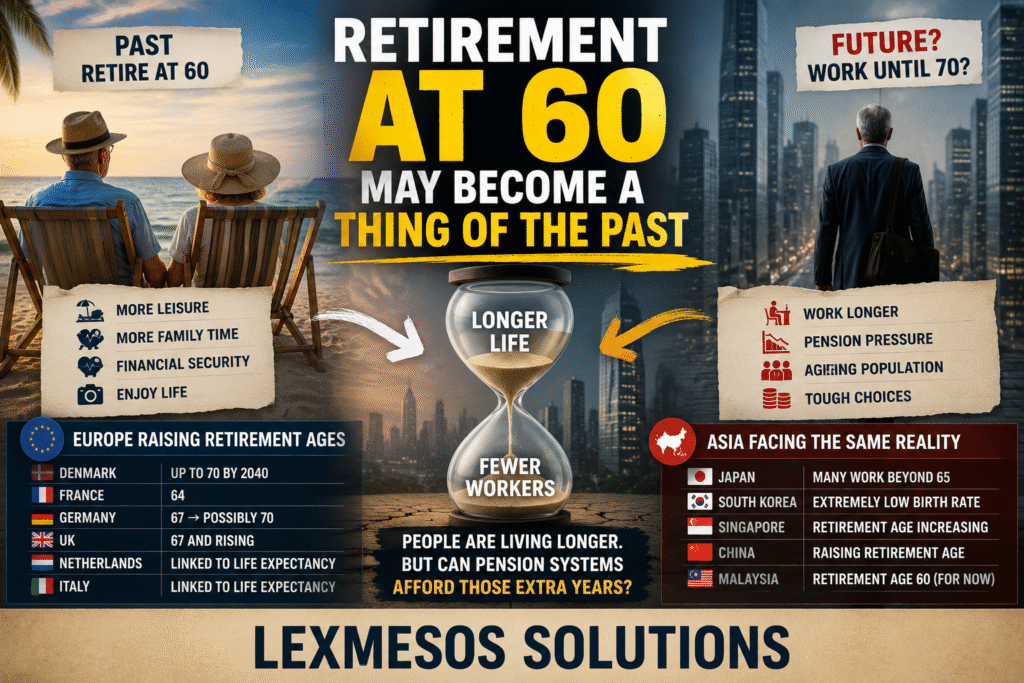
For many people, retirement has always followed a simple formula.
Study.
Work.
Retire.
Enjoy life.
But across Europe and Asia, governments are increasingly asking a difficult question:
What happens when people live longer, but fewer people are working?
Germany’s latest pension debate has attracted global attention after a government commission proposed linking retirement age more closely to life expectancy. If implemented over the coming decades, retirement could gradually move closer to 70 years old (Reuters).
While this may sound shocking, Germany is not alone.
In reality, many countries are facing the same challenge.
Germany Is Not The First
Germany’s proposal is making headlines, but several European countries have already started adjusting retirement ages.
Denmark has approved increases that could see retirement ages reach 70 in the future.
France recently raised its retirement age from 62 to 64 despite widespread protests and strikes.
The United Kingdom is gradually increasing retirement ages, while countries such as the Netherlands and Italy have already linked retirement systems to life expectancy.
The message is becoming clear:
Governments are preparing for people to work longer.
Asia Is Facing The Same Reality
The issue is not limited to Europe.
Japan has one of the world’s oldest populations, with many people continuing to work beyond traditional retirement ages.
South Korea faces one of the lowest birth rates globally, creating concerns about future pension sustainability.
Singapore has gradually increased retirement and re-employment ages to reflect longer life expectancy.
China recently began raising retirement ages after decades of maintaining fixed retirement limits.
Even Malaysia, where the retirement age remains 60, is not immune to demographic changes.
Like many countries, Malaysia is experiencing an ageing population and lower birth rates compared to previous generations.
Why Is This Happening?
The answer is surprisingly simple.
People are living longer.
At the same time, fewer children are being born.
Imagine a pension system decades ago.
Ten workers might have supported two retirees.
Today, those same ten workers may need to support five or six retirees.
The numbers simply do not work the same way anymore.
Governments therefore face difficult choices:
- Raise taxes
- Reduce pension benefits
- Increase retirement ages
- Encourage people to work longer
None of these options are particularly popular.
Yet many countries are finding that doing nothing is becoming increasingly difficult.
The Younger Generation May Feel The Impact Most
For younger workers, this debate is particularly important.
Many grew up believing retirement would arrive at a certain age.
However, future generations may experience a very different reality.
A person entering the workforce today could eventually retire much later than their parents or grandparents.
Some may even need to rethink how they save, invest and plan for retirement altogether.
Is Working Longer Necessarily Bad?
Not everyone views later retirement negatively.
Many people remain healthy and active well into their 60s and 70s.
Some enjoy continuing to work, stay engaged and maintain social connections.
The challenge is that not all jobs are the same.
A person working in an office may be able to continue longer than someone performing physically demanding labour.
This is where policymakers face another difficult balancing act:
How do you create a system that is both financially sustainable and fair to different types of workers?
The Bigger Question
The retirement debate is often presented as a discussion about age.
In reality, it is a discussion about demographics, economics and quality of life.
People are living longer than ever before.
That is a remarkable achievement.
But it also means societies must rethink assumptions that previous generations took for granted.
Final Thoughts
Germany’s proposal may sound controversial today.
Yet similar discussions are already happening across Europe and Asia.
Retirement at 60 was once considered normal.
For future generations, it may become increasingly rare.
The question is no longer whether people are living longer.
The real question is whether pension systems can afford those extra years.
Keywords: Retirement, Retirement Age, Pension Reform, Germany, Europe, Asia, Ageing Population, Workforce, Employment, Life Expectancy, Pension Sustainability, Public Policy, Demographics, Social Security, Retirement Planning, Future of Work, Global Trends, Economy
23 June 2026