 Skip to content

Imagine this.
You walk into a café in Paris.
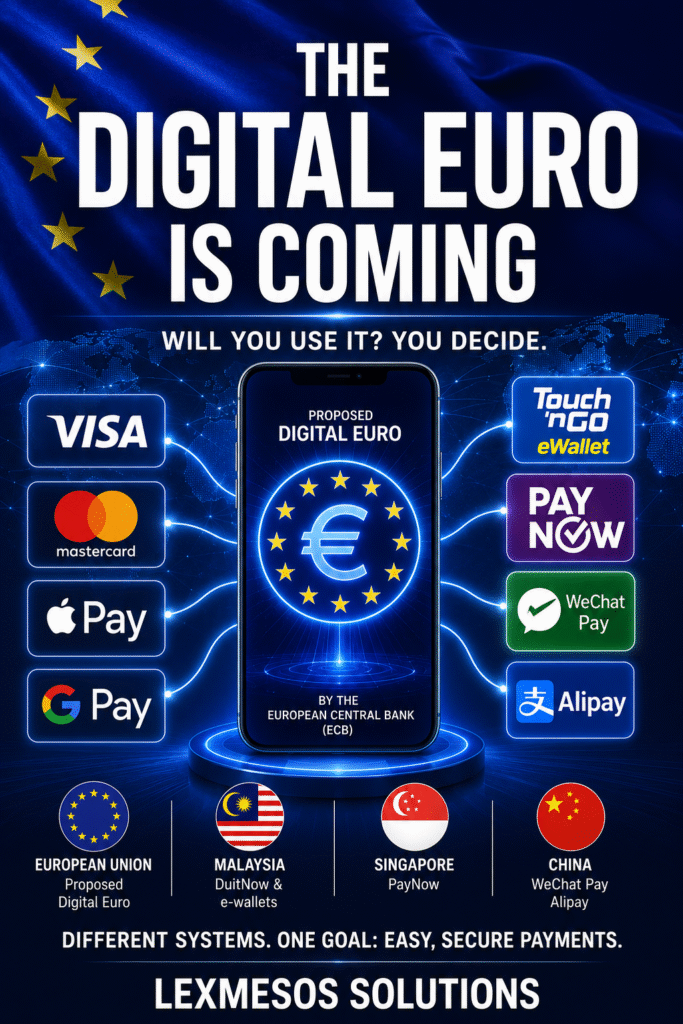
You can already pay using:
- 💳 Visa
- 💳 Mastercard
- 📱 Apple Pay
- 📱 Google Pay
Soon, you may also be able to pay using the Digital Euro.
Many people immediately ask:
“Why do we need another payment method?”
It’s a fair question.
Let’s break it down in simple English.
First, what exactly is the Digital Euro?
No, it is not cryptocurrency.
It is not Bitcoin.
It is not another bank card.
The Digital Euro is a digital version of the euro issued by the European Central Bank (ECB).
Think of it as digital cash.
Just as you can hold a €20 banknote in your wallet today, the idea is that you could one day hold €20 in Digital Euros.
So why is Europe creating it?
Many people assume it is because current payment systems do not work.
Actually…
They work very well.
The issue is something else.
Today, many digital payments rely on companies headquartered outside Europe.
For the EU, this raises bigger questions:
- Should Europe rely heavily on foreign payment providers?
- What happens if international payment systems are disrupted?
- Should Europe have its own public digital payment infrastructure?
The Digital Euro is one possible answer.
But here’s the question ordinary people ask…
If I already have:
- Visa
- Mastercard
- Apple Pay
- Google Pay
Why would I switch?
That is probably the biggest challenge.
Because technology alone does not change people’s habits.
Governments and users don’t always ask the same questions
| Policymakers ask… | Ordinary users ask… |
|---|---|
| How can Europe strengthen payment sovereignty? | Can I use it everywhere? |
| How can Europe reduce reliance on foreign payment providers? | Will it work when I travel? |
| How can Europe build a resilient payment system? | Is it easier than what I already use? |
| How can Europe protect monetary sovereignty? | Why should I change? |
Neither side is wrong.
They simply have different priorities.
How does this compare with other countries?
Many people think Europe is the first to build its own payment ecosystem.
Not really.
Different countries have taken different approaches.
| Region | Main payment approach |
|---|---|
| 🇪🇺 European Union | Digital Euro (planned) |
| 🇲🇾 Malaysia | DuitNow + private e-wallets such as Touch ‘n Go eWallet, MAE, Boost and GrabPay |
| 🇸🇬 Singapore | PayNow + private payment apps |
| 🇨🇳 China | WeChat Pay and Alipay dominate everyday payments |
| 🌍 Global | Visa and Mastercard remain widely accepted worldwide |
Notice something?
Most domestic payment systems work very well at home.
However, when people travel internationally, many still rely on globally accepted payment networks.
That’s where things become interesting
Imagine you are an EU citizen travelling to:
🇯🇵 Japan
🇰🇷 South Korea
🇲🇾 Malaysia
🇹🇭 Thailand
Will local merchants accept the Digital Euro?
Maybe.
Maybe not.
That depends on future agreements, payment providers and merchant adoption.
The same applies in reverse.
A Malaysian Touch ‘n Go eWallet works brilliantly in Malaysia, but it is not accepted everywhere in Europe.
Every payment ecosystem has limits.
So is the Digital Euro a good idea?
It could be.
The Digital Euro is not simply about replacing cash or competing with Visa.
It is about giving Europe another payment option that is backed by its own central bank.
Whether people choose to use it is a different question.
What will determine its success?
Privacy.
Trust.
Convenience.
Merchant acceptance.
Cross-border usability.
Because at the end of the day…
People usually choose the payment method that is the quickest, easiest and works almost everywhere they go.
Technology can be built.
Laws can be passed.
But changing everyday payment habits is much harder.
Final Thoughts
The Digital Euro is more than a new way to pay.
It is part of a wider conversation about digital sovereignty, financial resilience and the future of money.
For governments, it is about strategy.
For businesses, it is about implementation.
For ordinary people, the question is much simpler:
“Will this make my life easier?”
That may be the question that ultimately matters most.
Continue Reading
Digital transformation is changing how we pay, work and do business. Explore more easy-to-understand articles on AI, privacy, digital regulation and emerging technology in our E-Library.
Keywords: Digital Euro, European Central Bank, ECB, CBDC, Visa, Mastercard, Apple Pay, Google Pay, digital payments, payment sovereignty, cross-border payments, Malaysia Touch ‘n Go, DuitNow, Singapore PayNow, WeChat Pay, Alipay, digital currency, fintech, EU payments
10 July 2026