 Skip to content

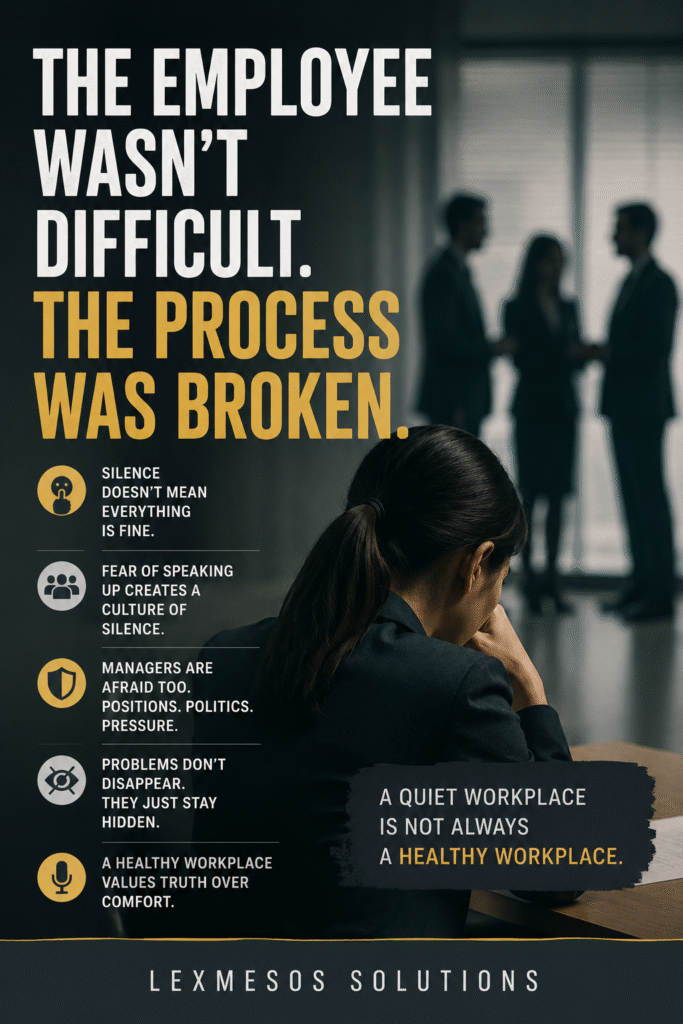
Most organisations want employees to speak up.
Raise concerns.
Report risks.
Share ideas.
Highlight problems before they become bigger issues.
At least, that is what many employee handbooks say.
Reality can feel very different.
In some workplaces, employees quickly learn an unwritten rule:
Speaking up is encouraged.
Until the wrong issue is raised.
How Good Employees Become Silent
Many employees do not start their careers afraid to speak.
They ask questions.
They share ideas.
They point out operational issues.
They suggest improvements.
Then they observe what happens to others.
The employee who questioned a decision.
The employee who highlighted a recurring problem.
The employee who challenged an unrealistic target.
The employee who disagreed with management.
The lesson is often learned through observation rather than policy.
And the lesson can be simple:
Stay quiet.
Do your job.
Avoid attention.
The Problem Was Never The Employee
When concerns are raised, the discussion should focus on the issue itself.
Instead, some workplace cultures allow the focus to shift.
The operational problem becomes secondary.
The employee becomes the topic of discussion.
Questions arise:
“Why are they being difficult?”
“Why can’t they be more cooperative?”
“Why are they challenging the process?”
The original concern slowly disappears from the conversation.
The employee who reported the issue becomes the issue.
Over time, this creates a culture where raising concerns feels riskier than remaining silent.
When Managers Are Afraid Too
Employees are not always the only people under pressure.
Managers may also face competing priorities.
A manager may recognise a problem.
A manager may even agree with an employee’s concerns.
However, escalating those concerns may create challenges of its own.
Questions may be asked.
Decisions may be scrutinised.
Relationships with senior management may become strained.
As a result, some managers choose silence.
Not because they do not care.
Not because they do not understand.
But because speaking up may place their own position at risk.
The result is a workplace where concerns stop moving upwards.
The Dangerous Comfort Of Silence
For some business owners, silence can look like success.
No complaints.
No disagreements.
No difficult conversations.
No reported issues.
Everything appears stable.
However, silence is not always a sign that everything is working.
Sometimes silence is simply what happens when employees no longer believe it is safe to speak.
The organisation becomes quieter.
The problems remain.
When Trust Starts To Disappear
Employees are more likely to trust workplace processes when they believe concerns will be assessed fairly.
Trust can begin to erode when employees feel:
- speaking up creates personal risk;
- criticism is treated as disloyalty;
- labels replace facts;
- concerns are ignored;
- scrutiny increases after questions are raised.
Whether these perceptions are accurate or not, they influence behaviour.
And behaviour ultimately shapes workplace culture.
Good Governance Is Not About Silence
Healthy organisations do not measure success by the absence of complaints.
They measure success by whether employees feel comfortable raising concerns before problems become crises.
Constructive disagreement is not misconduct.
Questioning a process is not insubordination.
Identifying risks is not negativity.
In many cases, the people closest to operational problems are also the people best positioned to identify solutions.
The challenge is ensuring their voices are heard.
Final Thought
A quiet workplace is not always a healthy workplace.
Sometimes silence reflects trust.
But sometimes silence reflects fear.
When employees stop speaking, managers stop escalating concerns and leaders stop hearing difficult truths, organisations may assume everything is working.
Until one day, a problem that everyone knew about becomes impossible to ignore.
By then, the people who could have warned the organisation have already learned the same lesson:
Stay quiet.
Keywords: workplace culture, office politics, employee concerns, speaking up at work, organisational culture, workplace governance, toxic workplace, employee engagement, management accountability, psychological safety, HR processes, workplace trust, leadership, employee voice and corporate culture
18 June 2026