 Skip to content
The Rohingya issue has once again returned to the headlines.
Recent reports involving settlements, housing arrangements, university admissions, public reactions and human rights concerns have reignited a debate that Malaysia has been having for years.
Yet despite countless discussions, one question remains unanswered:
What is the long-term plan?
The public conversation often becomes polarised. One side focuses on humanitarian obligations and human rights. The other focuses on immigration control, public resources and national interests.
However, perhaps both sides are overlooking a more important question.
How long should Malaysia be expected to carry a responsibility that originated beyond its borders?
Malaysia’s Role Is Often Overlooked
Malaysia is not a signatory to the 1951 Refugee Convention (European Commission).
Despite this, Malaysia has hosted Rohingya refugees and asylum seekers for many years. Throughout this period, support has come from various sources, including charities, community organisations, educational institutions, employers, religious groups and ordinary Malaysians.
Whether one agrees with current policies or not, it is difficult to deny that Malaysia has played a significant humanitarian role.
Many countries speak about human rights in principle. Malaysia has dealt with the practical realities on the ground.
For years, refugees have found shelter, community support, educational opportunities and economic opportunities within Malaysia.
That reality deserves acknowledgement.
The Question Nobody Wants to Ask
Public discussions often focus on the refugees themselves.
However, if we look beyond the headlines, a different picture emerges.
If refugee families are renting homes, someone is providing those homes.
If rent is being paid, someone is receiving that rent.
If refugees are working, someone is employing them.
If communities continue to exist over many years, there are broader social and economic systems that make that possible.
This observation is not an accusation against any individual or organisation.
Rather, it highlights an important reality.
The issue is larger than refugees alone.
It involves housing, employment, policy, enforcement, economics and governance.
Focusing exclusively on refugees risks ignoring the wider ecosystem that has developed around a situation that has existed for many years.
Human Rights and Public Concerns Are Not Opposites
Unfortunately, discussions about the Rohingya issue often become emotional.
Some assume that anyone raising policy concerns is motivated by hostility.
Others assume that anyone discussing human rights is ignoring national interests.
Neither assumption is fair.
A person can support human dignity while still asking legitimate questions about long-term policy.
A person can support humanitarian assistance while still believing that governments should have clear plans and clear accountability.
These positions are not mutually exclusive.
Human rights and good governance should work together, not compete with one another.
Should Malaysia Carry the Responsibility Alone?
This is perhaps the most important question of all.
For years, discussions about the Rohingya issue have largely focused on Malaysia and other host countries.
Far less attention is given to a fundamental issue:
What responsibility should be borne by Myanmar itself?
Every country has responsibilities towards addressing issues involving its own population and its own long-term stability.
Likewise, the international community frequently calls upon host countries to demonstrate compassion and humanitarian commitment.
These calls may be well-intentioned, but they should also be accompanied by meaningful efforts to support sustainable solutions.
Humanitarian assistance can provide protection.
It cannot, by itself, resolve a situation indefinitely.
At some point, discussions must move beyond temporary arrangements and towards durable solutions.
A More Difficult Conversation
For years, the debate has largely focused on whether host countries should continue providing assistance.
Yet a more difficult conversation is often avoided.
What happens if temporary arrangements become permanent?
Humanitarian responses are often designed to address urgent and immediate needs. However, when situations continue for years or even decades, questions about sustainability naturally arise.
If future generations continue to inherit the same unresolved issue, policymakers must eventually ask whether existing approaches are achieving their intended objectives.
Compassion remains important.
But compassion alone cannot substitute for long-term planning, regional cooperation and practical solutions.
A sustainable policy should protect human dignity while also providing clarity about responsibilities, expectations and future outcomes.
What Happens Next?
After years of discussion, perhaps the most important question is no longer whether Malaysia should help.
Malaysia has already helped.
The more important question is what comes next.
Humanitarian assistance can provide temporary relief.
Compassion can provide protection.
But neither can replace a clear and sustainable long-term strategy.
Until that strategy exists, the same debate will continue to return whenever another headline appears.
The Rohingya issue is not solely a Malaysian issue.
It is a regional issue.
It is an international issue.
And ultimately, it is an issue that requires participation from all relevant stakeholders, including Myanmar itself.
Malaysia’s humanitarian efforts deserve recognition.
At the same time, lasting solutions require more than goodwill.
They require accountability, cooperation and a shared commitment to addressing root causes rather than merely managing the consequences.
Until then, one question will continue to remain:
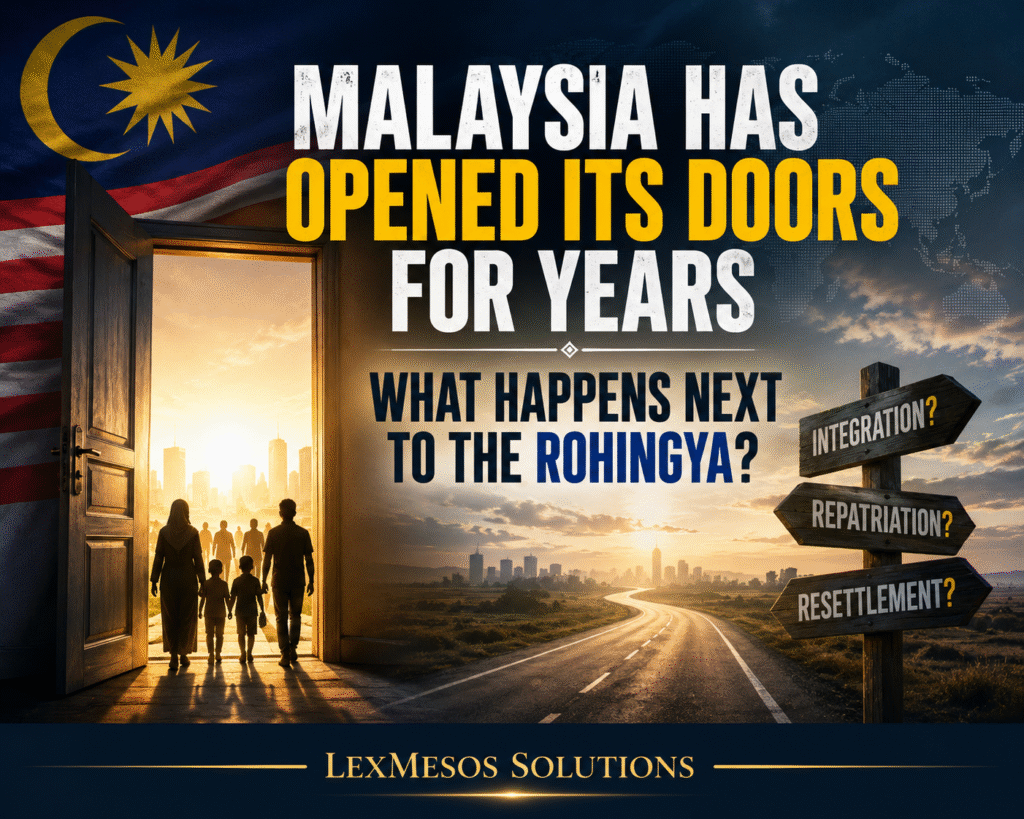
Malaysia has opened its doors for years.
What happens next to the Rohingya?
Keywords: Rohingya in Malaysia, Rohingya refugees Malaysia, Malaysia refugee policy, human rights Malaysia, refugee debate Malaysia, Myanmar responsibility, humanitarian assistance, refugee governance, long-term solution for Rohingya, public policy Malaysia
18 June 2026