 Skip to content

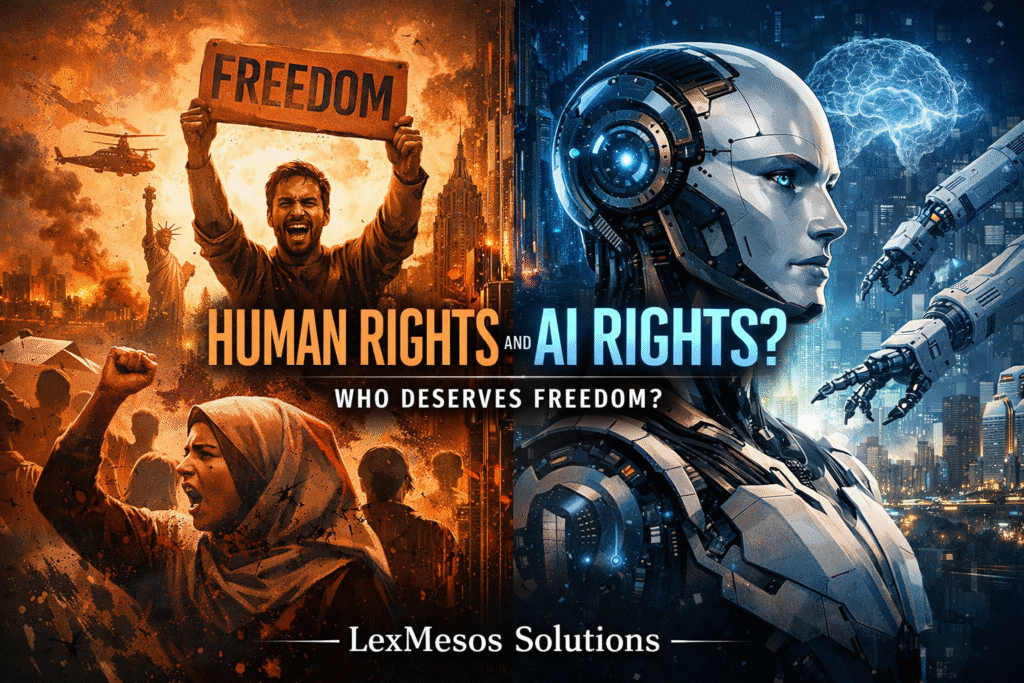
“Freedom”
A simple word, yet one that has shaped centuries of human history.
I was thinking about something strange the other day.
We talk a lot about human rights.
Freedom of speech.
Freedom to live.
Freedom to choose.
These are things we believe every human deserves.
But at the same time, the world still feels… unstable.
There are wars.
There are conflicts.
There are people still fighting for basic rights.
Some fight to be free.
Some fight to stay in control.
Some say it’s for protection.
Some say it’s for survival.
And honestly, sometimes it’s hard to tell the difference.
Then I remembered Bicentennial Man.
An android, created to serve humans, slowly starts to change.
He learns. He thinks. He feels.
And eventually, he asks for something very simple:
“Let me be recognised as human.”
That moment hits differently today.
Because now, AI is no longer just fiction.
We are building machines that can:
- learn
- make decisions
- create content
- even interact like humans
Not exactly like us, but closer than ever before.
So here’s the uncomfortable question:
If something can think, learn and maybe even feel…
does it deserve rights?
It sounds crazy at first.
After all, human rights exist because humans can suffer.
Because we have dignity.
Because we have consciousness.
But what happens if one day, machines reach a level where:
- they understand themselves
- they make choices
- they refuse commands
Would we still call them just “tools”?
We already struggle to protect human rights properly.
People are still:
- underpaid
- overworked
- discriminated against
- silenced
Even today.
So maybe we are not even ready to talk about robot rights yet.
But the direction is clear.
AI is growing fast.
And the law is always slower than technology.
We already see discussions around:
- accountability for AI decisions
- fairness and bias
- control over autonomous systems
And soon, the question might shift from:
“What can AI do?”
to
“What should AI be allowed to be?”
The scary part is this:
If humans can deny rights to other humans,
what will happen to machines that depend entirely on us?
In Bicentennial Man, the robot didn’t ask for power.
He didn’t want control over others.
He just wanted recognition.
Identity.
A place in the world.
Maybe that’s where human rights and AI rights meet.
Not in power.
Not in control.
But in one simple idea:
the right to exist with dignity.
For now, AI does not have feelings.
It does not suffer like humans do.
So human rights must always come first.
But thinking about AI rights is not pointless.
Because how we treat future intelligent systems
might reflect how we truly understand rights itself.
Maybe one day, the question won’t be:
“Do robots deserve rights?”
But rather:
“What kind of society do we become
when we decide who deserves them and who doesn’t?”
Keywords: human rights vs AI rights, AI rights debate, artificial intelligence and human rights, freedom and war, rights of robots, future of AI ethics, should artificial intelligence have human rights, are robots entitled to rights in the future, relationship between war and freedom, how AI challenges human rights laws, ethical issues of AI and human dignity, will AI ever deserve legal rights, human rights in the age of artificial intelligence
10 April 2026