 Skip to content
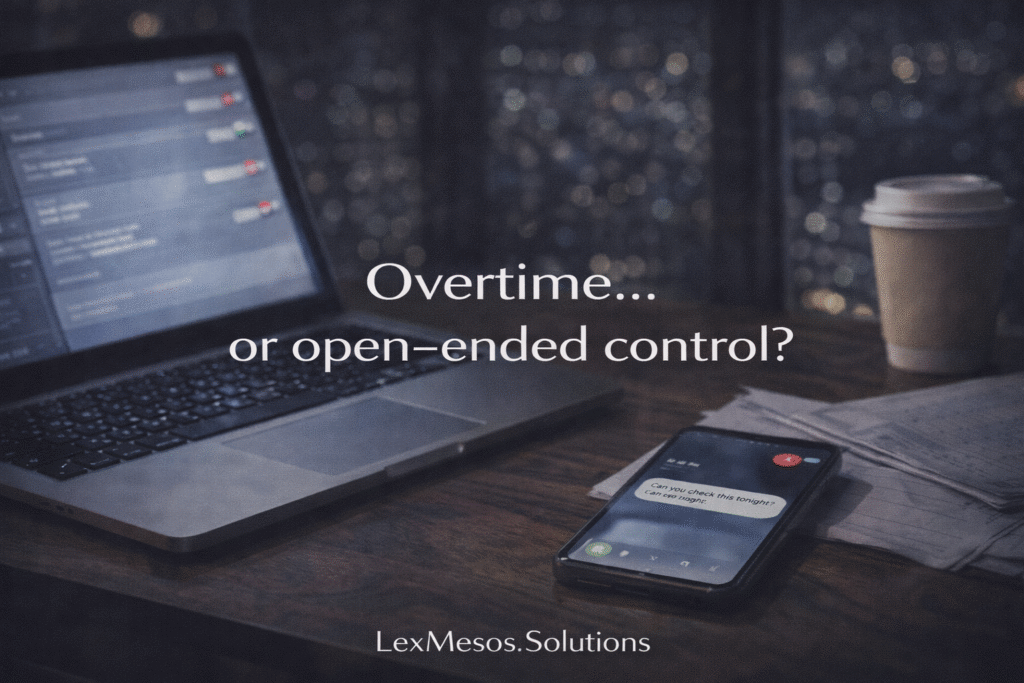
“It’s just a small task.”
“Can you stay online tonight?”
Most employees have heard this before.
And many employers will say:
👉 “Overtime may be required from time to time.”
👉 “You agree to work beyond normal hours if necessary.”
This is often discussed during interviews or stated in the employment contract.
So… is it legally allowed?
In many cases, yes.
Employment contracts often include flexibility clauses, allowing employers to request overtime based on operational needs.
But here’s the issue:
👉 These clauses are usually broad and undefined
Where the problem starts
When “overtime may be required” becomes:
- Expected availability after working hours
- Weekend work without structure
- Continuous “on-call” behaviour
- No additional pay or time-off
At this point, it is no longer just flexibility.
👉 It becomes a lack of boundary and governance
⚠️ The real risk (for businesses)
This is not just an employee concern.
It creates:
- Unclear expectations
- Inconsistent practices across teams
- Potential disputes over working hours
- Compliance and policy gaps
What many companies overlook
Having a clause is not enough.
A proper structure should include:
- Clear definition of overtime scope
- When overtime applies (and when it does not)
- Compensation or time-off arrangements
- Boundaries on after-hours communication
Without this:
👉 “discretion” becomes uncertainty and risk
Related Workplace Realities
This issue is more common than it appears.
See also:
- 👉 Fake Promotions & Title Manipulation
- 👉 Silent Overtime & Always-On Culture
- 👉 Abuse of Power in the Workplace
Final Thought
Overtime clauses are meant to provide flexibility.
But without proper structure and governance,
they can easily turn into uncontrolled expectations.
If your organisation does not have clear policies on overtime,
it may be time to review your internal structure and documentation.
Keywords: overtime clause Malaysia, employment contract overtime, unpaid overtime, workplace compliance Malaysia, governance workplace policy
10 April 2026