 Skip to content
When people hear the word trademark, they usually think of a company name or logo.
But what if I told you that a trademark could also be…
🟥 A colour?
👠 A red shoe sole?
📦 A blue gift box?
🍫 A chocolate wrapper or packaging?
🥤 A bottle shape?
🏪 A store layout?
🌸 A flower pattern?
Sounds unbelievable?
Yet these have all become the subject of real intellectual property disputes.
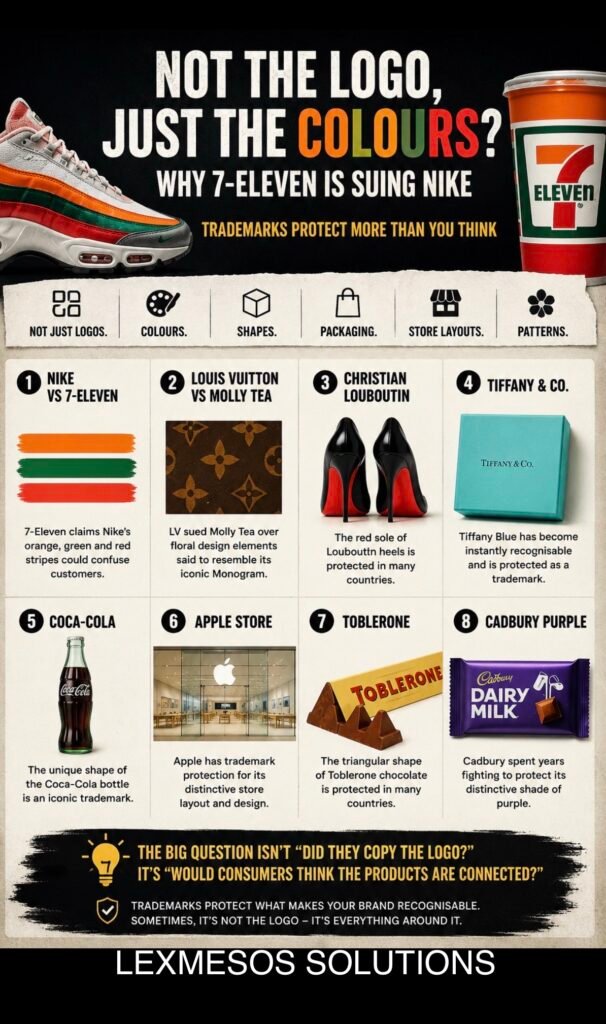
The latest example is the lawsuit between 7-Eleven and Nike, where the dispute isn’t about copying a logo, but whether the overall use of orange, green and red stripes could cause consumers to believe there is a connection between the two brands.
Let’s take a look at how trademark law protects far more than most people realise.
The Latest Case: Nike vs 7-Eleven
One of the latest trademark disputes involves Nike and 7-Eleven (Reuters).
Surprisingly, 7-Eleven is not accusing Nike of copying its logo.
Instead, the dispute centres on Nike’s upcoming Air Max 95, which features an orange, green and red stripe design.
According to 7-Eleven, the colour combination and overall appearance are so closely associated with its brand that consumers may believe the shoes are connected with or endorsed by 7-Eleven.
Whether the court ultimately agrees remains to be seen.
However, the case raises an interesting question:
Can colours really become intellectual property?
The answer is yes, but not automatically.
It’s Not Always About the Logo
Modern trademark law protects much more than words and logos.
In the right circumstances, protection may also extend to colours, shapes, packaging, patterns and even the overall appearance of a product or business.
The key question is often not:
“Did someone copy the logo?”
Instead, courts frequently ask:
“Would consumers believe these products or services come from the same business, or are commercially connected?”
That principle explains why so many unusual trademark disputes exist around the world.
Famous Examples You May Not Know
👠 Christian Louboutin’s Red Sole
Can someone own the colour red?
Not every shade of red.
However, Christian Louboutin has successfully protected the distinctive red sole on luxury high heels in a number of jurisdictions because consumers associate that feature with the brand.
The protection is tied to the specific use and context, rather than the colour red in every situation.
📦 Tiffany Blue
Many people recognise a Tiffany gift box before they even see the jewellery inside.
Over decades, Tiffany Blue has become one of the world’s most recognisable luxury brand colours.
This shows that colours themselves can become powerful brand identifiers when consumers immediately associate them with a particular business.
🌸 Louis Vuitton vs Molly Tea
Another recent dispute comes from China.
Louis Vuitton brought legal action against Molly Tea over floral design elements that LV says resemble protected features of its famous Monogram collection.
Again, the issue is not simply that both designs contain flowers.
The legal question is whether the protected design elements are distinctive enough that consumers could mistakenly believe there is a connection between the two brands.
🏪 Apple Store Layout
Can an entire shop become intellectual property?
In some jurisdictions, yes.
Apple has obtained protection for aspects of its distinctive retail store layout because the design itself has become closely associated with the Apple brand.
Sometimes, customers recognise the store before they even see the Apple logo.
🥤 Coca-Cola Bottle
Even without the famous red label, many people can identify a Coca-Cola bottle simply from its shape.
The contour bottle has become one of the world’s most recognisable product designs and demonstrates that product shapes can also function as valuable intellectual property.
🟣 Cadbury Purple
Can a single colour become a trademark?
Sometimes.
Cadbury has spent years seeking trademark protection for its distinctive shade of purple used on chocolate packaging. The litigation has produced different outcomes over the years, showing that registering a colour as a trademark can be more complex than registering a logo.
The case demonstrates that, in certain circumstances, a colour itself can function as a brand identifier.
What About Black-and-White Trademark Registrations?
Many businesses choose to register their logos in black and white because, in many jurisdictions, this can provide broader protection regardless of colour.
However, where a specific colour or colour combination has become an important part of a brand’s identity, businesses may also seek protection for those colours themselves.
That is why colours can sometimes become just as valuable as logos.
The Business Lesson
Many businesses spend thousands designing a logo.
But they often overlook other valuable brand assets.
Sometimes customers remember:
- the colour,
- the packaging,
- the shape,
- the pattern, or
- even the layout of a shop,
long before they remember the logo.
These elements may become valuable intellectual property if they are distinctive and recognised by consumers.
Final Thoughts
The next time you read about a trademark dispute, don’t just look for a copied logo.
Look at the colours.
Look at the packaging.
Look at the product shape.
Look at the overall appearance.
Sometimes, that’s where the real intellectual property lies.
Is Your Brand Really Protected?
Many businesses register a logo but overlook other valuable brand assets such as colours, packaging, product designs and trade dress.
If you’re building a brand, it’s worth understanding what can and cannot be protected.
Keywords: Explore whether colours can be trademarked, how trade dress and non-traditional trademarks work, and what businesses can learn from the Nike vs 7-Eleven, Louis Vuitton vs Molly Tea, Christian Louboutin, Tiffany, Apple and Coca-Cola intellectual property cases
Disclaimer: This article is for general information only and does not constitute legal advice. Trademark protection varies between jurisdictions. Whether colours, shapes, packaging, layouts or other non-traditional elements are protected depends on the applicable law, the registration, the evidence of distinctiveness and the specific facts of each case.
4 July 2026