 Skip to content

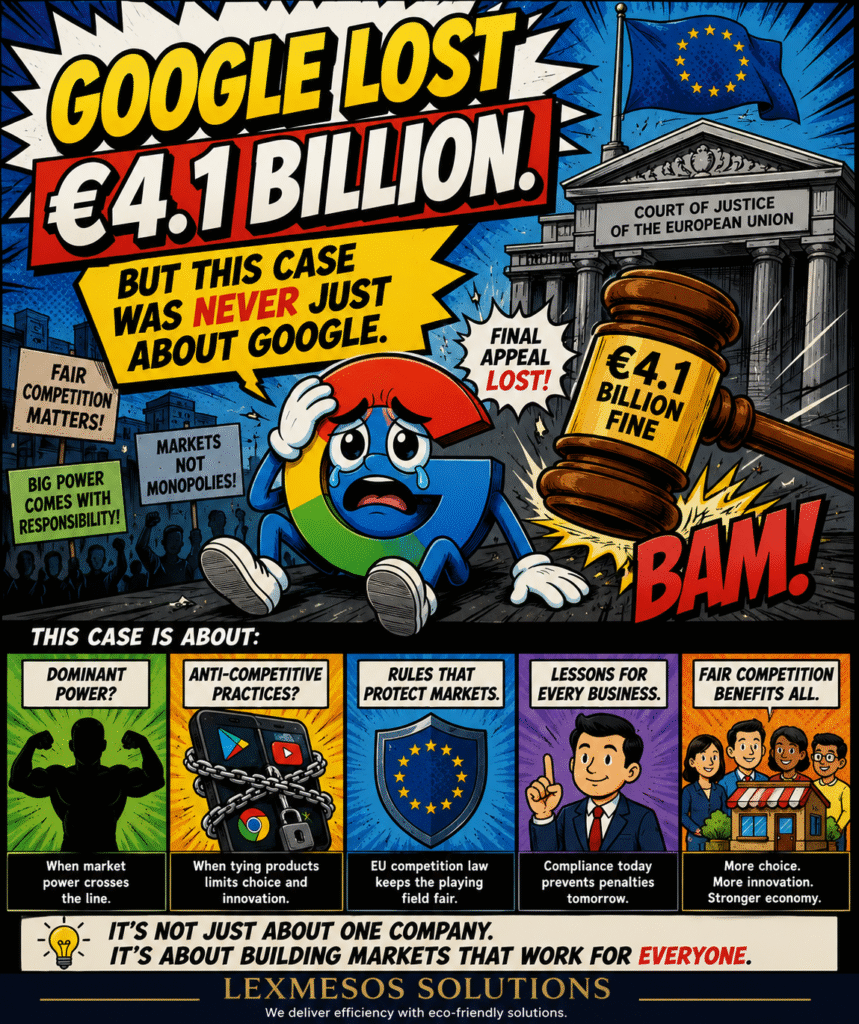
When headlines announced that Google had lost its final appeal against a €4.1 billion fine, many people asked the same question:
“How can Europe fine a successful company simply for being successful?”
The answer is simple.
It can’t.
Competition law does not punish companies for being successful.
It intervenes when a company abuses a dominant market position in a way that restricts competition and limits consumer choice.
What happened?
The case dates back to 2018, when the European Commission concluded that Google had used agreements with Android device manufacturers to require the pre-installation of Google Search, Google Chrome and the Google Play Store on Android devices. The Commission also found restrictions that made it harder for manufacturers to use alternative Android versions.
Google appealed.
In 2022, the fine was reduced from €4.34 billion to €4.1 billion.
Was Google punished for innovation?
No.
Google argued that Android created more choice, not less, because it is an open platform used by many manufacturers.
The EU court, however, upheld the finding that Google’s contractual practices gave its own services an unfair advantage and restricted competition.
That distinction matters.
The issue was not Android itself.
The issue was how market power was used.
Competition law is not about protecting competitors
This is perhaps the biggest misconception.
Competition law does not exist to protect weaker competitors simply because they are smaller.
Its purpose is to protect competition itself.
Healthy competition encourages:
- Innovation
- Consumer choice
- Fair opportunities for businesses
- Better prices
- Better products
When one dominant company uses its position to make it significantly harder for rivals to compete, regulators may intervene.
Why should ordinary businesses care?
Many SMEs assume competition law only affects global technology companies.
Not necessarily.
The underlying principle applies across many industries.
Businesses should compete by offering:
- Better products
- Better services
- Better innovation
not by using market power to unfairly exclude competitors.
The Google decision reminds us that being a market leader is not unlawful.
But how that market power is exercised can have legal consequences.
Final Thoughts
The €4.1 billion figure may grab headlines.
The legal principle behind it is even more important.
Competition law does not punish success.
It seeks to ensure that success is achieved through fair competition rather than practices that undermine consumer choice and the competitive process.
That principle extends far beyond Google.
It is relevant to every business operating in today’s digital economy.
Fair Competition Starts with Legal Awareness
Competition law is no longer relevant only to multinational technology companies. As businesses grow, understanding competition law, compliance and commercial legal risks becomes increasingly important.
Whether you’re a startup, SME or established business, taking proactive legal and compliance steps today can help reduce costly disputes tomorrow.
Keywords: This article discusses Google’s €4.1 billion EU competition law case, abuse of dominant position, Android antitrust ruling, CJEU judgment, EU antitrust law, digital markets, market dominance, competition law, business compliance and corporate legal risk
Disclaimer: This article is for general informational purposes only and does not constitute legal advice. Competition law assessments depend on the facts of each case, the applicable legal framework and the relevant jurisdiction.
6 July 2026