 Skip to content

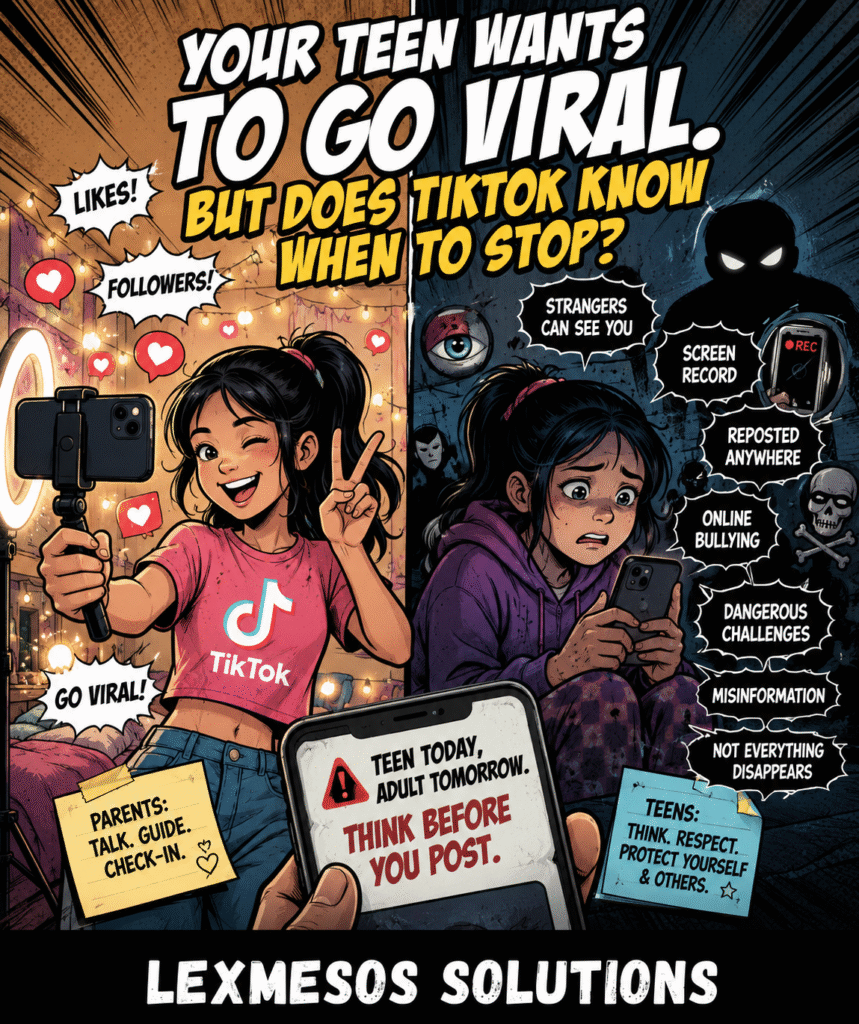
A teenager stands in front of a phone.
One dance.
One trend.
One video.
Post.
Then comes the waiting.
How many views?
How many likes?
Did anyone share it?
Did it make the For You Feed?
For many teenagers, TikTok is no longer simply an app they occasionally open. Social media has become part of how young people communicate, entertain themselves, follow trends and present their lives to everyone else.
And sometimes, the goal is simple:
Go viral.
But on 24 July 2026, the European Commission raised a much more uncomfortable question.
When the person chasing those views is still a child, how far should a platform allow that visibility to go?
Yet the regulatory question goes far beyond privacy settings.
It goes to the heart of modern teenage culture:
What happens when children grow up believing that almost every part of their lives can become content?
Your 16-Year-Old Can Have a Public Audience
TikTok already provides a number of protections for teenage users.
But there is an important difference between private by default and remaining private.
A 16- or 17-year-old can change their account to public.
That is precisely where the European Commission has intervened.
The Commission says minors can currently choose public accounts, and content posted by 16- and 17-year-olds with such settings can be recommended to other TikTok users through the For You Feed.
That sounds like a technical dispute about privacy settings.
It isn’t.
It raises a much bigger question:
Does a 16-year-old wanting attention mean a platform should give them potentially unlimited attention?
Everyone Wants to Go Viral Until Going Viral Goes Wrong
Teenagers do not necessarily need to be tricked into making themselves public.
Some actively want it.
The dream of becoming an influencer or simply getting one viral video can make visibility itself feel like success.
So they dance.
They lip-sync.
They copy trends.
They film what they eat.
They post their outfits.
They talk about friendships and relationships.
They document ordinary moments of their daily lives.
There is nothing inherently wrong with teenagers being creative or having fun online.
The problem begins when the boundary between private life and public content starts disappearing.
A teenager may understand that their friends will see a video.
Do they fully appreciate what it means when thousands, potentially far more of complete strangers can see it?
Or when someone screen-records it?
Downloads it?
Reposts it somewhere else?
Turns it into a meme?
Uses it years later?
Deleting the original video does not necessarily delete every copy of it.
And Then the Camera Goes to School
This is where the issue stops affecting only the teenager holding the phone.
Students increasingly live in a world where practically anything can become content.
That includes school.
A funny moment with a teacher.
Something that happened during class.
A classmate sleeping at a desk.
An argument.
A school event.
A teacher saying something that sounds funny when reduced to a ten-second clip.
The student filming may be perfectly happy to appear on TikTok.
But there is another question:
Did everyone else in the video agree to become content too?
A classmate may not want their face uploaded publicly.
Another parent may not want their child appearing on a stranger’s TikTok account.
A teacher may not want an interaction from a classroom extracted from its context and presented to thousands of people online.
School uniforms, classroom interiors, names and other details can potentially reveal far more than the teenager intended.
This is where digital literacy has to mean more than:
“Don’t tell strangers your password.”
Young people also need to understand privacy, consent, permanence and the rights of other people caught by their cameras.
When “Everyone Is Doing It” Becomes Dangerous
Most TikTok trends are harmless.
But social-media culture has also demonstrated how quickly imitation can cross into risky behaviour.
A teenager watches someone attempt something.
Then someone else copies it.
Another person films themselves doing it.
Views increase.
The behaviour starts looking normal because everyone seems to be doing it.
There have already been tragic cases associated with dangerous viral challenges.
The point is not that TikTok invented teenage risk-taking.
Teenagers took risks long before smartphones existed.
The difference is scale.
A foolish idea that once might have circulated among five friends can now potentially be recorded, imitated, recommended and distributed to enormous audiences.
And the incentive structure is different.
There is now an audience watching.
There are views to collect.
There are comments waiting.
There is the possibility that doing something more extreme will attract even more attention.
That changes the equation.
Misinformation Can Look Exactly Like Advice
There is another problem.
On TikTok, expertise and confidence can look remarkably similar.
Someone can stand in front of a camera and confidently explain:
“This food is bad for you.”
“This product will fix your skin.”
“Drink this.”
“Don’t eat that.”
“This is what doctors aren’t telling you.”
“This is how you lose weight.”
“This is what happened at my school.”
“This person did this.”
The speaker may be qualified.
Or they may simply own a smartphone.
For adults, distinguishing anecdote, advertising, satire, misinformation and reliable information can already be difficult.
For young teenagers, repetition creates another problem.
When the same claim appears twenty times in a feed, popularity can start looking like evidence.
That is why dangerous misinformation is not merely a content-moderation problem.
It is also an algorithm problem.
Who decided that the teenager should see the next video?
And the next?
And the next?
TikTok Is Already Facing Another EU Investigation Over Addictive Design
The July development is not happening in isolation.
In February 2026, the European Commission separately preliminarily found TikTok’s addictive design in breach of the DSA.
The Commission specifically identified features including infinite scroll, autoplay, push notifications and highly personalised recommendations.
Put the two EU cases together and an interesting regulatory picture emerges.
In February, Europe asked:
What is TikTok’s design doing to the person watching?
In July, Europe effectively asked:
What happens when the person being watched is a child?
Those questions are connected.
A platform built around attention does not merely decide what you see.
Its recommender system can also influence who sees you.
The For You Feed Changes Everything
Traditional social media was relatively easy to understand.
You had friends or followers.
You posted something.
They saw it.
Algorithmic platforms changed that relationship.
A teenager with a relatively small number of followers can potentially post something that travels far beyond their immediate social circle.
That possibility is precisely what makes TikTok exciting.
It is also what makes child safety complicated.
If going viral is the dream, telling teenagers simply to “be careful what you post” places an enormous amount of responsibility on the person least equipped to understand the long-term consequences.
The EU’s approach increasingly reflects a different philosophy:
Safety should be built into the platform itself.
The DSA includes enhanced protections for minors, including restrictions around targeted advertising and requirements aimed at reducing risks to children.
That represents an important change in thinking.
Instead of only asking:
“Where were the parents?”
Regulators are increasingly asking:
“How was the platform designed?”
But Parents Cannot Disappear From the Conversation Either
Platform responsibility does not mean parental responsibility disappears.
Parents cannot outsource the entire upbringing of a child to regulation.
Knowing that your teenager has TikTok is different from understanding how they use TikTok.
Are they watching?
Posting?
Livestreaming?
Talking to strangers?
Filming their school?
Sharing their location?
Trying to become an influencer?
Following health advice?
Copying challenges?
How many hours are they spending scrolling?
But technology cannot replace conversations about judgement.
A teenager eventually needs to understand why something should not be posted, not simply discover that a parent has disabled a setting.
And We Should Not Pretend Social Media Is Entirely Bad
There is another side that deserves acknowledgement.
Young people use social media to communicate, learn, create, find communities and discover interests.
Not every teenager using TikTok is addicted.
Not every viral trend is dangerous.
Not every public video produces harm.
And banning everything associated with risk can create different problems.
The broader evidence on youth social media reflects this complexity. The US Surgeon General’s advisory notes both potential benefits and meaningful risks, while reporting that social-media use among young people is extremely widespread.
So the policy challenge should not be reduced to:
TikTok good versus TikTok bad.
The more useful question is:
What level of risk should society accept when the product is being used by children?
Malaysia Has Chosen an Even Tougher Route
And this is where the story becomes particularly interesting for Malaysia.
While Europe is debating how TikTok should configure accounts belonging to minors, Malaysia has gone considerably further for younger children.
The headline rule is significant:
Children under 16 are not permitted to open and hold their own social-media accounts.
That puts Malaysia and the EU on somewhat different paths.
Malaysia is asking: should younger children be on these platforms at all?
The EU is also asking: where minors are on a platform, how should the platform be designed around them?
Neither question makes the other irrelevant.
Because turning 16 does not suddenly give someone adult judgement.
A Malaysian Teen Turns 16. Then What?
This may ultimately become the more important question for Malaysia.
Suppose the under-16 restriction works exactly as intended.
A child cannot have their own TikTok account at 14.
Cannot have one at 15.
Then comes their sixteenth birthday.
Now what?
They are still a minor.
They may still be susceptible to peer pressure.
They may still desperately want to become famous.
They may still post their school life.
They may still film classmates.
They may still believe something because thousands of people liked it.
They may still underestimate what it means for strangers to save their videos.
So an age threshold solves one part of the problem.
It does not solve the entire problem.
The Real Question Is Not Whether Teenagers Will Make Mistakes
They will.
Every generation of teenagers has made mistakes.
The difference is that previous generations did not necessarily make those mistakes in front of a camera connected to millions of strangers.
A foolish moment once disappeared.
Today it can become searchable.
Shareable.
Downloadable.
Repostable.
Algorithmically recommended.
And potentially permanent.
That is why child online safety cannot rest entirely on telling teenagers:
“You should have known better.”
Parents have responsibilities.
Schools have responsibilities.
Teenagers need digital literacy and accountability.
But platforms that design recommendation systems, optimise engagement and determine how widely content travels have responsibilities too.
The European Commission’s latest action against TikTok is therefore about much more than whether a 16-year-old should be allowed to click “Public.”
It asks a question every social-media platform will increasingly have to answer:
When your technology can make a child visible to the world, how much responsibility do you have for deciding when the world should not be allowed to watch?
And perhaps parents need to ask their teenagers another question before the next video goes online:
You want everyone to see this today. But are you sure you will still want everyone to see it ten years from now?
Keywords: TikTok minors, TikTok child safety, TikTok teenagers, TikTok teen safety, TikTok viral trends, TikTok dangerous challenges, TikTok misinformation, TikTok school videos, children social media privacy, teenage influencers, teenagers going viral, TikTok For You Feed, TikTok public accounts, TikTok algorithm, TikTok addictive design, social media addiction teenagers, social media child protection, online safety children, Digital Services Act, DSA TikTok, European Commission TikTok, EU child online safety, TikTok DSA investigation, Malaysia social media under 16, Malaysia social media age verification, Online Safety Act 2025 Malaysia, Child Protection Code Malaysia, MCMC social media, digital literacy teenagers, children’s privacy online, platform responsibility, parental responsibility, school privacy social media, social media misinformation, child safety by design
Disclaimer: This article is provided for general informational, educational and public-interest discussion only and does not constitute legal, medical or mental-health advice. References to regulatory investigations and preliminary findings should not be interpreted as final findings of legal liability. Individual incidents involving online challenges may involve multiple circumstances and should not be interpreted as establishing that a particular platform caused an individual’s injury or death.
27 July 2026