 Skip to content

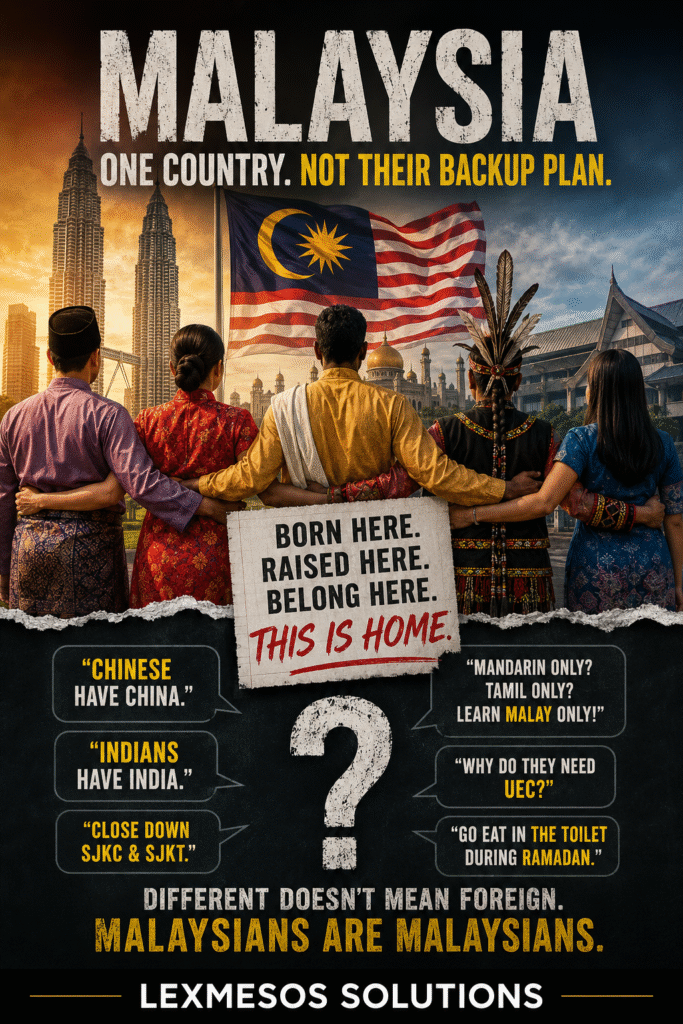
Malaysia has a race problem. Pretending otherwise will not make it disappear.
For decades, Malaysians have been told that racial harmony is one of the country’s greatest strengths.
And in many ways, it is.
Malay, Chinese, Indian, Sabahan, Sarawakian, Orang Asli and Malaysia’s many Indigenous communities live together, work together, study together and build businesses together. Mosques, temples and churches can stand within kilometres of one another. Malaysians grow up surrounded by different languages, food and traditions.
Yet every few years, sometimes every few months, the same uncomfortable question returns:
Who is considered truly Malaysian?
The remarks have triggered political criticism and a police investigation. Critics say rhetoric of this kind risks inflaming racial divisions; Sanusi has reportedly defended his remarks as historical rather than intended to provoke racial hostility.
An investigation, of course, is not a conviction.
But the controversy raises a question far bigger than whether one politician ultimately broke a law.
If Malaysian Chinese “have China” and Malaysian Indians “have India”, where exactly are Malaysian Chinese and Malaysian Indians supposed to call home?
For millions of them, the answer is obvious.
Malaysia.
A Malaysian Citizen Should Not Need Another Country
A Malaysian Chinese person may have never lived in China.
A Malaysian Indian person may have never lived in India.
Their parents may have been born in Malaysia. Their grandparents may have been born here too.
They hold Malaysian citizenship. They went to Malaysian schools. They work in Malaysia. They pay Malaysian taxes. Their children are Malaysian.
China is not automatically a Malaysian Chinese citizen’s country simply because that person is ethnically Chinese.
India is not automatically a Malaysian Indian citizen’s country simply because that person is ethnically Indian.
Just as ethnicity should not determine whether someone belongs to Malaysia.
That distinction sounds obvious.
The fact that Malaysia still has to debate it is precisely why the latest controversy matters.
This Debate Did Not Begin With Sanusi
It would be easy to turn this into an article about one PAS politician.
That would miss the larger problem.
Questions about race, religion, language and belonging have surfaced repeatedly across Malaysian public life.
Sometimes they appear in elections.
Sometimes they appear in education.
Sometimes they appear in employment.
Sometimes they involve something as ordinary as where a child is allowed to eat lunch.
Remember the Ramadan school controversies?
She specifically said she did not want non-Muslim children eating in storerooms or other inappropriate places when schools already had canteens.
Think about what that means.
A government minister had to clarify that children who are not fasting should be able to eat in an appropriate place at school.
There is nothing wrong with Muslim pupils observing Ramadan.
There is also nothing wrong with a non-Muslim child eating lunch.
Respect must work in both directions.
A Muslim child’s religious observance should be respected. But respecting that observance should not require another child to behave as though eating food is something shameful that must be hidden.
Tolerance cannot mean that only the minority must accommodate the majority.
Then There Is the Fight Over Chinese and Tamil Schools
Malaysia has argued about vernacular education for decades.
Calls to abolish SJKC (Chinese language primary schools) and SJKT (Tamil language primary schools) periodically return to public discussion, often accompanied by arguments about national unity and the role of Bahasa Melayu.
But there is an important distinction that frequently disappears from these debates:
Supporting Bahasa Melayu as Malaysia’s national language does not require eliminating Mandarin or Tamil.
These are not mutually exclusive propositions.
A Malaysian child can speak Bahasa Melayu fluently and also learn Mandarin.
Another can speak Bahasa Melayu and Tamil.
Another may speak Malay, English, Mandarin and Japanese.
Multilingualism does not cancel citizenship.
And disagreements over vernacular education have gone far beyond social-media arguments. Legal challenges were brought against the constitutionality of Chinese and Tamil vernacular schools. The Court of Appeal upheld their constitutionality, and in 2024 the Federal Court refused leave for a further appeal, effectively leaving that judgment standing.
So people are entitled to debate education policy.
But saying “I think Malaysia should have a different education system” is not the same as saying that Chinese or Tamil language and culture somehow make someone less Malaysian.
Chinese Language Schools Are Not Only for Chinese Pupils
Chinese national-type primary schools (SJKC) are not attended exclusively by Chinese Malaysians.
And the broader non-Chinese presence is even larger. Research by Singapore’s ISEAS–Yusof Ishak Institute noted that non-Chinese pupils had grown to approximately 20% of SJKC enrolment by 2020, with Malay pupils driving much of that increase.
Education Ministry figures reported in 2024 similarly showed that Bumiputera pupils accounted for 18.52% of Chinese primary-school enrolment, almost double the 9.5% recorded in 2010. Some individual Chinese schools have even developed overwhelmingly Malay student populations.
So the stereotype that an SJKC is simply a school “for Chinese people” does not reflect the reality on the ground.
Malay, Indian and other Malaysian families also choose Chinese language education. An academic study of Malay pupils attending Chinese primary schools found that parents’ expectations concerning their children’s learning and academic outcomes were a major reason for choosing those schools.
That raises an obvious question:
If Malay, Indian and other Malaysian children can study alongside Chinese children in an SJKC, why should Chinese language education automatically be portrayed as something that divides Malaysians?
Learning Mandarin does not make a Malay child Chinese.
Learning Tamil does not make someone Indian.
And learning Bahasa Melayu does not require Malaysians to abandon every other language they know.
In fact, Malaysia’s multilingual education system can potentially produce something extremely valuable: Malaysians who can communicate across communities and across borders.
The more meaningful questions should be whether these schools provide children with a good education, encourage interaction across communities and ensure adequate proficiency in Malaysia’s national language, not whether the language used for instruction originated from one particular ethnic community.
What About the UEC?
The Unified Examination Certificate (Unified Examination Certificate for Chinese independent secondary schools) has similarly become more than an educational-policy question.
Its recognition has repeatedly generated political controversy.
There are legitimate questions governments can ask about educational standards, Bahasa Melayu proficiency, curriculum requirements and admission criteria.
Those questions can be debated.
But the debate becomes something else when it shifts from:
“What standards should Malaysia require?”
to:
“Why do these people need Chinese education at all?”
The first is public policy.
The second raises a deeper question about whether integration is being confused with assimilation.
“Everyone Should Learn Malay”- Yes. But Why “Malay Only”?
Bahasa Melayu is Malaysia’s national language.
Expecting Malaysian citizens to have reasonable proficiency in the national language is therefore hardly controversial.
But there is a huge difference between:
You should learn Bahasa Melayu.
and:
You should only learn Bahasa Melayu.
Why shouldn’t a Malaysian learn Mandarin?
Why shouldn’t another learn Tamil?
Or Japanese?
German?
Arabic?
Korean?
French?
English?
In an increasingly global economy, multilingualism is usually treated as an advantage.
Yet language in Malaysia can suddenly become controversial when it intersects with ethnicity.
That contradiction becomes particularly obvious in employment.
“Mandarin Speaker Required”- Racism or a Genuine Job Requirement?
Job advertisements asking for Mandarin speakers regularly generate accusations of racial discrimination.
But this also requires nuance.
Imagine a Malaysian or foreign company needs an employee to negotiate daily with Mandarin-speaking customers, communicate with suppliers in China or review Chinese-language documents.
Requiring Mandarin may make perfect commercial sense.
The applicant does not necessarily have to be Chinese.
A Malay applicant who speaks Mandarin can possess the skill.
An Indian applicant who speaks Mandarin can possess it too.
Likewise, a Malaysian company dealing extensively with Japan might legitimately seek a Japanese speaker.
Nobody should automatically conclude:
“Japanese speaker required= Japanese race only.”
The real question should therefore be:
Does the job genuinely require the language?
If yes, language proficiency can be a professional skill.
If an employer says “Mandarin required” when Mandarin has virtually nothing to do with the job and actually means “we want Chinese employees”, that raises a very different discrimination issue.
The principle should be simple:
Hire for the language the job genuinely requires- not the race the employer prefers.
But Should Foreign Clients Be Expected to Speak English?
Another argument frequently appears whenever Malaysian employers advertise for Mandarin-speaking employees:
“If companies from China want to do business in Malaysia, why can’t their clients communicate in English and let Malaysian companies hire locals without a Mandarin requirement?”
At first glance, the argument may sound reasonable. Malaysia should certainly protect employment opportunities for Malaysians, and employers should not disguise racial preferences as language requirements.
But international business rarely works on the assumption that the customer must adapt to the seller.
A Malaysian company doing business with clients in China may need employees who can negotiate, explain technical issues, understand documents or build relationships in Mandarin. The same applies when dealing with markets where Japanese, Korean, Arabic, German or other languages are commercially important.
And importantly, “Mandarin-speaking” does not mean “Chinese only.”
A Malay, Indian, Sabahan, Sarawakian or any other Malaysian who speaks Mandarin could potentially fulfil that language requirement.
Telling a Chinese client that they should simply speak English because they want to do business with Malaysia also overlooks commercial reality. English is widely used internationally, but it is not the mother tongue of every businessperson in the world.
Malaysia itself benefits from being multilingual.
The better question is therefore not:
“Why can’t the Chinese client speak English?”
It is:
“Is Mandarin genuinely necessary to perform this particular job?”
If the answer is yes, requiring the language can be commercially understandable.
If the answer is no, and “Mandarin speaker” is merely a convenient way of saying “Chinese applicants preferred,” then concerns about racial discrimination become much harder to dismiss.
Protecting local employment and recognising genuine language requirements are not contradictory. Malaysia can do both.
Bahasa Melayu Does Not Need Mandarin or Tamil to Disappear
Malaysia can protect the status of Bahasa Melayu without treating other languages as threats.
These things can coexist.
A strong national language does not require weak mother tongues.
National unity does not require everyone to have the same culture.
And integration does not have to mean assimilation.
This distinction matters because Malaysia’s diversity is not some temporary demographic situation waiting to disappear.
It is Malaysia.
“Cina babi”= “Chinese pig” did not appear yesterday
Malaysia has previously witnessed the racial slur “Cina babi” directed at Chinese Malaysians in politically charged environments. During the 2015 Red Shirts rally, a Chinese journalist was subjected to the insult, prompting widespread condemnation. The controversy became even more disturbing when a political figure subsequently argued that Chinese people should not be offended because they eat pork.
More than a decade later, Malaysia is again debating political rhetoric about whether Chinese and Indian Malaysians truly belong.
Different words.
Same dangerous question:
when does political rhetoric stop debating policy and start reducing Malaysian citizens to their race?
When Does Political Speech Become a 3R Issue?
Malaysia commonly uses the shorthand 3R- race, religion and royalty, for particularly sensitive public discourse.
But the existence of sensitive subjects cannot mean nobody is allowed to discuss race.
Quite the opposite.
If Malaysia has racial problems, Malaysians need to be able to discuss them.
The difficult legal and democratic question is where criticism, historical discussion and political opinion end, and where speech capable of promoting hostility or racial division begins.
That distinction matters particularly during elections.
Political speech is supposed to persuade voters.
But politicians also possess enormous platforms. A statement repeated at a political rally can be clipped, uploaded, shared and amplified to millions of people within hours.
The consequences therefore extend well beyond the audience standing in front of the stage.
That is why a police report itself should never be treated as proof that somebody committed an offence.
Investigation is not guilt.
Equally, “political speech” should not automatically provide immunity from scrutiny.
The Bigger Problem: Who Gets to Be Malaysian Without Explanation?
Perhaps this is the question Malaysia should be discussing.
A Malay Malaysian should not have to apologise for being Malay.
A Chinese Malaysian should not have to apologise for being Chinese.
An Indian Malaysian should not have to apologise for being Indian.
A Muslim Malaysian should be able to practise Islam.
A Buddhist, Christian, Hindu, Sikh or other Malaysian should be able to maintain their own beliefs and traditions within the law.
Someone speaking Mandarin at home does not make Bahasa Melayu less important.
Someone attending an SJKC does not automatically reject Malaysia.
Someone speaking Tamil does not make India their country.
And someone requiring Mandarin for a genuinely Mandarin-facing job does not automatically make the vacancy racist.
Malaysia becomes stronger when citizenship is strong enough to contain difference, not when difference has to disappear before citizenship is accepted.
Criticising Racial Politics Is Not Criticising Malays
This distinction is essential.
It would itself be racial stereotyping to take the actions or views of individual politicians, activists or social-media users and conclude:
“Malays are racist.”
Millions of Malay Malaysians do not necessarily share those views.
Likewise, Chinese, Indian and other communities contain prejudices of their own.
Racism is not genetically attached to one ethnicity.
The legitimate criticism is directed at racial exclusion, discriminatory conduct and political narratives that divide citizens according to ancestry.
Malaysia cannot solve racial politics by creating another racial stereotype.
Article 153: Special Position Does Not Mean Others Have No Position
Malaysia is not constitutionally race-blind. Article 153 of the Federal Constitution of Malaysia expressly recognises the special position of Malays and the natives of Sabah and Sarawak. Various Bumiputera policies have also created preferential opportunities in particular areas of Malaysian economic and social life.
That reality makes another question worth asking.
Why should protecting the special position of one group require another Malaysian to surrender their language, school, culture or sense of belonging?
These concepts are not mutually exclusive.
Protecting Bumiputera interests does not require telling Malaysian Chinese that they “have China”. Protecting Malay culture does not require treating Mandarin as foreign to Malaysian society. Protecting Bahasa Melayu does not require Tamil to disappear.
And perhaps most importantly, a constitutionally recognised special position is not a constitutional declaration that everybody else is merely a guest.
Malaysian Chinese and Malaysian Indians are citizens, not visitors waiting to return somewhere else.
Nearly Seven Decades After Merdeka, Why Are We Still Asking This?
Malaysia achieved independence in 1957.
Generations have been born since then.
Yet arguments about who belongs, which language should be spoken, which schools should exist and which communities are sufficiently “Malaysian” continue.
Perhaps the most troubling consequence isn’t one controversial political speech.
It is what repeated rhetoric can normalise.
Children hear it.
Young voters hear it.
Employers hear it.
Politicians discover that racial anxiety generates attention.
Social media then magnifies everything.
Eventually, Malaysians may stop being shocked by statements that once would have been extraordinary.
That is far more difficult to regulate than one speech.
Malaysia Does Not Belong to Only One Race
Malaysia’s constitutional arrangements recognise the national language, Islam’s constitutional position and specific protections concerning Malays and the natives of Sabah and Sarawak.
Those constitutional realities should not simply be erased from this discussion.
But neither should the citizenship of other Malaysians.
This does not have to be a competition where recognising one community requires denying another.
Malaysia’s challenge has always been more difficult and more ambitious:
building one country from people who do not all look alike, pray alike, speak alike or trace their ancestry to the same place.
Political leaders have a particularly heavy responsibility in that environment.
Words matter.
Context matters.
Intent matters.
And so does their effect on the people listening.
So, “Chinese Have China, Indians Have India”?
Perhaps the better question is:
What does China have to do with a Malaysian citizen who happens to be ethnically Chinese?
And what does India have to do with the citizenship of a Malaysian who happens to be ethnically Indian?
Ancestry is not citizenship.
Language is not citizenship.
Religion is not citizenship.
A Malaysian’s country is Malaysia.
The debate over Sanusi’s remarks will continue, and whether any law was actually breached is ultimately a matter for the investigation and, if proceedings follow, the legal process, not social-media conviction.
But Malaysia should not need a criminal prosecution to answer the larger question.
A country cannot spend decades celebrating multiculturalism while repeatedly making some of its citizens prove that they belong.
Perhaps the real test of Malaysian unity is not whether everyone eventually becomes the same.
It is whether Malaysians can finally accept that different does not mean foreign.
And nearly seven decades after Merdeka, there is one question Malaysia should no longer need to ask:
How many generations must someone be Malaysian before nobody tells them they have another country to go back to?
Malaysia is already their home.
Keywords: Malaysia race problem, racism in Malaysia, Malaysia 3R issues, race religion royalty Malaysia, Sanusi Chinese have China Indians have India, Muhammad Sanusi Md Nor remarks, Malaysian racial politics, political speech Malaysia, freedom of speech Malaysia, racial harmony Malaysia, Malaysian Chinese citizenship, Malaysian Indian citizenship, Malay Chinese Indian relations, multicultural Malaysia, national unity Malaysia, SJKC Malaysia, SJKT Malaysia, Chinese vernacular schools Malaysia, Tamil vernacular schools Malaysia, vernacular schools constitutional Malaysia, UEC recognition Malaysia, Bahasa Melayu national language, Mandarin language Malaysia, Tamil language Malaysia, mother tongue education Malaysia, Mandarin speaker jobs Malaysia, language requirement employment Malaysia, workplace discrimination Malaysia, racial discrimination Malaysia, Ramadan school canteens Malaysia, non-Muslim students Ramadan Malaysia, religious tolerance Malaysia, integration versus assimilation Malaysia, Malaysian identity, equal citizenship Malaysia, minorities in Malaysia, race and education Malaysia, race and employment Malaysia, racial rhetoric Malaysia, 3R political speech Malaysia, Malaysia diversity, Merdeka racial unity, Malaysian Constitution Article 152, multilingual Malaysia, language discrimination Malaysia, political responsibility Malaysia, race relations Malaysia
Disclaimer: This article is published for general informational, educational and public-interest discussion only. It does not constitute legal advice and should not be interpreted as making any finding of criminal liability, racial intent or wrongdoing against any individual or organisation mentioned. References are based on publicly available information at the time of publication. An investigation or allegation does not establish guilt. Views expressed in this article concern broader issues of race relations, equality, language, education, citizenship and public discourse in Malaysia and should not be construed as criticism of any racial, religious or other community as a whole.
26 July 2026