 Skip to content

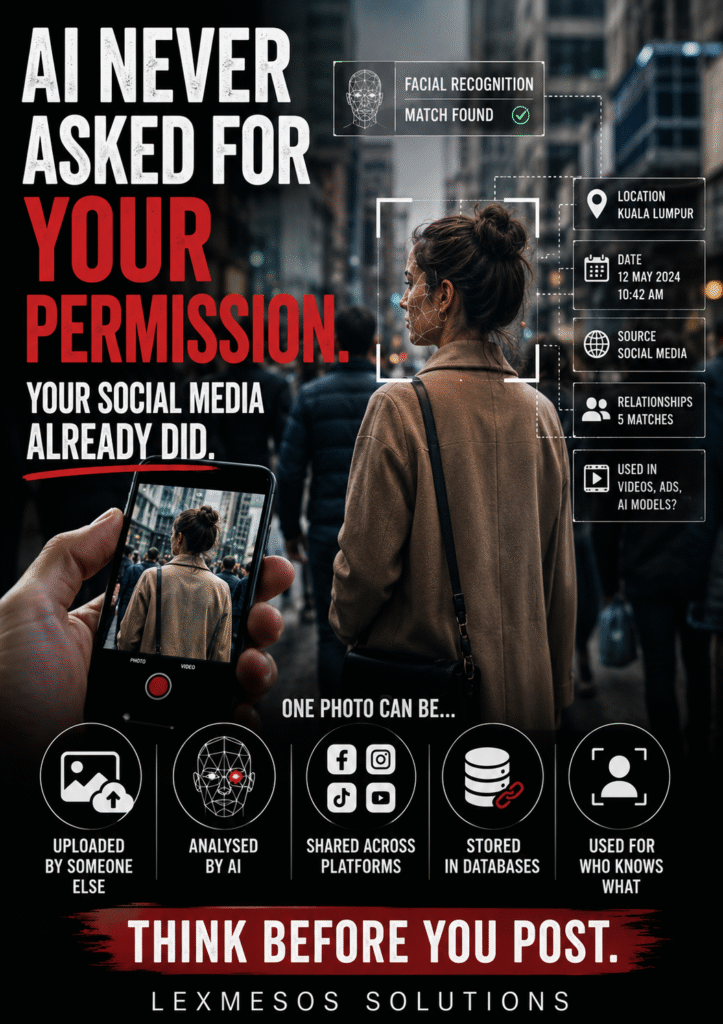
You never gave artificial intelligence (AI) permission to recognise your face.
Or did you?
Walk through a shopping mall.
Sit in a café.
Take public transport.
Attend a concert.
Someone takes a photo.
Another person records a video.
A travel vlogger uploads a reel.
A family influencer posts a holiday vlog.
A stranger appears in the background for just three seconds.
It seems harmless.
But in the age of AI, those three seconds may last forever.
“I Never Agreed.”
Many people believe privacy disappears the moment they step outside.
“If you’re in public, anyone can photograph you.”
“If you’re in public, anyone can film you.”
“If you’re in public, you have no privacy.”
But today’s question is not just simply about photography.
It is about what happens after the image is uploaded.
AI Sees More Than People Do
A human sees a photograph.
AI sees data.
Your face.
Your age.
Your gender.
Your clothing.
Your location.
The people around you.
Patterns.
Connections.
Relationships.
One photograph may reveal far more information than most people realise.
Every Upload Creates A Bigger Digital Footprint
Every photo uploaded to social media adds another piece to your digital identity.
One café.
One airport.
One holiday.
One graduation.
One shopping trip.
Individually, they may seem insignificant.
Together, they can build a surprisingly detailed picture of someone’s life.
It Is No Longer Just About Facial Recognition
AI is evolving rapidly.
Today’s technologies may be capable of:
- recognising faces;
- matching images across different platforms;
- analysing locations;
- generating realistic deepfakes;
- enhancing old photographs;
- connecting publicly available information.
Technology continues to develop and the potential uses of publicly available images continue to expand.
That is why conversations about privacy are becoming more important but not less.
Social Media Changed The Rules
20 years ago…
A photograph might stay inside a family album.
Today…
One upload can reach millions of people within hours.
The internet never forgets easily.
AI never gets tired.
Public Doesn’t Always Mean Permission
Being in a public place does not automatically answer every legal or ethical question.
Different countries approach photography, publication and commercial use differently.
More importantly…
AI does not stop to ask whether the photograph was uploaded with good intentions.
Once an image becomes publicly available, it may be copied, shared, analysed or reused in ways the original uploader never imagined.
Businesses Should Care Too
This is no longer just a personal privacy issue.
Businesses increasingly use AI-powered systems.
Employees upload content.
Marketing teams create videos.
Influencers collaborate with brands.
Organisations use facial recognition technologies.
Without appropriate governance, policies and awareness, even ordinary social media activity may create legal, ethical and reputational risks.
AI governance is no longer only for technology companies.
It is becoming a business issue for everyone.
Before You Press “Post”
Before uploading a photograph or video containing other people, ask yourself:
- Is someone clearly identifiable?
- Do they reasonably expect to appear online?
- Could this image affect their privacy?
- Could AI use this image in ways I have not considered?
- Would I be comfortable if someone uploaded the same image of me?
Sometimes, the question is not whether something is technically possible.
It is whether it is responsible.
Final Thought
People often ask:
“Can AI recognise my face?”
Perhaps the better question is:
“How did AI get my face in the first place?”
Sometimes…
The answer is surprisingly simple.
Because someone pressed “Post”.
Ready To Strengthen Your AI Governance Framework?
AI is transforming how personal information, images and digital identities are created, analysed and shared.
Understanding AI governance, privacy and responsible digital practices has never been more important.
Explore LexMesos Solutions’ AI Governance & Compliance Support and prepare your organisation for an evolving digital future.
Keywords: This article discusses artificial intelligence, AI governance, facial recognition, public photos, social media, digital privacy, digital identity, digital footprints, online privacy, responsible AI, image recognition and responsible online sharing
This article is provided for general informational purposes only and does not constitute legal advice.
30 June 2026