 Skip to content

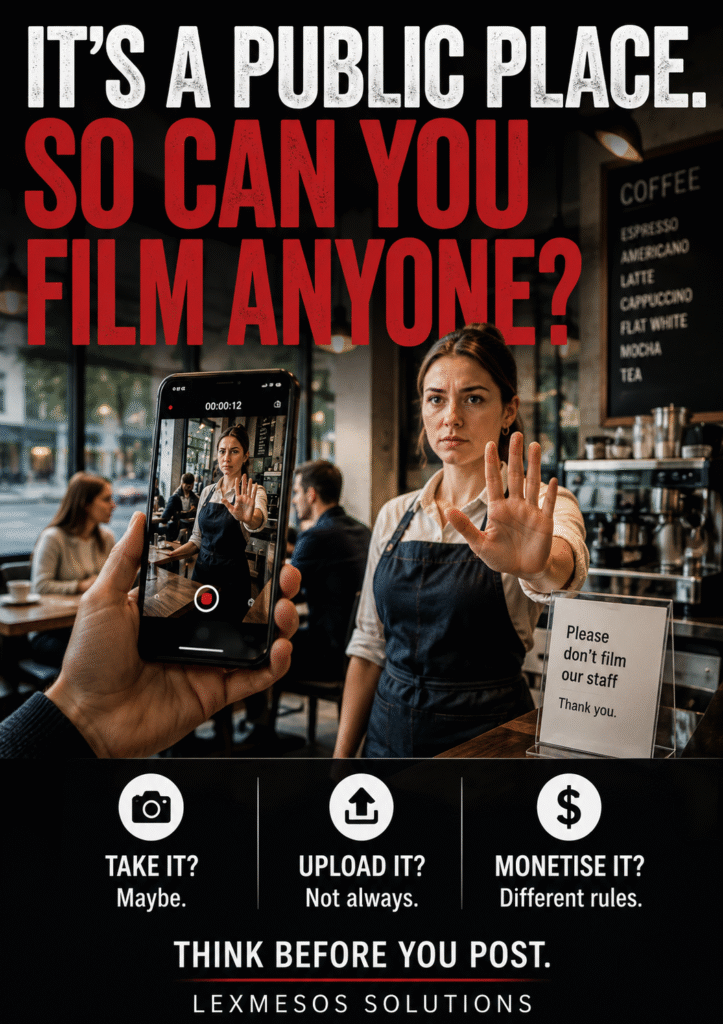
You are sitting in a café.
The coffee looks nice.
The interior looks beautiful.
So you take out your phone.
A short video.
A quick photo.
Maybe for Instagram.
Maybe for TikTok.
Maybe just for memories.
But in the background, a staff member appears.
A customer appears.
A stranger appears.
Later, the video is uploaded.
Shared.
Commented on.
Maybe even goes viral.
Then someone says:
“I never agreed to be filmed.”
So the question is simple.
If it is a public place, can you film anyone you want?
The answer is not as simple as many people think.
A Moment In Edinburgh That Made Me Think
While visiting Edinburgh, Scotland, I was at a café when I noticed something interesting.
As customers were taking photos and videos, a member of staff politely asked that employees not be photographed or filmed while they were working.
It was not a dramatic argument.
It was not a legal dispute.
It was simply a request.
But it raised an important question.
Many people assume that once they are in a café, restaurant, shop or street, they can record anything because it is a “public place”.
But is that really true?
Or are there boundaries that many people forget?
“It Is A Public Place”
This is one of the most common arguments online.
People say:
“You have no privacy in public.”
“If you are outside, anyone can film you.”
“If you don’t want to be recorded, stay home.”
But the law is usually more complicated than that.
A café, restaurant or shop may be open to the public, but it is often still a private business premises.
The street may be public, but that does not automatically mean every recording can be used however someone wants.
There are usually three different questions:
Can you take the photo?
Can you upload it?
Can you use it for commercial content?
These are not always the same question.
Malaysia: Public Place Does Not Always Mean Free Use
In Malaysia, there is no single rule saying every photo taken in public can automatically be posted online.
Depending on the circumstances, issues such as harassment, defamation, misuse of image, personal data, workplace dignity or improper online content may arise.
If a person is accidentally in the background of a travel photo, the risk may be low.
But if the person becomes the main subject of the post, especially for ridicule, criticism, commercial gain or viral content, the risk becomes higher.
The key question is not only:
“Was this taken in public?”
It is also:
“How was the person shown, and why was it posted?”
The legal position in Malaysia is still developing, and there are differing views among legal practitioners on the extent of privacy protection, particularly for photography and online publication in public spaces.
United Kingdom: Context Matters
In the UK, taking photos in public is generally not automatically unlawful.
However, context matters.
A person may still raise concerns if the recording is intrusive, harassing, misleading, defamatory, commercially exploitative or taken in a place where they reasonably expected more privacy.
A café staff member working behind a counter is not the same as a landmark building.
A stranger’s face is not the same as a cup of coffee.
That distinction matters.
Germany: Personality Rights Are Taken Seriously
Germany is known for taking personal image rights and privacy seriously.
Even where a photo is taken in public, publishing it may raise issues if an identifiable person is the main subject and there is no lawful basis or applicable exception.
This reflects a stronger legal culture around dignity, personality rights and control over one’s image.
In simple terms:
Being seen in public does not always mean agreeing to be published online.
France: Image Rights Are Strong
France also has strong protection for image rights and privacy.
The issue is often not merely whether a person was in public, but whether their image was captured and used in a way that affects their privacy, dignity or personal rights.
This is why content creators need to be careful when filming identifiable people, especially where the footage is used for social media, marketing or commercial content.
United States: Broader Public Photography, But Still Limits
The United States generally gives broader protection to photography and expression in public spaces.
However, that does not mean everything is allowed.
Commercial use, false endorsement, harassment, stalking, defamation or use of someone’s likeness for advertising may still create legal issues depending on the state and circumstances.
Again, the difference between recording and using the recording matters.
Australia And Other Countries
In Australia, the position depends on the state or territory, the location, the purpose of the recording and how the image is used.
In many countries, the same general principle appears:
Taking a casual photo may be one thing.
Uploading identifiable people for attention, ridicule, commercial promotion or monetised content may be another.
The AI Problem
Today, the problem is no longer just the camera.
Artificial intelligence (AI) has changed the risk.
A photo or video can now be:
- copied;
- downloaded;
- reposted;
- matched with facial recognition;
- edited;
- used in deepfakes;
- used to identify a person;
- stored permanently online.
A person who appeared for three seconds in the background of a video may later become part of a digital footprint they never agreed to create.
That is why this issue matters more today than it did twenty years ago.
Think Before You Upload
Not every recording is wrong.
People take photos in public every day.
Tourists film streets.
Customers photograph food.
Creators record vlogs.
The issue is not whether people should stop taking photos forever.
The issue is whether they should think before posting someone else’s face online.
Before uploading, ask:
Is this person clearly identifiable?
Are they the main subject?
Could this embarrass or harm them?
Am I using this for views, jokes or money?
Would I be comfortable if someone posted the same video of me?
Sometimes the legal answer may be uncertain.
But the ethical answer may still be clear.
Final Thought
The phrase “it is a public place” does not answer everything.
It may explain where the photo was taken.
It does not always explain whether it should be uploaded, monetised, mocked, edited or shared with thousands of strangers.
In the age of AI, perhaps the better question is no longer:
“Can I film this?”
Perhaps it is:
“Should I post this?”
Ready To Navigate The AI Era?
As AI transforms how images, videos and personal data are created, analysed and shared, understanding privacy, governance and responsible digital practices has never been more important.
Explore LexMesos Solutions’ AI Governance & Compliance Support and prepare your organisation for an evolving digital landscape.
Keywords: This article discusses public photography, filming in public, consent, privacy, image rights, social media, AI, facial recognition, digital footprint, Malaysia, United Kingdom, Germany, France, United States, Australia and responsible online sharing
This article is provided for general informational purposes only and does not constitute legal advice.
30 June2026