 Skip to content

Open Facebook.
Open Instagram.
Open TikTok.
It doesn’t take long.
Another family vlog.
Another morning routine.
Another birthday celebration.
Another holiday.
Another sponsored post.
Another smiling child.
It doesn’t matter where they live.
From Europe and the United Kingdom to North America, Australia and Asia, family influencers have become part of everyday social media.
Thousands of likes.
Hundreds of comments.
Millions of views.
Sometimes, it feels as though the children have become more famous than the parents themselves.
People know their favourite food.
Their personality.
Their daily routine.
Their favourite toys.
Some even know where they usually spend their weekends.
But one important question is rarely asked.
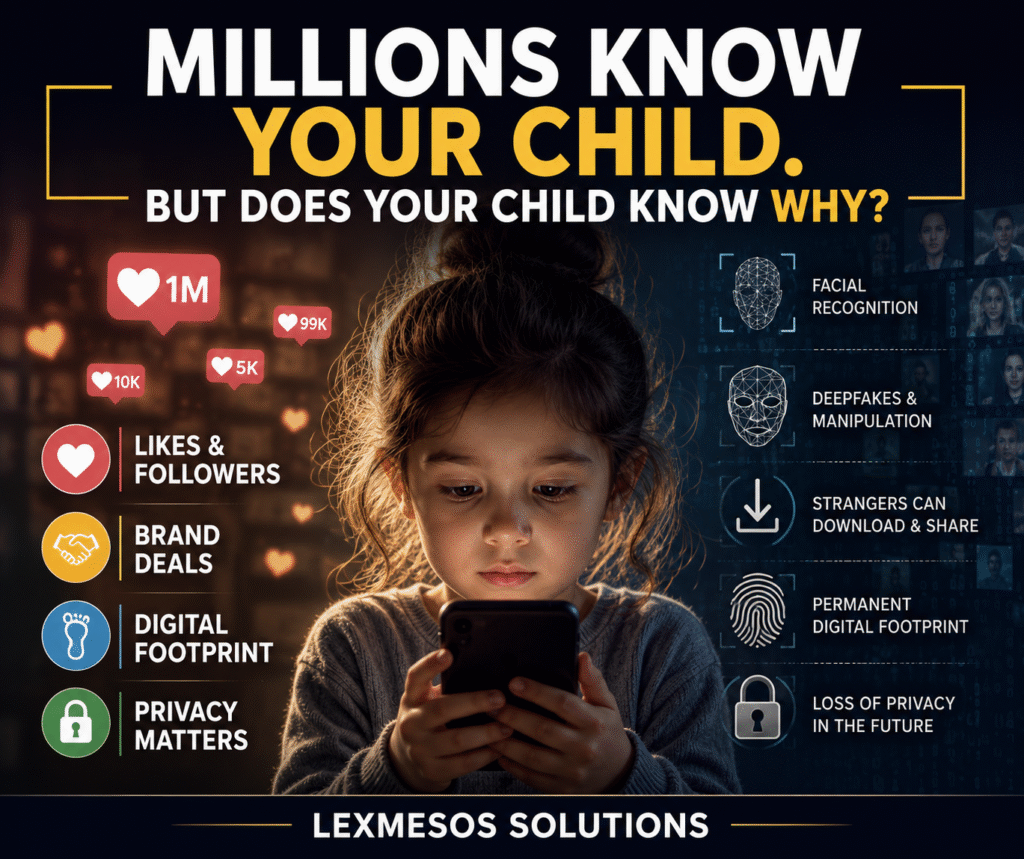
Does the child understand why millions of strangers know who they are?
Childhood Or Content?
There is nothing wrong with parents sharing family memories.
Most parents simply want to celebrate milestones and preserve happy moments.
Social media has made that easier than ever.
However, the line becomes less clear when children appear regularly in sponsored content, product reviews, lifestyle videos and commercial collaborations.
At what point does sharing family life become building an online brand around a child?
Children cannot negotiate sponsorship agreements.
They cannot understand algorithms.
They cannot appreciate artificial intelligence (AI), facial recognition or permanent digital footprints.
Yet every photograph…
Every video…
Every livestream…
Every sponsored collaboration…
May remain online long after childhood has ended.
Why Do Some Children Dream Of Becoming Influencers?
Not every child follows the same path.
But today’s children are growing up in a world very different from previous generations.
Many no longer dream only of becoming doctors, teachers or pilots.
Some dream of becoming influencers.
Why?
1. Growing Up As Part Of The Family Brand
Some children are featured in social media from birth.
Their first smile.
Their first birthday.
Their first day at school.
Their daily routines.
Their holidays.
Being in front of the camera simply becomes normal.
As audiences grow, the child gradually becomes one of the main reasons people follow the page.
2. Learning That Fame Brings Success
Children observe everything.
When they see social media bringing recognition, free products, luxury travel, invitations and income to the family, they naturally begin connecting online popularity with success.
Without anyone explicitly saying it, they may start believing:
“I want to be famous too.”
3. Learning From Social Media
Every day, children watch other children.
Children opening expensive gifts.
Children travelling the world.
Children receiving millions of views.
Children becoming internet celebrities before they even enter secondary school.
To a young child, this looks exciting.
What they rarely see are sponsorship contracts, commercial pressure, online criticism, privacy risks or the fact that nothing posted online truly disappears.
4. Growing Up In An Influencer Environment
Some children are surrounded by classmates, relatives or friends who are already creating online content.
When everyone around them appears to be filming videos, chasing views and discussing followers, becoming an influencer may start to feel completely normal.
Just as previous generations admired athletes or musicians, today’s children may admire creators they watch every day.
Europe Is Asking Different Questions
Family influencers also exist across Europe.
However, the conversation has increasingly shifted beyond popularity.
More attention is now being given to children’s privacy, image rights and long-term digital footprints.
Countries such as France have introduced legal protections relating to child influencers and monetised online content involving children (europa.eu).
Privacy experts across Europe have also encouraged parents to think carefully before sharing every moment of a child’s life online.
The discussion is no longer simply:
“Can parents post photos of their children?”
It is increasingly becoming:
“Should children become part of an online business before they are old enough to understand what that means?”
AI Makes The Conversation Even More Important
AI is changing the internet faster than ever.
Photos can be copied.
Videos can be edited.
Faces can be recognised.
Images can be manipulated.
Data can be collected.
A photograph uploaded today may be analysed by technologies that do not even exist yet.
Children cannot possibly understand these risks.
Adults must.
The Real Question Isn’t Whether Parents Love Their Children
Most parents love their children deeply.
That has never been the issue.
The real question is whether children should inherit a permanent digital identity before they are old enough to decide for themselves.
One day, today’s toddlers will become adults.
Some may be grateful that their childhood memories were shared.
Others may wonder why their entire childhood was documented for strangers before they even understood what social media was.
Perhaps every parent should ask themselves one question before pressing “Post”.
If your child turned 18 tomorrow…
Would they thank you for every photo, every video and every sponsored post you shared today?
Or would they wish they had been given the chance to decide for themselves?
Protecting Tomorrow Starts Today
Technology has transformed the way families share their lives and it has also transformed the risks.
Understanding digital privacy, AI, governance and responsible online practices is becoming increasingly important in today’s connected world.
Explore LexMesos Solutions’ AI Governance & Compliance Support and discover how better digital awareness can help individuals and organisations navigate an evolving technological landscape.
Related Reading
This article continues our discussion on children’s online privacy. If you would like to explore how a child’s digital identity is created from an early age and why it matters, read our related article:
Keywords: This article discusses child influencers, children’s digital privacy, sharenting, children’s rights, social media, parental responsibility, AI, digital identity, online safety, influencer marketing, digital footprint, GDPR and responsible parenting
This article is provided for general informational purposes only and does not constitute legal advice.
29 June 2026