 Skip to content

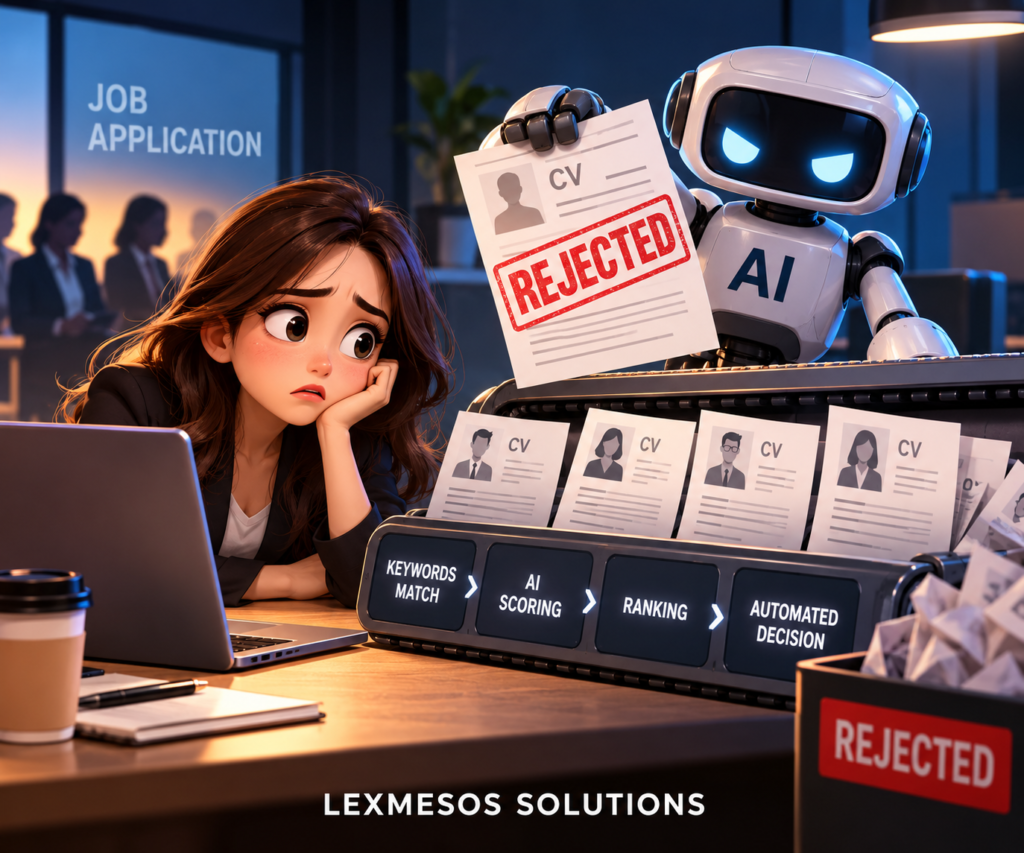
The hidden risks of AI recruitment screening and why employers cannot outsource fairness to an algorithm.
Imagine spending hours preparing your CV, tailoring your application and explaining years of professional experience.
You click Submit.
Minutes later, a rejection email arrives.
No interview. No explanation. No opportunity to demonstrate your abilities.
But here is the uncomfortable question:
Did a recruiter actually reject you or did an algorithm decide you were not worth interviewing?
Artificial intelligence is changing recruitment. Employers can use automated systems to filter applications, compare qualifications, rank candidates and identify supposedly suitable applicants.
The technology promises speed, efficiency and lower recruitment costs.
But efficiency raises a difficult question when it affects someone’s livelihood:
What happens when the system gets it wrong?
1. The invisible recruiter
Consider two applicants.
One has spent ten years managing complex contracts, negotiating disputes and supervising teams. The other has three years of experience but uses precisely the keywords appearing in the job advertisement.
An automated screening tool might rank the second applicant higher.
Why?
Perhaps the system places significant weight on matching terminology, recent job titles or particular qualifications.
That does not necessarily mean the first applicant is less capable.
It means the system has evaluated both applicants according to its programmed criteria.
Not every employer uses AI screening, and not every automated system operates this way. Some tools simply organise applications, while others produce rankings or recommendations that substantially influence hiring decisions.
The concern arises when a screening score is mistaken for an objective measurement of human potential.
A candidate’s abilities cannot always be reduced to keywords, employment dates or statistical patterns.
2. Why the European Union treats AI recruitment as high-risk
Under the EU Artificial Intelligence Act, certain AI systems intended for recruitment and candidate selection fall within the high-risk category.
Annex III specifically addresses AI systems used to analyse and filter job applications, evaluate candidates and support recruitment decisions. (European Commission)
This classification recognises that hiring decisions can affect employment opportunities, livelihoods, privacy and fundamental rights.
An AI system may unintentionally disadvantage candidates because of historical hiring patterns, unrepresentative training data or inappropriate selection criteria.
For example, a system trained on an employer’s previous successful hires could reproduce patterns that disadvantaged particular groups.
AI does not automatically eliminate human bias. Sometimes, it makes existing bias faster, less visible and harder to challenge.
There is an important legal distinction, however: not every recruitment-related software tool is automatically subject to every high-risk obligation. Classification depends on the system’s intended purpose, functionality and applicable legal exceptions.
An important update: the enforcement timetable has changed
The EU AI Act’s general application date was 2 August 2026. However, Regulation (EU) 2026/1744 subsequently postponed the application of the principal high-risk requirements for Annex III systems, including employment-related AI, to 2 December 2027.
That does not mean employers should ignore the risks until then. Other applicable laws and AI Act provisions may already impose obligations. (European Commission)
The message is clear: businesses have additional preparation time, not permission to abandon responsible governance.
3. What about Malaysia? Can employers let AI reject applicants?
Malaysia is taking a different regulatory approach.
As of October 2026, Malaysia does not have a dedicated, comprehensive AI statute equivalent to the EU AI Act. Its National AI Office identifies a proposed AI Governance Bill alongside existing laws and voluntary governance guidance. (Malaysia’s Ministry of Digital)
However, that does not mean employers can process applicants’ personal information without safeguards.
Malaysia’s Personal Data Protection Act 2010, as amended, remains relevant to the handling of personal data in commercial transactions. The Personal Data Protection Commissioner has also published an Automated Decision-Making and Profiling Guideline.
The distinction matters:
An AI recruitment system may not be expressly classified as “high-risk” under Malaysian law, but its use can still raise data protection, fairness and accountability concerns.
Employers should therefore examine whether candidates understand how their information is processed, whether selection criteria are appropriate, and whether a meaningful human review process exists.
Malaysia’s National Guidelines on AI Governance and Ethics also encourage responsible AI practices through principles and voluntary guidance.
The absence of an EU-style AI Act is not the absence of responsibility.
4. Different countries, different rules, but the same uncomfortable question
Countries regulate AI differently because their priorities differ.
The EU emphasises risk-based regulation and fundamental rights. The United States relies significantly on sector-specific laws and risk-management frameworks. Singapore has promoted practical, voluntary governance guidance. China uses more state-directed regulation, while other jurisdictions are developing combinations of legislation, standards and ethical principles.
These approaches can broadly be understood as risk-based, sectoral, state-centric, principles-based and hybrid governance.
For multinational employers, this creates a practical challenge: a recruitment platform used across several countries may face different legal requirements.
But the underlying concern remains remarkably similar.
Who is responsible when an automated decision harms someone?
The software developer?
The recruitment agency?
The HR manager?
Or the employer who purchased the system?
The answer depends on the applicable law and the parties’ responsibilities. Buying an AI product does not automatically transfer every compliance obligation to its developer.
5. Even judges are being told not to trust AI blindly
The issue extends beyond recruitment.
UNESCO’s Guidelines for the Use of AI Systems in Courts and Tribunals advocate transparency, accountability, human rights protection and meaningful human oversight. (UNESCO)
The guidelines describe AI as a tool that should assist judicial work rather than substitute for human judgment. They also encourage appropriate training and participation by relevant stakeholders in AI governance.
Although these judicial guidelines are not employment legislation, their underlying lesson is relevant to recruitment.
If courts must exercise caution when relying on AI, why should employers assume an algorithm’s candidate ranking is automatically correct?
A human clicking Approve without questioning the result is not necessarily meaningful human oversight.
The reviewer must understand what the system is doing, recognise its limitations and have the authority to challenge its recommendations.
6. The problem is not just bad AI. It is humans trusting AI too much.
An algorithm can produce a neat table:
| Candidate | AI suitability score |
|---|---|
| Applicant A | 92% |
| Applicant B | 78% |
| Applicant C | 61% |
These are illustrative figures, not results from a particular recruitment system.
But what exactly does 92% mean?
Does it measure technical knowledge? Communication skills? Cultural fit? Keyword similarity? Historical hiring patterns?
Without understanding the methodology, a recruiter may treat an unexplained score as scientific evidence.
A precise-looking number is not proof of a fair decision.
This reflects a wider problem discussed in our earlier article, AI Can Sound Smart and Still Be Wrong.
The danger is not simply that AI can make mistakes.
It is that people may stop questioning those mistakes because the results appear professional, consistent and objective.
7. Five questions every employer should ask before using AI recruitment
Employers considering automated screening should be able to answer five basic questions:
- What is the system measuring? Are its selection criteria genuinely relevant to the job?
- Could it disadvantage qualified candidates? Has the system been tested for inappropriate bias or discriminatory outcomes?
- What happens to applicants’ data? Is personal information collected, stored and shared appropriately?
- Can a human challenge the result? Is there meaningful review rather than automatic acceptance of AI recommendations?
- Who is accountable? Has the employer documented responsibility for system selection, monitoring and complaints?
These questions are relevant even where the organisation is not directly subject to the EU AI Act.
For further context, read our earlier articles on EU AI Act enforcement, Europe’s changing regulatory approach and AI compliance for businesses.
8. What should job applicants do?
Candidates should not automatically assume that every rejection was generated by AI. Recruitment decisions can depend on many factors, including competition, job requirements and human judgment.
Nevertheless, applicants can take practical steps to improve clarity and protect their interests.
Use clear job descriptions and relevant terminology in your CV, without exaggerating qualifications. Avoid unnecessary sensitive personal information. Where appropriate, ask the employer whether automated screening is used and whether a decision can be reviewed.
The availability of explanations, reviews or legal remedies depends on the jurisdiction and circumstances.
And remember:
Being rejected by an algorithm does not establish that you are unqualified. It establishes only that your application did not satisfy the process used.
Those are not necessarily the same thing.
Final thoughts: When did efficiency become more important than people?
Businesses need efficiency. Recruiters cannot always manually assess hundreds or thousands of applications.
AI can genuinely help.
But there is a difference between using technology to support recruitment and allowing technology to determine someone’s future without appropriate scrutiny.
An employer may save hours by automating candidate screening.
A qualified applicant may lose an opportunity without ever knowing why.
That is why AI governance matters.
Not because every algorithm is unfair.
Not because every employer is irresponsible.
But because the consequences of an automated mistake are experienced by real people, not by software.
The next time you receive a rejection email, perhaps the most important question is not simply why you were rejected.
It is:
“Was I ever evaluated as a person or merely processed as data?”
Does your organisation use AI for recruitment, employee evaluation or other business decisions? Explore our services to strengthen internal policies, risk assessments and responsible AI practices.
Keywords: AI recruitment screening, AI job rejection, automated CV screening, AI hiring bias, EU AI Act recruitment, Malaysia AI governance, AI recruitment compliance, automated decision-making, human oversight, employment discrimination
LexMesos Solutions is a consultancy, not a law firm. This article provides general information and does not constitute legal advice.
23 October 2026