 Skip to content

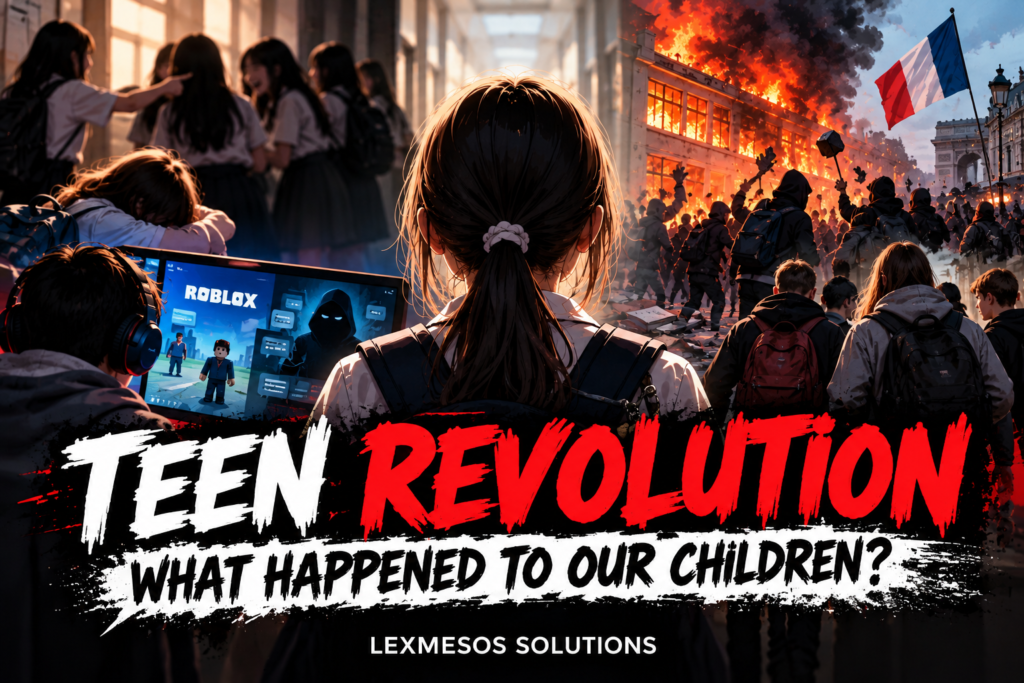
From school violence in Malaysia and terrorist recruitment through online games to youth unrest in Europe, are we witnessing a generation in rebellion or a society failing to understand and protect its children?
You Send Your Child to School. You Expect Them to Come Home Safe.
Imagine receiving an urgent message from your child’s school.
A student has brought a dangerous object onto the premises. A teacher has been injured. Police are investigating. Parents must collect their children earlier than usual.
For any parent, this is a frightening message.
On 21 October 2026, that fear became reality at an international school in Kuching, Sarawak.
According to news reports, a 16-year-old male student brought an unauthorised sharp object to school. A teacher was injured while attempting to intervene and was subsequently taken to hospital. (The Star)
The student was restrained, police were called and the school arranged an early dismissal as a precaution.
Further reports alleged that the incident had been livestreamed, raising questions about preparation, online behaviour and the possible role of social media. (See Hua Daily News)
Police subsequently disputed reports that an axe was the weapon used, identifying a knife pen instead. The student’s motive and the circumstances surrounding the reported video remain matters for investigation.
But one fact is already troubling enough.
A teacher went to school to educate children and ended up requiring hospital treatment.
How did we reach a point where teachers may have to worry about being attacked in their own classrooms?
And how can parents feel confident about their children’s safety when an ordinary school day can turn into a police investigation?
Yesterday, It Was a Pair of Scissors. Tomorrow, What Will It Be?
The Kuching incident is not the only reason parents should be concerned.
On 20 October, at another international school in Europe, a disturbing classroom incident was described to us.
A group of girls reportedly mocked a classmate about her weight.
One student asked who was the fattest girl in the class. Others shouted the targeted girl’s name and laughed loudly.
The girl who was humiliated reportedly reacted by throwing scissors towards another classmate.
Fortunately, the other student managed to dodge them.
No serious injury was reported to us.
The disciplinary response reportedly involved detention.
Consider what could have happened if those scissors had struck an eye, face or neck.
Would the response have been different?
Would the incident suddenly have become more serious because somebody needed stitches, surgery or emergency treatment?
Why should the seriousness of dangerous behaviour depend on whether the victim was fortunate enough to escape injury?
But there is another uncomfortable question.
What about the girls who publicly humiliated their classmate?
Were they also held accountable?
Were their parents informed?
Was the possibility of repeated bullying investigated?
A school cannot simply focus on the student who reacted dangerously while ignoring the behaviour that may have contributed to the confrontation.
Equally, being bullied does not give anyone permission to injure another person.
Both matters require attention.
The students involved are minors, and their identities and personal circumstances should remain private. This account is based on information shared with us and has not been independently verified against the school’s records.
Malaysia: When a Children’s Game Becomes a Recruitment Ground for Terrorists
Parents used to worry about their children spending too much time playing video games.
Now, there is something potentially far more frightening.
What if the person playing online with your 12-year-old child is not another child, but someone attempting to recruit them into a terrorist organisation?
In October 2026, Malaysia’s former Deputy Inspector-General of Police, Tan Sri Ayob Khan Mydin Pitchay, warned that extremist groups were targeting children as young as 12 through online gaming platforms, including Roblox. (New Straits Times)
According to his account, recruiters first approach children through games, build relationships and subsequently invite them into private communication groups.
There, the children may be exposed to extremist propaganda and instructions relating to terrorist attacks.
This is not merely a theoretical concern.
In March 2026, Malaysian police announced that six young people, including three minors, had been arrested in connection with suspected Islamic State-linked extremist activities.
Investigators identified online gaming and messaging platforms, including Roblox, Discord, Telegram and WhatsApp, as channels associated with the suspects’ radicalisation and communications.
Consider the implications.
A child could be sitting safely at home, playing games in the bedroom, while being approached by someone with dangerous intentions.
The parents may believe their child is simply enjoying an ordinary online game.
The danger is not necessarily the game itself. It is who may be communicating with the child through it.
Most children who play Roblox are not involved in extremism, and the platform prohibits terrorist content. But the reported recruitment methods demonstrate how ordinary digital environments can be exploited.
When Does Online Friendship Become Manipulation?
Children naturally seek friendship, recognition and a sense of belonging.
Some may be especially vulnerable to manipulation when they feel lonely, excluded or misunderstood.
Extremist recruiters can exploit those needs by presenting themselves as friends, mentors or members of a welcoming community.
A conversation about gaming may gradually move towards ideology, secrecy and harmful instructions.
By the time parents notice changes in their child’s behaviour, the relationship may already have developed beyond the original gaming platform.
This is why online safety cannot be reduced to limiting screen time.
Parents need to understand whom their children communicate with, what private groups they join and whether anyone is encouraging them to keep conversations secret.
Schools also have a role in teaching digital literacy, manipulation awareness and the difference between legitimate online communities and predatory recruitment.
Should Children Be Treated as Criminals or Victims?
There is another difficult question.
When a child is recruited, manipulated or indoctrinated by extremists, should the authorities treat that child primarily as a criminal or as someone who has been exploited?
In March 2026, Malaysia’s Human Rights Commission, SUHAKAM, and children’s rights advocates expressed concern about the detention of minors under the Security Offences (Special Measures) Act 2012. (New Straits Times)
They called for child-sensitive protection, rehabilitation and intervention rather than relying on security detention.
This does not mean authorities should ignore credible threats or planned attacks.
It means that protecting society and protecting exploited children must both be considered.
A child who poses a genuine danger may require immediate intervention. A child manipulated by an extremist network may also require protection from the very people who recruited them.
The two responsibilities are not mutually exclusive.
Malaysia Is Already Considering Stronger Digital Safeguards
On 19 October 2026, Communications Minister Datuk Seri Fahmi Fadzil announced that the government would examine extending electronic identity and age-verification measures to online gaming platforms such as Roblox. (New Straits Times)
The proposal reflects growing concern about children’s exposure to extremist recruitment and other online risks.
But age verification alone cannot solve every problem.
A verified account does not guarantee that every conversation is safe.
Technology companies must strengthen detection and reporting mechanisms. Parents need practical awareness. Schools must teach children how to recognise manipulation. Authorities must investigate credible threats while respecting children’s rights.
Because the next serious threat to a child’s safety may not begin at the school gate. It may begin with a friendly message inside an online game.
When Did Humiliating Someone Become Entertainment?
Many adults dismiss children’s teasing as an ordinary part of growing up.
Children make jokes. Teenagers laugh at one another. Arguments happen.
But there is a difference between friends joking together and a group deliberately humiliating someone in front of an audience.
Imagine being a teenager whose classmates repeatedly laugh at your appearance.
You hear your name shouted across the classroom.
Everyone laughs.
You are expected to smile, remain calm and pretend it does not hurt.
Then, when the situation escalates, adults may focus only on the final reaction.
That is not a complete understanding of what happened.
Bullying is not harmless simply because it leaves no visible bruises.
At the same time, emotional distress does not justify dangerous retaliation.
A responsible school must be capable of recognising both truths.
It must protect children from humiliation while teaching them that anger cannot be expressed through violence.
France: When Classrooms Become Battlegrounds
Thousands of kilometres away, France has been experiencing serious unrest involving students and wider sections of society.
In early October 2026, student protests spread across the country over teacher shortages, overcrowded classrooms, deteriorating school buildings and educational conditions.
According to Euronews, hundreds of secondary schools faced full or partial closure, with some educational facilities damaged by fire or vandalism. (Euronews)
Education staff were also reported injured.
Later in October, wider protests concerning living costs and public services were accompanied by destructive violence in several French cities.
Shops were looted, public buildings damaged and fires started.
Many demonstrators protested peacefully, and the violence must not be attributed indiscriminately to all students or protesters.
Nevertheless, the destruction raises an important question.
Since when did burning a school become a way to demand better education?
A student may have legitimate complaints about inadequate teaching resources.
A family may be struggling with rising living costs.
Citizens may disagree strongly with government policies.
They have every right to express grievances through lawful means.
But setting fire to buildings, attacking people and looting businesses cannot be justified simply because someone is angry.
The shopkeeper whose premises are destroyed may have no responsibility for the policies being protested.
The teacher whose classroom is damaged may be just as frustrated with the education system as the students.
And the children whose school is closed are ultimately deprived of the education they were demanding.
Italy: Anger, Protests and the Question of Responsibility
Italy has also experienced demonstrations amid wider European concerns about living costs and public services. (ABC News)
These events should not be treated as identical to school attacks or classroom bullying. Nor should every demonstration be portrayed as violent.
But they provide another opportunity to examine the boundaries between expressing frustration and causing harm.
A protest is an exercise of civic freedom.
An assault is not.
Public disagreement is part of democracy.
Destroying another person’s property is not automatically protected merely because it occurs during a demonstration.
Society must be able to recognise legitimate grievances without excusing criminal conduct.
The same principle applies inside schools.
Students deserve to be heard.
They also have responsibilities towards the safety and dignity of others.
Portugal: When Social Unrest Reaches the School Gates
The concerns are not limited to Malaysia, France or Italy.
In Lisbon, Portugal, recent demonstrations have also raised questions about public safety, social frustration and the disruption of everyday life.
In October 2026, reports indicated that the Lycée Français Charles Lepierre, a French school in Lisbon, delayed classes over concerns about a possible student blockade linked to protests in France. (Le Monde)
Meanwhile, demonstrations concerning housing affordability and rising living costs brought further tensions to Lisbon’s streets, including police intervention and reported vandalism.
These incidents are not equivalent to an armed school attack, nor should peaceful demonstrators be associated automatically with violence.
But they illustrate how disputes over education, living conditions and public policy can begin to affect schools, businesses and the wider community.
A school should be a place where children learn to express disagreement, not where education becomes another casualty of public confrontation.
There is nothing wrong with students questioning authority, demanding better educational conditions or speaking out against injustice.
In fact, learning to express disagreement responsibly is an important part of education.
But there must be a distinction between exercising one’s rights and interfering with the rights and safety of others.
When a demonstration prevents children from attending lessons, when vandalism damages public property or when intimidation replaces discussion, society must ask whether the original message is being undermined by the methods used to deliver it.
Freedom of expression matters. So does the responsibility not to endanger others.
From Malaysia’s classrooms to the streets of France, Italy and Portugal, the circumstances may differ, but the underlying challenge remains important:
How do we teach young people to manage anger, confront injustice and demand change without resorting to intimidation, aggression or destruction?
The answer cannot be punishment alone.
It requires education, parental involvement, effective safeguarding, meaningful opportunities to raise concerns and proportionate accountability.
Because a society that teaches children how to demand their rights must also teach them how to respect the rights of others.
Are We Raising Children Who Understand Rights but Not Responsibilities?
Today’s children are growing up in a world where almost everything can be recorded, uploaded and shared.
Arguments become videos.
Humiliation becomes entertainment.
Violent confrontations can attract enormous online attention.
Social media can amplify dangerous behaviour, although it would be wrong to assume that every violent incident is caused by online influence.
Meanwhile, adults frequently discuss children’s rights, emotional well-being, freedom of expression and mental health.
These are important protections.
But what about responsibility?
What about self-control?
What about learning that being offended, frustrated or humiliated does not entitle someone to harm another person?
And what about the responsibility not to provoke, ridicule or bully others in the first place?
Rights and responsibilities are not competing ideas. They are supposed to exist together.
Children deserve protection from mistreatment.
Teachers deserve a safe workplace.
Parents deserve meaningful information about serious incidents.
And students must understand that their actions can have consequences for other people’s lives.
What Happens When Parents Defend Everything Their Children Do?
It is natural for parents to protect their children.
But protecting a child is not the same as defending every action that child takes.
If a child repeatedly humiliates a classmate, parents should not automatically dismiss it as a joke.
If a child threatens someone, parents should not simply blame the victim for provoking the reaction.
If a child struggles with behavioural or emotional difficulties, the answer should include appropriate professional support and reasonable accommodations where needed.
But support should not mean ignoring serious risks.
Parents, schools and students all have responsibilities.
A child who is never taught to accept responsibility may eventually learn about consequences in a much more painful way.
Detention Is a Punishment. Is It Always a Solution?
Schools commonly use detention, warnings, suspension and other disciplinary measures.
But discipline should not become a box-ticking exercise.
A student throws scissors.
The school issues detention.
The student serves the detention.
The matter is considered closed.
But has anyone established why the incident happened?
Has the school assessed the risk of recurrence?
Have the students involved been interviewed separately?
Has the alleged bullying been investigated?
Are other students confident that they can report concerns without retaliation?
Has a plan been put in place to prevent another dangerous confrontation?
If the answer is no, detention may punish the behaviour without addressing the underlying safety problem.
This does not mean every serious incident automatically requires expulsion.
It means that disciplinary measures must be proportionate, evidence-based and accompanied by effective safeguarding procedures.
The objective should not merely be to punish what happened yesterday. It should be to reduce the likelihood of something worse happening tomorrow.
Paying More for an International School Does Not Guarantee Safety
Parents sometimes assume that private and international schools offer a safer environment because they charge higher fees, have smaller classes or promote international standards.
But school safety is not a luxury product.
An expensive campus does not prevent bullying.
A prestigious curriculum does not automatically prevent aggression.
And an impressive school brochure does not guarantee effective safeguarding.
What matters is how a school responds when a problem emerges.
Does it take complaints seriously?
Does it investigate dangerous behaviour promptly?
Does it protect students who report bullying?
Does it support teachers facing threats?
Does it communicate serious risks to parents appropriately?
And, most importantly, does it take meaningful steps to prevent recurrence?
These questions apply equally to public, private and international schools.
A school’s reputation should never matter more than the safety of the children entrusted to its care.
Who Is Accountable When Something Goes Wrong?
When an incident becomes public, everyone starts looking for someone to blame.
The student.
The parents.
The teacher.
The principal.
The school management.
Sometimes responsibility may be shared. Sometimes an institution has acted reasonably despite an unpredictable incident.
Not every act of violence can be prevented, and an injury does not automatically establish legal negligence.
But schools should be able to demonstrate that they have appropriate policies, supervision, reporting channels, staff training and emergency procedures.
Parents should understand their responsibilities in addressing harmful behaviour.
And authorities should investigate serious incidents fairly, without allowing public pressure or viral speculation to replace evidence.
The question is not simply who deserves punishment.
It is whether the people and institutions responsible for protecting children are taking reasonable steps to do so.
Must Someone Die Before We Take School Safety Seriously?
This is the most uncomfortable question of all.
When a student is mocked, adults may call it teasing.
When a student threatens someone, it may be dismissed as anger.
When scissors are thrown but miss their target, it may be treated as a disciplinary matter.
When a teacher is injured, the police become involved.
When buildings burn, the world finally pays attention.
But why should prevention begin only after serious harm occurs?
A student should not have to lose an eye before throwing scissors is treated seriously.
A teacher should not have to be hospitalised before school security is reviewed.
A bullied child should not have to reach breaking point before adults investigate repeated humiliation.
And a school should not have to burn before society listens to students’ legitimate concerns.
The incidents in Malaysia and Europe are not all caused by the same factors. There is no evidence that one single explanation accounts for bullying, individual attacks and violent public unrest.
But together, they remind us why prevention, accountability and institutional responsibility matter.
Schools exist to educate children, not merely to prepare them for examinations.
Education should teach knowledge, empathy, boundaries, respect and the ability to resolve disagreements without violence.
Because the true measure of a successful education system is not only how many students achieve excellent grades.
It is also whether those students learn to live alongside others without humiliating, threatening or harming them.
We cannot promise that every school will always be safe.
But we should never accept a system that waits for tragedy before deciding safety matters.
What Happened to Our Children?
A girl is humiliated in front of her classmates.
Scissors are thrown, but fortunately nobody is struck.
A teacher in Kuching is injured during a school incident.
Children as young as 12 are reportedly approached by extremist recruiters through online games.
Elsewhere, educational protests and wider public unrest have sometimes descended into violence and destruction.
These are different incidents, involving different circumstances and causes. They do not prove that an entire generation has become violent or that children today are inherently worse than previous generations.
But they force us to confront an uncomfortable reality.
We spend so much time preparing children for examinations, careers and success. Are we spending enough time preparing them to recognise manipulation, respect others, manage conflict and take responsibility for their actions?
Parents cannot supervise every conversation.
Teachers cannot prevent every argument.
Governments cannot eliminate every threat.
And technology companies cannot guarantee that every user will behave responsibly.
But that does not mean society should accept preventable harm as inevitable.
What happened to our children?
Perhaps the more important question is:
What are the adults, schools, institutions and digital platforms responsible for their well-being doing to protect them?
Because children should not have to become victims before the world decides their safety matters.
The Conversation Doesn’t End Here- Explore More:
Keywords: Teen revolution, school violence in Malaysia, school bullying, Kuching school incident 2026, teenage rebellion, student safety, parental responsibility, school accountability, online radicalisation, extremist recruitment through gaming, Roblox online safety, youth unrest in Europe, child safeguarding and institutional accountability
Editorial note: The Kuching incident and French unrest are discussed using publicly reported information available as of 21 October 2026. Investigations and reporting may develop. The separate classroom incident is an anonymised personal account and should not be understood as an independently verified finding against any student or school.
21 October 2026