 Skip to content

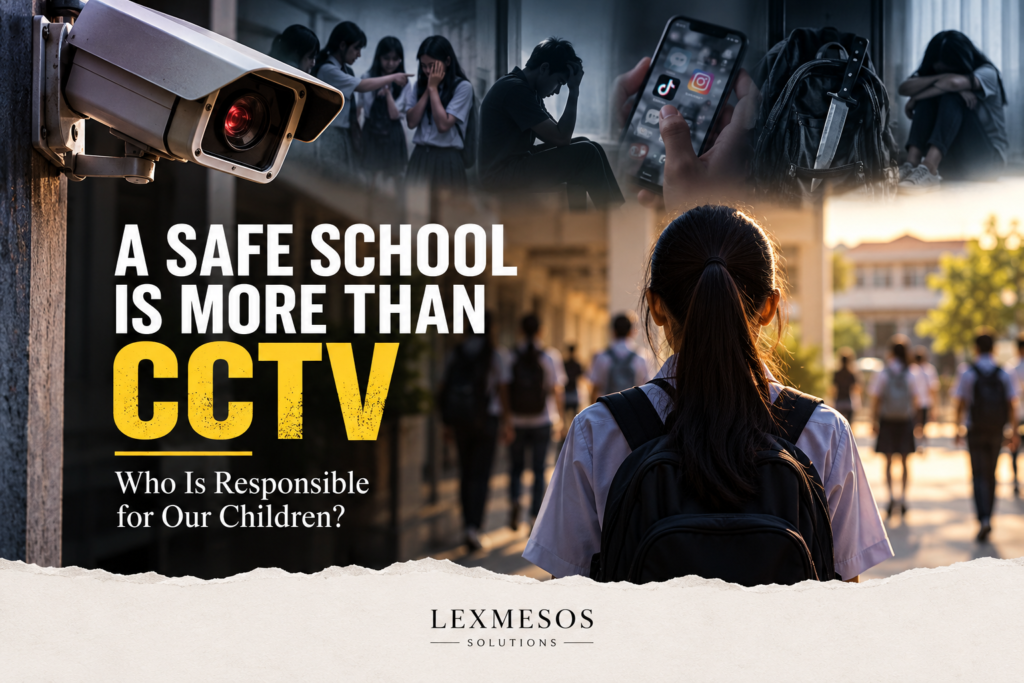
Another tragedy involving a student happens.
The questions immediately follow.
Where was the CCTV?
Where were the teachers?
Why didn’t the school know?
Why didn’t the parents notice?
Was the child being bullied?
Should schools increase security?
All are reasonable questions. But perhaps we are asking them too separately.
Because keeping children safe today is no longer simply about installing more cameras or punishing bullies after something has already happened.
Recent cases in Malaysia and abroad point to something much broader: school safety involves parents, teachers, school management, mental health, peer behaviour, social media and online influences, safeguarding procedures, reporting systems and the willingness of institutions to act when warning signs appear.
There is no single cause behind every tragedy.
And that means there cannot be one single solution.
Malaysia: 5,681 Bullying Cases in Just Eight Months
On 6 October 2026, Prime Minister Anwar Ibrahim told Parliament that 5,681 bullying cases had been reported in Malaysian schools between January and August 2026. (The Straits Times)
They included physical, verbal, non-verbal and cyberbullying.
More concerningly, he said the actual number could be higher because some incidents may go unreported when institutions are concerned about protecting their reputation.
Malaysia has already introduced measures including safety audits, counselling, mental-health support and increased monitoring.
But the Prime Minister acknowledged that existing measures remain insufficient.
The government is also expanding CCTV coverage in schools, with another RM15 million programme expected to cover 1,000 schools in 2027.
CCTV certainly has a role to play.
But even Education Minister Fadhlina Sidek acknowledged following another recent tragedy that CCTV is not a complete solution to school safety. (The Star)
And that distinction matters.
Irene Sofiya: What Does a “Safe School” Actually Mean?
The discussion intensified following the death of 16-year-old Irene Sofiya Mohd Khairool Faisal in Johor. (The Star)
She was found with multiple injuries in her school hall after extra classes. Her death is the subject of a criminal investigation.
It is important not to turn an ongoing investigation into an online trial. SUHAKAM itself has cautioned against speculation about the motive or unverified allegations concerning bullying.
But the tragedy has raised a separate question that does not require us to speculate about criminal responsibility:
How do schools account for children who remain on school premises after ordinary school hours?
SUHAKAM has called for stronger safeguarding measures, including student check-out procedures, monitoring of students remaining for tuition and co-curricular activities, missing-student escalation procedures, after-school risk assessments, confidential reporting mechanisms and psychosocial support. (The Star)
This goes considerably further than installing cameras.
It is about creating a safeguarding system.
CCTV Can Watch. But CCTV Cannot Raise a Child.
CCTV can deter certain behaviour.
It can identify blind spots.
It can provide evidence.
It may help us understand what happened after an incident.
But a camera cannot teach empathy.
It cannot teach respect.
It cannot teach consent or boundaries.
It cannot recognise every child who is becoming increasingly isolated, aggressive or distressed.
It cannot persuade a frightened student that it is safe to speak.
And it cannot replace parents, teachers, counsellors or adults who pay attention.
Perhaps the bigger question therefore isn’t simply:
“How many more cameras do schools need?”
It is:
“What is happening to our children when the cameras aren’t watching?”
Bandar Utama: When the Warning Signs Are Much More Complicated
Malaysia had already confronted another deeply disturbing school tragedy on 14 October 2025. (The Star)
A 14-year-old boy killed a 16-year-old female student at a secondary school in Bandar Utama, Petaling Jaya.
Police subsequently confirmed that sharp weapons seized from him, two knives and a kerambit had been purchased online.
At the time, social media influence and emotional triggers were among the possible factors investigated. Police also made clear that the case was not a bullying case.
A year later, the High Court findings revealed a considerably more complicated picture.
The teenager was found to have suffered from very early-onset schizophrenia, which the court found had developed from around the age of nine and progressed for approximately five years without psychiatric assessment.
The High Court acquitted him of murder on the ground of unsoundness of mind and ordered that he be placed in a psychiatric hospital subject to the applicable legal process.
The judgment also dealt with his exposure to violent media. Importantly, the court did not simply conclude that violent content “made him violent”. Rather, it considered that exposure in the context of an already seriously disordered and delusional mind.
That distinction is crucial.
It would be far too easy to blame one video game, one social-media platform, one parent or one teacher.
The reality was much more complicated.
But the case still leaves uncomfortable questions.
How can serious psychological difficulties develop in a child for years without adequate specialist intervention?
How do parents and schools distinguish ordinary teenage behaviour from warning signs that require professional assessment?
How easily can children purchase dangerous items online?
And do students know what to do if they see another student carrying something dangerous?
School security cannot answer all of those questions.
Safeguarding has to go further.
Parents Cannot Be Left Out of the Conversation
Children do not suddenly acquire their behaviour, attitudes and values when they enter the school gate.
Family remains part of the equation.
What happens when a child becomes increasingly aggressive?
What happens when parents repeatedly dismiss harmful behaviour as:
“They’re only kids.”
What happens when a teenager is humiliating classmates online?
What happens when parents have little idea what their children are watching, sharing or discussing?
And what happens when adults automatically defend their own child instead of asking whether something may actually be wrong?
We previously explored part of this question in:
When Should Parents Be Liable for School Bullying in Malaysia?
Parental responsibility does not mean blaming parents for everything their children do.
It means recognising that educating and protecting children cannot realistically be outsourced entirely to teachers, schools or government.
India: When Violence Is Recorded and Shared
A recent case from Odisha, India, shows another dimension of the problem.
In early 2026, a Class 9 schoolgirl was allegedly sexually assaulted by several boys, including classmates. (NDTV)
According to police reports, the alleged assault was recorded on a mobile phone and the recording was circulated.
The allegations are subject to the relevant criminal and juvenile justice processes, but the circumstances highlight something that modern safeguarding systems increasingly have to confront:
Violence can now become digital content.
The harm may no longer end when the physical incident ends.
A recording can be circulated.
Humiliation can become permanent.
Hundreds of people can see something that should never have been recorded in the first place.
And this brings us to an environment that previous generations of parents and teachers never had to manage on this scale.
The School Gate No Longer Ends the School Day
A generation ago, when a child came home from school, much of the school social environment stayed behind.
Today, classmates can follow them home through a phone.
WhatsApp.
TikTok.
Instagram.
Gaming platforms.
Group chats.
A humiliating moment can be recorded.
A fight can become content.
A rumour can reach hundreds of students before the child reaches home.
Cyberbullying can continue throughout the night.
Children can also encounter violent, sexual or otherwise disturbing material at ages when parents may have little idea what they have already seen.
This does not mean social media causes school violence.
It would be irresponsible to make such a simplistic connection.
But it is equally unrealistic to discuss children’s behaviour today while ignoring the digital environment in which a significant part of their social development takes place.
Parents therefore need to ask more than:
“How many hours did you spend on your phone today?”
Perhaps we should also be asking:
What are you watching?
Who are you talking to?
What are people sharing with you?
What are you sharing with others?
And how is what happens online affecting what happens offline?
Singapore: Not Every School Tragedy Is Bullying
Singapore provides another important lesson.
In July 2021, a 16-year-old student at River Valley High School killed 13-year-old Ethan Hun Zhe Kai with an axe inside the school. (Reuters)
The two students did not know each other.
This was not a case of classmates bullying someone until violence escalated.
The older student was subsequently convicted of culpable homicide and sentenced to 16 years’ imprisonment. Court proceedings examined his history of depression and mental-health difficulties.
The case demonstrates something important:
Not every tragedy involving students can be explained by bullying.
Sometimes the issue may involve serious psychological distress.
Sometimes it involves aggression.
Sometimes sexual violence.
Sometimes bullying.
Sometimes online behaviour.
Sometimes institutional failures.
And sometimes several factors overlap.
That is why children’s psychological wellbeing must form part of any serious conversation about school safety.
Mental Health Support Should Begin Before a Crisis
We previously examined this issue through developments in Cyprus:
Children’s Mental Health and Psychological Support: What Can We Learn From Cyprus?
Psychological support is not a magic solution.
Nor should mental-health conditions be casually associated with violence. The overwhelming majority of people experiencing mental-health difficulties are not violent.
The point is much simpler:
Children need somewhere to turn before a problem becomes a crisis.
A counsellor.
A psychologist.
A trusted teacher.
A parent who actually listens.
A confidential reporting system.
And sometimes prevention begins with one adult noticing:
“Something has changed with this child.”
Cornell: What Happens After Someone Reports Something?
Safeguarding does not stop when students leave secondary school.
At Cornell University in the United States, thousands of students, faculty and community members rallied in October 2026 following allegations that a student had been sexually assaulted by fraternity members in 2024. (USA Today)
Those allegations remain contested and are the subject of legal and investigative processes. They should not be presented as established criminal findings.
But the controversy has expanded beyond the allegations themselves.
Protesters demanded an external review of the university’s handling of the matter, changes to disciplinary processes, stronger sanctions and better training for campus police responding to sexual-violence complaints.
Cornell has defended aspects of its response while also taking disciplinary action against some individuals and shutting down the fraternity chapter involved.
Whatever the eventual legal outcome, the controversy raises an important safeguarding question:
What happens after a student asks for help?
An institution can have policies.
It can have a disciplinary code.
It can have a reporting portal.
It can have posters telling students to speak up.
But those systems mean little if students do not trust them enough to report what is happening.
Do adults listen?
Is the complaint documented?
Is it properly investigated?
Is the student protected?
Are previous warning signs considered?
And does the institution learn from what happened?
Safety is not measured only by whether an institution has rules.
It is also measured by what happens when those rules are tested.
When Harmful Behaviour Becomes “Normal”
Bullying remains an important part of this wider picture.
We previously explored this in:
Bullying rarely begins with the worst possible incident.
It may begin with a joke.
A nickname.
A cruel message.
Exclusion.
A push.
A humiliating photograph.
A video uploaded for classmates to laugh at.
Someone says:
“They’re just playing.”
Someone else says:
“Kids need to toughen up.”
And everyone moves on.
Until something happens that nobody can ignore.
The difficult question is whether nobody really saw the earlier behaviour or whether adults saw it but did not consider it serious enough to intervene.
Different Cases. The Same Bigger Question.
These cases should not be treated as though they are identical.
They aren’t.
Irene Sofiya’s death raises urgent questions about safeguarding, supervision and accountability while a criminal investigation continues.
Malaysia’s Bandar Utama case highlights the complexity of severe childhood mental illness, early intervention, online exposure, access to dangerous items and warning signs.
The Odisha allegations bring sexual violence, peer behaviour and the digital circulation of harmful material into the discussion.
Singapore’s River Valley tragedy reminds us that severe student violence cannot automatically be labelled bullying.
Cornell raises another issue altogether: whether institutional reporting and disciplinary systems work when students need them most.
Different countries.
Different circumstances.
Different legal systems.
Different causes.
Yet they lead us back to one fundamental question:
What Does It Actually Mean to Keep a Child Safe?
There is a temptation after every tragedy to find one answer.
Install CCTV.
Punish the bully.
Blame the parents.
Blame the school.
Ban phones.
Restrict social media.
Send the child to counselling.
Each may have a role.
None is sufficient by itself.
Real safeguarding requires layers.
Parents must remain involved in their children’s lives.
Teachers need to recognise and report warning signs.
Schools need functioning safeguarding and escalation procedures.
Children need trusted ways to report problems without fearing humiliation or retaliation.
Psychological support must be accessible before a crisis.
Serious behaviour should not be dismissed simply because those involved are young.
Institutions must be willing to acknowledge problems rather than hide them to protect their reputation.
And parents, schools and policymakers cannot ignore the enormous digital world in which today’s children are growing up.
A Camera Can Watch. It Cannot Care.
Perhaps that is the biggest lesson.
More CCTV may make schools safer.
Better security may make schools safer.
Stronger laws may make schools safer.
Counselling may make schools safer.
Parental involvement may make schools safer.
Better digital awareness may make schools safer.
But none can carry the responsibility alone.
A camera cannot raise our children.
It cannot teach kindness.
It cannot teach consent.
It cannot teach respect for another person’s boundaries.
It cannot ask why a child has suddenly stopped talking.
It cannot notice everything a child is watching at 2 a.m.
It cannot convince a frightened student that somebody will believe them.
And it cannot replace parents, teachers, counsellors and institutions willing to act before something becomes a tragedy.
School safety is therefore not merely a security issue.
It is a safeguarding issue. A parenting issue. A mental-health issue. A digital-safety issue. An education issue. An institutional-accountability issue.
And ultimately, it is a shared responsibility.
So perhaps the question should no longer be only:
“How many more CCTV cameras do our schools need?”
Perhaps we should also ask:
“What is happening to our children when the cameras aren’t watching?”
Keywords: School safety Malaysia, school safeguarding, CCTV in schools, school bullying Malaysia, child safety, parental responsibility, student mental health, social media and children, cyberbullying, school violence, student safeguarding, psychological support, digital safety, institutional accountability, child protection, SUHAKAM, school security
6 October 2026
Disclaimer: This article is provided for general informational and educational purposes only and does not constitute legal, medical or professional advice. References to ongoing investigations, allegations and legal proceedings are based on publicly available information at the time of publication and should not be interpreted as findings of guilt or liability. Individuals are presumed innocent unless and until proven guilty in accordance with law. The cases discussed involve different facts, circumstances and legal systems and are referenced solely to examine broader issues of child safeguarding, school safety, mental health, digital influences and institutional responsibility.