 Skip to content

People love giving one piece of advice about a bad workplace:
“If you’re unhappy, just resign.”
It sounds simple.
Until you have bills to pay, responsibilities to carry and no other job waiting for you.
Sometimes people stay in jobs not because they are happy, loyal or comfortable.
They stay because, for now, they have nowhere else to go.
And sometimes a job does not become unbearable overnight.
It happens slowly.
One thing changes.
Then another.
Until one day you realise that the job you are doing and the environment you are doing it in, looks very different from what you once accepted.
Same Company. Same City. Completely Different Workplaces.
Imagine a large company operating several workplaces within the same city.
Some are premium.
Some are modern, comfortable corporate offices.
Others are fairly normal.
Then there is your building.
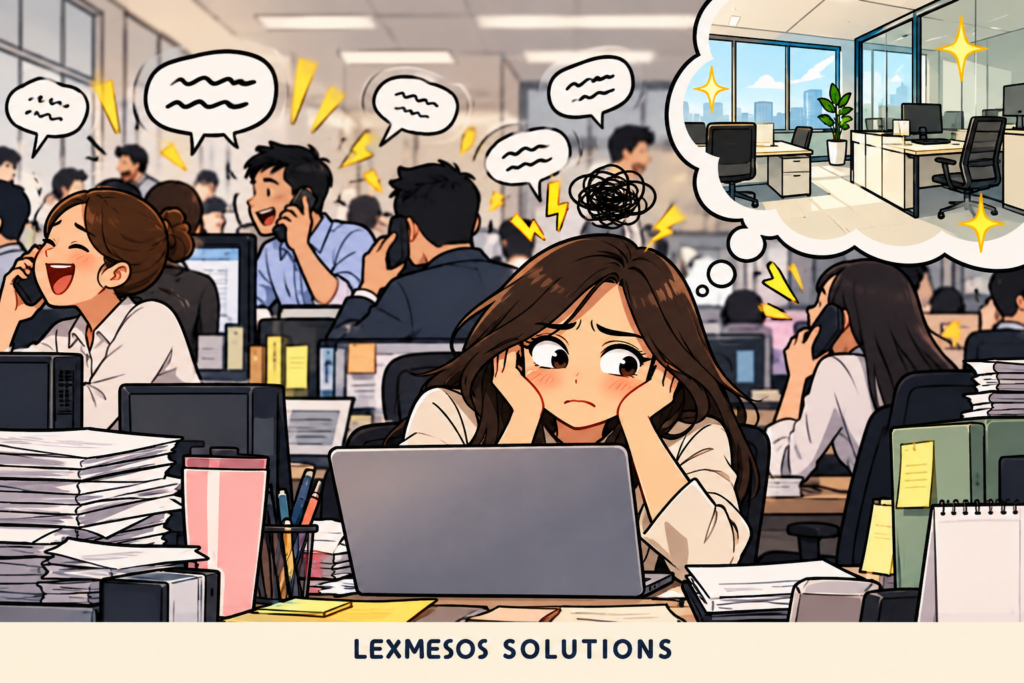
Old. Crowded. Noisy.
Employees are squeezed together on one floor, with only two toilets serving the floor.
This isn’t about demanding a luxury office.
Nobody needs marble floors, designer furniture or an executive suite simply to do their job.
But when employees of the same company, working in the same city, experience dramatically different working environments depending on their department, it is reasonable to ask:
What is the minimum standard employees should be able to expect?
This Isn’t a Quiet Back-Office Department
Now add another important fact.
People need to communicate with clients throughout the day. Calls aren’t occasional interruptions.
Calls are part of the job.
Put many client-facing employees together in one open space and the result is predictable.
One person is speaking to a client.
Another person answers another call.
Someone else needs to speak louder because they cannot hear properly.
Then the person beside them speaks louder too.
Before long, the workplace starts sounding more like a call centre.
Except many of the people sitting there are professionals handling partnerships, commercial relationships and important clients, often doing work that also requires concentration.
The problem isn’t that employees are inconsiderate.
The workplace simply doesn’t match the way the department works.
A Solution Was Suggested
The problem was raised with management.
Not once.
For more than a year.
A practical suggestion was made: install phone booths, acoustic cubicles or designated call areas so employees handling client calls could speak without filling the entire workplace with overlapping conversations.
Management rejected the idea.
Why spend money modifying the existing workplace when another workplace was supposedly being prepared for the department?
That explanation actually made sense.
So employees waited.
And waited.
Eventually, the new workplace was completed.
But the department didn’t move there.
The better space was allocated to others.
The department remained in the same old building.
The phone booths were never installed.
The relocation never happened.
And the original problem remained exactly where it had always been.
The Better Workplace Exists. It Just Wasn’t for You.
That is what makes the situation particularly frustrating.
The company clearly knows what a good workplace looks like.
It already operates them.
The company isn’t confined to one old building with no alternatives.
Within the same city, employees working for the same organisation can experience very different workplace standards.
Again, the question isn’t:
“Why don’t we get the luxury office?”
It is:
“Why can’t we have a workplace reasonably suited to the work we are expected to perform?”
Then It Starts Affecting Your Health
At first, perhaps you tolerate it.
Then the environment begins affecting you differently.
When colleagues come to work sick, everyone is sitting close together.
Someone starts coughing.
Someone else becomes sick.
Then you become sick.
Again.
The noise creates another problem.
You start relying on earphones simply to concentrate.
Eventually, you develop an ear problem and see a doctor.
The advice is to reduce your use of earphones.
Fair enough.
Except what happens when earphones are one of the few ways you can concentrate at work?
Don’t wear them, and you struggle with the surrounding calls.
Wear them throughout the day, and your ears suffer.
Move somewhere quieter?
There isn’t anywhere to move.
Ask for call booths?
Already rejected.
Wait for the new workplace?
You already did.
Raise the issue with management?
You have been doing that for more than a year.
“Talk to Management”
This is where ordinary workplace advice starts becoming almost meaningless.
“Have you spoken to management?”
Yes.
“Have you told the office team?”
They know.
“What about the safety officer?”
The company has one.
“Have you suggested a solution?”
Yes.
“Maybe the company needs more time?”
One year. Then almost two years have passed.
At some point, the problem is no longer a lack of communication.
Everyone who needs to know already knows.
But What About Your Own Director?
Then there is another uncomfortable layer.
What happens when your own department director works in the same environment, sees the same problems and knows employees have been raising them, but does not meaningfully push the issue upward?
Leadership is also supposed to communicate genuine operational problems upward.
If a department handles different clients, if constant calls are inherent to its work, and if employees have been complaining about the environment for years, workplace conditions are no longer simply somebody else’s problem.
Employees can raise concerns individually.
The office team can know.
The safety officer can know.
Senior management can know.
But when nobody with authority is prepared to push for change, employees can find themselves trapped between different layers of management.
Everyone knows.
Nobody acts.
And Now Everyone Must Be in the Office Five Days a Week
Then comes the announcement:
Employees are expected to work from the office five days a week.
For some people, that may represent a significant change.
For you?
Almost nothing changes.
Your department was already expected to be there every working day.
That is precisely why the issue has never really been about working from home versus working from the office.
You are prepared to work in the office.
You just want an office where you can reasonably work.
There is a difference.
Five days of physical presence does not automatically create five days of productivity.
Someone can sit at a desk for eight hours and achieve very little.
Someone else may spend those same eight hours fighting surrounding noise just to complete concentration-heavy work.
Being visible and being productive are not necessarily the same thing.
And when even sick employees continue turning up because attendance has become culturally important, another question appears:
What exactly is the company measuring: performance or presence?
Then Other Parts of the Job Start Changing Too
The office isn’t necessarily the only thing that changed.
Perhaps commission arrangements that once formed part of the attraction of the role change or disappear.
Perhaps the working environment becomes progressively worse.
Perhaps responsibilities involving important partners and VIP clients remain high while the support around the role declines.
Perhaps promises are made and quietly disappear.
None of these things, viewed separately, necessarily tells the whole story.
But employees don’t experience their jobs as isolated events.
They experience the cumulative effect.
Compensation.
Environment.
Management.
Recognition.
Workload.
Health.
Trust.
One change may be manageable.
Then another happens.
Then another.
Eventually, an employee may look around and think:
“How did the job I accepted become this?”
Why Don’t You Just Leave?
And inevitably someone asks:
“If it’s really that bad, why are you still there?”
Because life doesn’t work like LinkedIn motivational posts.
You may have rent or a mortgage.
A family.
Visa considerations.
School fees.
Financial commitments.
A difficult local job market.
Or simply no suitable offer waiting for you.
Resigning first and figuring everything out later isn’t a realistic option for everyone.
So people stay.
They update their CV.
They look quietly.
They tell themselves to tolerate another month.
Then another.
They continue walking into the same workplace because the alternative, suddenly having no income, may be worse.
That doesn’t mean the working environment is acceptable.
It means the employee has calculated that, for now, leaving carries an even greater risk.
A Bad Office Isn’t Automatically an Illegal Office
There is also an important distinction between a workplace being unpleasant and a workplace actually breaching employment or occupational safety requirements.
An old office isn’t automatically unlawful.
An open-plan office isn’t automatically unlawful.
Having colleagues speaking on the phone isn’t automatically unlawful.
And employees aren’t automatically entitled to the same premium workplace used by another department.
But that shouldn’t end the conversation.
When workplace conditions create identifiable health, safety or welfare concerns, particularly after those concerns have repeatedly been brought to the employer’s attention, the question becomes more serious.
The focus should not simply be:
“Is this office luxurious enough?”
It should be:
“Is this environment reasonably suitable and safe for the work people are actually being required to perform?”
Those are very different questions.
When Speaking Up Changes Nothing
Employees are constantly encouraged to speak up.
Tell HR.
Report safety concerns.
Suggest solutions.
But what happens when only one person is willing to speak?
For almost two years, one employee repeatedly raised concerns about the working environment. The matter reached management level, but apparently went no further to top management.
The office team knew.
Management knew.
A practical solution had been proposed.
The promised relocation did not happen.
Yet the problem remained.
Other employees experienced the same working environment, but they did not necessarily complain.
And silence should not automatically be interpreted as satisfaction.
Most employees are not local. For them, challenging management can feel much more complicated than simply sending an email to HR.
Their employment may be connected to their ability to remain in the country. Losing a job may mean much more than losing a monthly salary. For some, returning home could mean going back to a country facing war, political instability, economic hardship or very limited opportunities.
So they keep quiet.
They work.
They don’t want to be labelled difficult.
They don’t want to attract attention.
And most importantly, they don’t want to lose their jobs.
That creates a dangerous assumption in workplace management:
“Only one person complained, so it must only be that person’s problem.”
But one complaint does not necessarily mean only one person is affected.
Sometimes it means only one person feels able to say it out loud.
That is why employee silence is a poor measure of whether a workplace is functioning well.
And there is another important distinction in this case.
The concern was raised to management, but not necessarily to the highest level of the company.
If the internal people responsible for the workplace effectively close the discussion before it travels further, senior leadership may never hear the same version of the problem that employees are experiencing on the ground.
That leaves the employee in an unusual position.
Keep raising it, and risk being seen as the person who is always complaining.
Stop raising it, and management may conclude that the problem has disappeared.
Go above management directly, and risk being accused of bypassing the chain of command.
Leave the company, and face the reality that another job may not be waiting.
So eventually, the employee becomes quiet too.
Not because the workplace improved.
Not because the problem was solved.
But because speaking repeatedly without being heard is exhausting.
And perhaps that is the question companies should be asking:
When only one employee keeps raising an uncomfortable issue, is that person the problem or are they simply the only person who feels able to speak?
The Question Companies Should Ask
Companies spend enormous amounts of time talking about employee engagement, retention, productivity and workplace culture.
But sometimes the most useful question is much simpler:
If an employee has been telling you the same problem for two years, why are they still having to tell you?
A company doesn’t need to give everyone a luxury office.
It doesn’t need to approve every employee request.
And management will always have budgets, operational requirements and competing priorities.
But when employees repeatedly identify the same problem, propose workable solutions and continue experiencing the same conditions years later, silence itself eventually communicates something.
Maybe that is why some employees stop complaining.
Not because the problem disappeared.
Not because they suddenly became happy.
They simply stopped believing that anyone was listening.
If You Are Living Through This Right Now
If this story feels familiar, remember:
Staying does not always mean accepting.
Maybe you need the income. Maybe your family depends on you. Maybe you are waiting to qualify for something important to your future. Maybe you need more experience, are building your savings, completing a qualification, or quietly preparing something of your own.
Other people may wonder:
“If you’re so unhappy, why don’t you just resign?”
But they don’t know what you are working towards. And you don’t have to explain your entire plan to everyone.
Sometimes staying a little longer is part of the plan.
Use that time. Build your skills. Save what you can. Grow your network. Protect your health. Explore opportunities. Prepare quietly for whatever comes next.
For some people, the next chapter will be a better employer. For others, it may be a different career, a new place, freelancing, consulting or finally building something of their own.
There is no single correct way to move forward.
A difficult workplace can sometimes teach you one very important thing: what you don’t want your future to look like.
So if you cannot walk away today, it doesn’t mean you are going nowhere.
Stay for the reason you need to stay. Prepare for the reason you want to leave.
And when the time finally comes, your next move may not simply be another job.
It may be the beginning of something you built for yourself.
Keywords: Bad working environment, toxic workplace, workplace conditions, employee wellbeing, workplace noise, overcrowded office, employee health, workplace safety, management responsibility, employee voice, fear of speaking up, foreign workers, office working conditions, workplace culture, employee rights
2 October 2026