 Skip to content

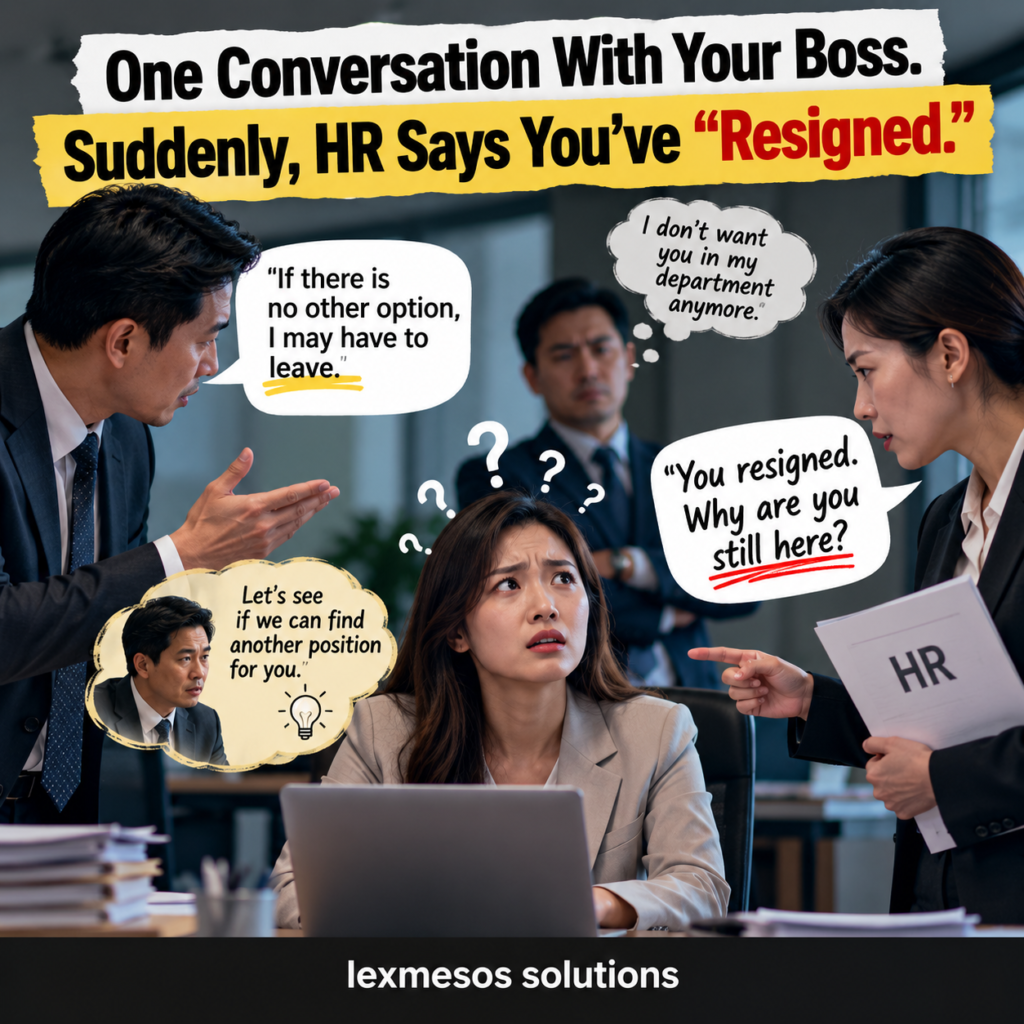
“Once you’ve said you want to leave, there’s no turning back.”
That is a surprisingly stubborn workplace belief.
You tell your boss that if there is no other option, you may eventually have to leave.
You don’t submit a resignation. You don’t give a last working day. Your boss is still looking for another position for you inside the company.
Then suddenly, your line manager says:
“You resigned. Why are you still here?”
And HR has been told that you are leaving.
But who actually decided that?
You or somebody interpreting your conversation for you?
Because there is a big difference between: “If there is no other option, I may have to leave” and “I resign.”
Thinking about leaving, talking about leaving and actually terminating your employment are not necessarily the same thing.
The Moment You Mention Leaving, Everything Changes
There is some workplace reality behind the myth.
Tell a manager that you are considering leaving and the relationship may change.
Your manager might start thinking about succession.
HR might wonder whether you will stay.
Your responsibilities might be reconsidered.
Someone may even start thinking about your replacement.
Those are human and management reactions.
But there is a big jump between: “We don’t think this employee will stay” and “This employee has resigned.”
One is an assumption about the future.
The other says that an employment relationship has actually been terminated by the employee.
That distinction matters.
Consider This Scenario
An employee has been with a company for more than ten years.
Things are no longer working well in the current department.
The employee speaks openly with the boss: “If there is no other choice, I may eventually have to leave.”
But the conversation doesn’t end there.
The boss asks: “Do you actually want to leave?”
The employee isn’t necessarily saying yes.
The employee then starts looking for another possibility.
Perhaps there is a vacancy in another department.
Perhaps an internal transfer could solve the problem.
The boss even asks: “If there really isn’t another option and you eventually leave, how many months would you need to settle everything and leave the country?”
The employee answers.
Perhaps two months.
Perhaps three.
But meanwhile, another person has heard something very different.
The line manager has heard:
“This employee wants to leave.”
And from that day onward, the line manager no longer wants the employee in the department.
Then comes the question: “You resigned. Why are you still here?”
Except the employee’s position is: “I never resigned.”
Now we have a problem.
Leaving a Department Is Not Necessarily Leaving the Company
This is where the situation becomes particularly interesting.
The boss may be thinking:
“Can we retain this employee somewhere else?”
The line manager may be thinking:
“I don’t want someone in my department who already wants to leave.”
And the employee may be thinking:
“I will only leave if there really is no other solution.”
Three people.
Three interpretations.
One conversation.
But only one question determines whether the employee actually gave notice:
What did the employee actually communicate?
The fact that a line manager no longer wants someone in their department does not itself answer whether that employee resigned from the company.
Perhaps the employee was considering leaving the department.
Perhaps the employee was considering leaving the company if no alternative position could be found.
Perhaps senior management was actively trying to retain them.
Those are different situations.
That Tiny Word “If” Can Change the Entire Conversation
Compare these:
“I resign.”
“I have decided to leave.”
“If there is no other option, I may have to leave.”
The third statement contains one very important word:
If.
There is still a condition.
There is still another possible outcome.
The employee may stay if another position is found.
The employee may reconsider.
Management may make another proposal.
The problem may be resolved.
Compare that with: “I hereby give three months’ notice. My final working day will be 31 December.”
There is much less ambiguity there.
The employee has made a decision and communicated it.
Malaysian Law Makes the Written Notice Point Important
Section 12 of Malaysia’s Employment Act 1955 provides for either party to give notice of an intention to terminate a contract of service.
And subsection 12(4) expressly says:
“Such notice shall be written.” (JTKSM)
The legislation also deals with the applicable notice period and, under section 13, allows termination without completing that notice by payment of an indemnity equivalent to wages for the relevant notice period or its unexpired portion. (JTKSM)
That doesn’t mean employees must type the magical words:
FORMAL NOTICE OF RESIGNATION
for a resignation to exist.
A written message can potentially communicate a clear decision to leave without using the word “resign.”
But there remains a considerable difference between: “I am leaving and my final day will be X” and “If we cannot find another solution, I may have to leave.”
One communicates a decision.
The other may be discussing a possibility.
“But You Told Your Boss You Wanted to Leave!”
This is probably where the workplace myth becomes strongest.
Some people genuinely believe: “Once you’ve told the company you want to leave, you’ve shown your true intention.”
Then comes:
“HR can’t trust you anymore.”
“Your manager knows you’re not committed.”
“There’s no point keeping you.”
Perhaps the working relationship has changed.
Perhaps the manager’s confidence has changed.
Perhaps HR now considers the employee a retention risk.
But none of those things automatically answers:
Did the employee give notice terminating the employment relationship?
An employer’s loss of confidence that someone will remain indefinitely is not itself the employee’s resignation.
And neither is the line manager’s preference that the employee should now leave.
If You Really Resigned, What Happened Next?
There is also a practical reality.
Most established companies don’t receive a resignation and then simply say:
“Okay, bye.”
A resignation normally triggers administration.
HR needs to know the final working day.
The contractual notice period needs to be checked.
Outstanding leave may need to be dealt with.
If the employee wants to leave before completing the required notice, the question of the unserved notice period may arise.
Someone needs to take over ongoing work.
Files and responsibilities need to be handed over.
Company equipment may need to be returned.
Many organisations have clearance forms, exit forms, exit interviews and formal handover procedures.
Not every one of these steps is legally required for every Malaysian resignation. Company procedures differ.
But they raise an obvious factual question.
If an employee supposedly resigned weeks ago:
When does the notice period end?
What is the last working day?
Where is the HR acknowledgement?
Who is taking over the work?
Where is the handover?
Why hasn’t the exit process started?
And, most strangely:
Why is the boss still trying to find the employee another job inside the same company?
None of these points individually proves that there was no resignation.
Together, however, they may tell you a lot about what everyone actually understood at the time.
“I Need Three Months If I Leave” Is Not “My Three-Month Notice Starts Today”
This is particularly important for employees working abroad.
Imagine the boss asks: “If nothing can be worked out and you have to leave the country, how long would you need?”
The employee says: “Probably three months.”
That could mean three months to deal with housing, family arrangements, immigration matters, belongings and relocation.
It does not necessarily mean: “I hereby give three months’ contractual notice starting today.”
A hypothetical question can have a hypothetical answer.
Context matters.
Even Directors Don’t Just Vanish From the Company
There is an interesting comparison in Malaysian corporate law.
Directorship and employment are legally different relationships, so the rules should not be mixed together.
But the comparison demonstrates something useful about formal departures.
Under section 208(2) of Malaysia’s Companies Act 2016, a director may resign by giving written notice to the company at its registered office. SSM’s own guidance explains this requirement and also notes special restrictions where resignation would leave the company without the statutory minimum number of directors. (SSM)
In corporate practice, the departure then has consequences for the company’s corporate records and filings.
Imagine instead a director saying at lunch: “If things keep going this way, maybe I should step down.”
Would the sensible response really be: “Great. Director resigned.”
Of course, employee resignation and director resignation are governed by different legal regimes.
But the comparison exposes the same practical problem:
Discussing departure and formally departing are not necessarily the same event.
This Isn’t Just a Malaysian Idea
Cyprus provides an interesting European comparison.
Cyprus employment rules are obviously not Malaysian employment rules.
And there is no single universal resignation procedure applicable to every employee around the world.
But the comparison is useful because the basic practical problem is not uniquely Malaysian:
When does talking about leaving actually become notice that you are leaving?
What If the Manager Says: “You Resigned. Why Are You Still Here?”
This is the point at which an employee should be careful about leaving the misunderstanding unanswered.
If the employee’s position genuinely is that no resignation was given, a written clarification may be sensible:
For avoidance of doubt, I have not submitted my resignation or given notice terminating my employment. Our previous discussions concerned the possibility that I may need to leave if no alternative internal position can be identified. As discussed with management, alternative internal opportunities remain under consideration. I remain employed and available to perform my duties.
Why write it down?
Because six months later, this: “That’s not what I remember you saying.”
is much harder to deal with than a contemporaneous email.
But Employees Should Be Careful Too
This article isn’t saying employees can say absolutely anything about leaving and later simply declare:
“I didn’t mean it.”
Words matter on both sides.
Writing:
“I’m done.”
“I’m leaving.”
“This is my last month.”
“I won’t be returning.”
can create very different issues depending on the context.
If you are merely considering leaving, say so.
If your decision depends on whether another internal position can be found, make that clear.
If you have made a final decision to resign, make that clear too.
Ambiguity is rarely helpful when someone’s livelihood is involved.
The Real Myth Is “There’s No Turning Back”
Perhaps this is the part workplaces get wrong.
An employee tells the boss:
“I’m thinking about leaving.”
Everyone immediately assumes the relationship is finished.
But why?
People reconsider major career decisions all the time.
An employee may decide to stay because the company offers another role.
The problem with their manager may be resolved.
Working conditions may change.
A promotion may become available.
Personal circumstances may change.
Or the employee may simply sleep on it and decide:
“Actually, I don’t want to leave.”
There can certainly be practical consequences after telling an employer you are considering departure.
Trust may change.
Relationships may become uncomfortable.
A manager may question the employee’s long-term commitment.
But:
An uncomfortable relationship is not itself a resignation.
Thinking about leaving is not necessarily resigning.
Talking about leaving is not necessarily resigning.
And somebody else deciding that you should now leave is not the same thing as you deciding to resign.
So, “Once You’ve Said You Want to Leave, There’s No Turning Back”?
Maybe that’s how some workplaces think.
But employment relationships shouldn’t be ended purely through assumptions.
Before turning: “If there is no other option, I may have to leave” and “The employee resigned.”
look at what actually happened.
Was there written notice?
Was the decision final or conditional?
Was a last working day established?
Did the contractual resignation procedure begin?
Did HR start the exit process?
Was a handover arranged?
Or was senior management still trying to find another position for the employee?
And was the real problem simply that one manager no longer wanted someone in the department after hearing that they might leave?
Because there is a significant difference between: “I might leave” and “I am leaving.”
And an even bigger difference between: “I think you should leave” and “I resign.”
So the next time someone says:
“You already said you wanted to leave. There’s no turning back.”
perhaps the simplest response is also the most important:
Show Me the Resignation.
Keywords: resignation, employee resignation, thinking about leaving a job, HR says I resigned, verbal resignation, written resignation, notice of resignation, employment contract, notice period, employee rights, Malaysia employment law, Cyprus employment law, internal transfer and workplace rights
This article provides general information and comparative discussion only and does not constitute legal advice. Whether a resignation has legally taken effect depends on the applicable law, the employment contract, workplace policies, the communications between the parties and the individual circumstances.
26 September 2026