 Skip to content
“Why do students your age vape?”
I asked a Year 9 student in Cyprus this question.
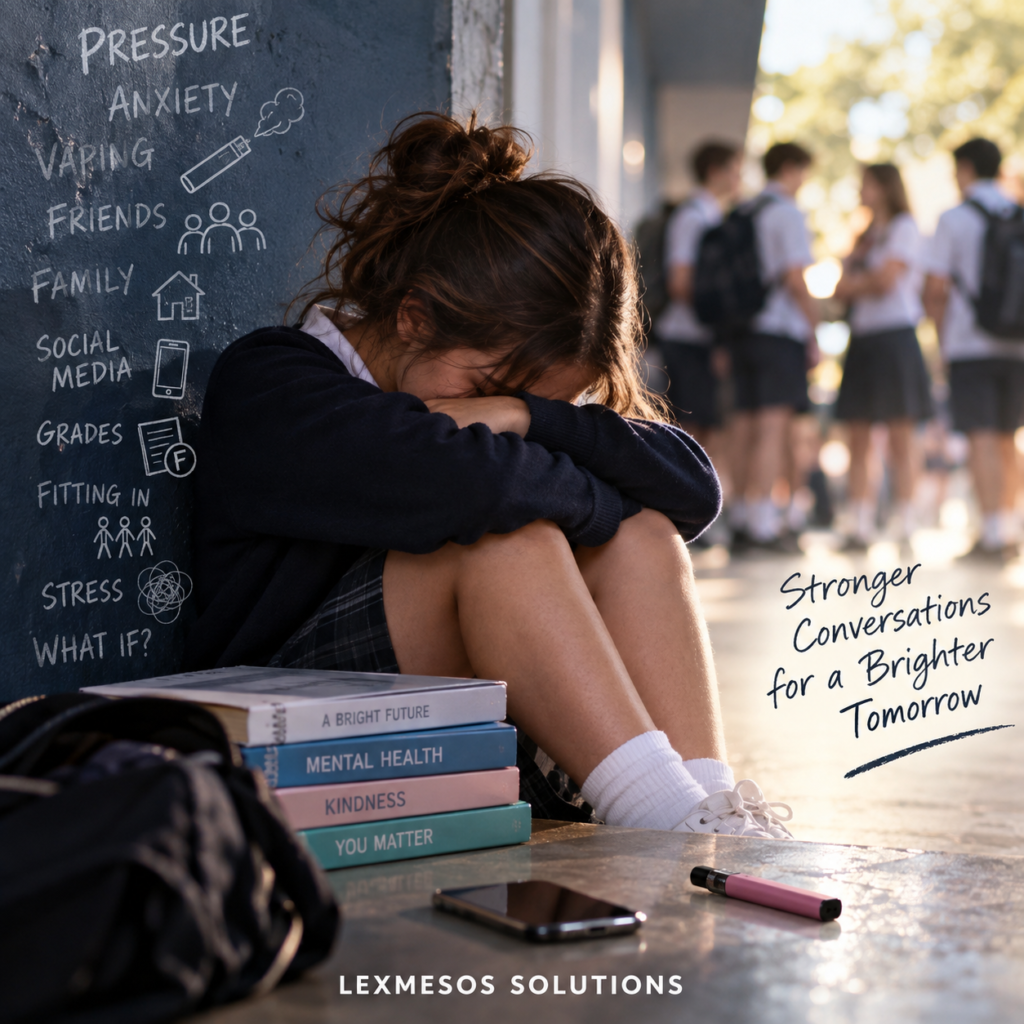
The answer was surprisingly straightforward: “Friends, family and stress.”
It was the view of one student, not a scientific survey and certainly not something that can represent every teenager in Cyprus. But the answer stayed with me because it touches on a much bigger question.
What is actually happening to our children?
In Cyprus, referrals to the Educational Psychology Service have risen sharply. There were 7,229 referrals in the 2019–2020 school year. By 2023–2024, the number had reached 10,598.
That is an increase of approximately 47% in five years.
Of the 2023–2024 referrals, 1,176 involved violence and behavioural difficulties. Another 941 concerned serious emotional difficulties, including depression, anxiety and trauma-related conditions.
Separately, 1,282 secondary-school students received counselling interventions relating to addictive behaviours such as smoking, alcohol, illegal substances and problem gambling.
Those numbers can easily produce a frightening headline.
But perhaps we are asking the wrong question.
Are Cyprus’s children really becoming more troubled?
There are certainly reasons for concern.
The Cyprus results from the international Health Behaviour in School-aged Children study, covering more than 4,800 students aged 11 to 15, found that 38% of 15-year-olds had tried e-cigarettes, compared with 17% in the previous survey. (Health Behaviour in School-aged Children)
Cannabis use was reported by 7% of 15-year-olds, while experimentation with waterpipe smoking was also widespread.
Anyone around teenagers will also recognise the wider concerns: vaping, fights, bullying, vandalism, excessive phone use and other difficult behaviour.
It is tempting to conclude that today’s children simply have less discipline.
There may be cases where discipline is exactly what is needed. Breaking school rules still requires consequences. Vandalism should not be excused. Violence should not be normalised. Mental health should never become a convenient explanation for every instance of bad behaviour.
But that cannot be the end of the conversation.
Sometimes behaviour is the problem.
Sometimes behaviour is also a symptom of another problem.
“Friends, family and stress”
The Year 9 student’s answer is interesting because international evidence points towards some of the same pressures.
WHO’s latest comparable study covered almost 280,000 adolescents aged 11, 13 and 15 across 44 countries and regions in Europe, Central Asia and Canada.
Between 2018 and 2022, the proportion reporting high family support fell from 73% to 67%. High peer support also declined.
Meanwhile, pressure from school increased.
Among 15-year-olds, 63% of girls reported feeling pressured by schoolwork, compared with 54% in 2018. Among boys, the figure increased from 40% to 43%.
WHO also found that adolescents who felt strongly supported by both family and friends reported better mental health and well-being than those with limited support.
And Cyprus stands out on one part of this comparison.
In the 2021–2022 HBSC survey, more than 60% of 15-year-old boys in Cyprus reported feeling pressured by schoolwork. Among 15-year-old girls, the figure was above 80%.
Cyprus was among the countries and regions with the highest reported school pressure for both groups.
So when a teenager casually answers “friends, family and stress”, perhaps adults should listen before dismissing it.
But Cyprus is not uniquely facing a youth mental-health crisis
This is equally important.
Not every European comparison puts Cyprus at the top.
According to Health at a Glance: Europe 2024, 42% of 15-year-old girls in Cyprus reported multiple recurring health complaints, exactly the EU27 average for girls. Among 15-year-old Cypriot boys, the figure was 34%, compared with an EU average of 37%. (Organisation for Economic Co-operation and Development)
Several EU countries recorded considerably higher levels.
Across the wider WHO region, adolescents are reporting declining family support, increasing school pressure and other challenges to well-being.
This is therefore not simply a “Cyprus problem”.
It is a generational issue appearing in different forms across many societies.
Then why are so many children being referred in Cyprus?
Here is where the numbers deserve another interpretation.
Perhaps an increase in children receiving psychological support is not entirely evidence of failure.
It may also mean that problems are being identified.
Cyprus’s Educational Psychology Service allows both parents and schools to refer children experiencing learning, emotional or behavioural difficulties.
For ordinary school referrals, parents are informed and involved. Schools first set targets and monitor the child’s progress. Where difficulties continue despite those efforts, psychological advice or intervention may then be sought. The psychologist can work with the child, family and school to develop an appropriate plan.
Urgent cases can receive an immediate response.
The service describes its mission as promoting students’ mental health and supporting their learning and overall development.
That infrastructure matters.
Perhaps 10,598 is not the only number we should worry about
Imagine two countries.
In Country A, 10,000 children seek or receive psychological assistance.
In Country B, only 1,000 do.
Which country has the bigger mental-health problem?
We cannot know from those numbers alone.
Country A might genuinely have more children struggling.
But it could also have better detection, greater awareness, less stigma or more accessible services.
Country B might have healthier children.
Or thousands might simply be suffering silently.
This distinction matters when countries are compared.
Even within the EU, UNICEF warns that comparable information on children’s access to mental-health services remains limited. In 2022, almost half of young adults aged 18 to 29 reported unmet mental-health care needs. UNICEF specifically cautions that the available data do not yet provide a complete picture of children’s access across EU countries. (UNICEF)
So a country recording more referrals should not automatically be labelled as having “worse children” or worse parenting.
Sometimes visibility is uncomfortable.
But invisibility can be far more dangerous.
What happens when asking for help is shameful?
This question becomes even more important outside Europe.
In many societies, mental health still carries significant stigma. Children may be reluctant to tell their parents that they are struggling. Parents themselves may not know where to seek assistance, may worry about how others will perceive the family, or may simply be unable to afford sustained private treatment.
A child who never reaches a psychologist does not necessarily become a healthy child.
The problem may simply remain untreated.
And children eventually become adults.
Years of unresolved anxiety, trauma, family conflict, isolation or depression do not automatically disappear on someone’s eighteenth birthday.
This is why access matters.
The purpose of comparing systems should therefore not be to say that European children are mentally weaker or that Asian children are stronger because fewer seek psychological assistance.
Silence is not evidence of good mental health.
Help does not replace parental responsibility
There is another side to this debate.
Schools cannot become responsible for everything.
Neither can psychologists.
Parents still have responsibility for boundaries, behaviour, discipline and what happens outside school. Teachers must still be able to maintain order. Children themselves must gradually learn that actions have consequences.
A teenager cannot vandalise property and simply say, “I am stressed.”
A student cannot assault another student and expect psychological difficulties automatically to erase accountability.
But accountability and support are not mutually exclusive.
A school can impose consequences for fighting and ask why the same child repeatedly becomes violent.
A parent can confiscate a vape and ask why their 13-year-old feels the need to use it.
A teacher can discipline disruptive behaviour and notice that a previously engaged student has suddenly withdrawn from everyone.
That is not being soft.
It is dealing with both the behaviour and what may be underneath it.
Perhaps the child who asks for help is not the one we should fear most
Cyprus clearly has challenges.
A 47% increase in educational psychology referrals deserves attention. So does the rise in vaping. So do violence, addictive behaviours, emotional difficulties and extraordinary levels of reported school pressure among some teenagers.
The government also faces a practical problem: demand is increasing faster than the Educational Psychology Service’s capacity. Cyprus currently has only around 71 educational psychologists, while the Education Ministry has sought substantial additional recruitment.
But there is another side to those numbers that should not be lost.
A child has been noticed.
Someone has recognised that something may be wrong.
There is at least a system through which a school or parent can say: this child needs help.
That is not something society should be ashamed of.
The greater danger may be the child who struggles for years but never tells anyone because asking for psychological help is considered embarrassing, weak or unacceptable.
Today’s Year 9 student eventually becomes tomorrow’s employee, spouse, parent and member of society.
Problems that remain buried throughout adolescence can follow people well into adulthood.
So perhaps the question should not be:
“Why do so many children in Cyprus need psychologists?”
Perhaps we should also ask:
“How many children elsewhere need exactly the same help, but never feel able to ask for it?”
And when a teenager tells us the problem is “friends, family and stress”, perhaps our first response should not always be punishment or disbelief.
Sometimes, it should simply be to listen.
Keywords: Cyprus children mental health, educational psychologists Cyprus, student mental health, school stress Cyprus, teenage vaping Cyprus, youth vaping, school violence, adolescent mental health Europe, psychological support for children, mental health stigma, parental responsibility, student wellbeing, youth mental health EU, child psychology, school counselling Cyprus
17 September 2026