 Skip to content

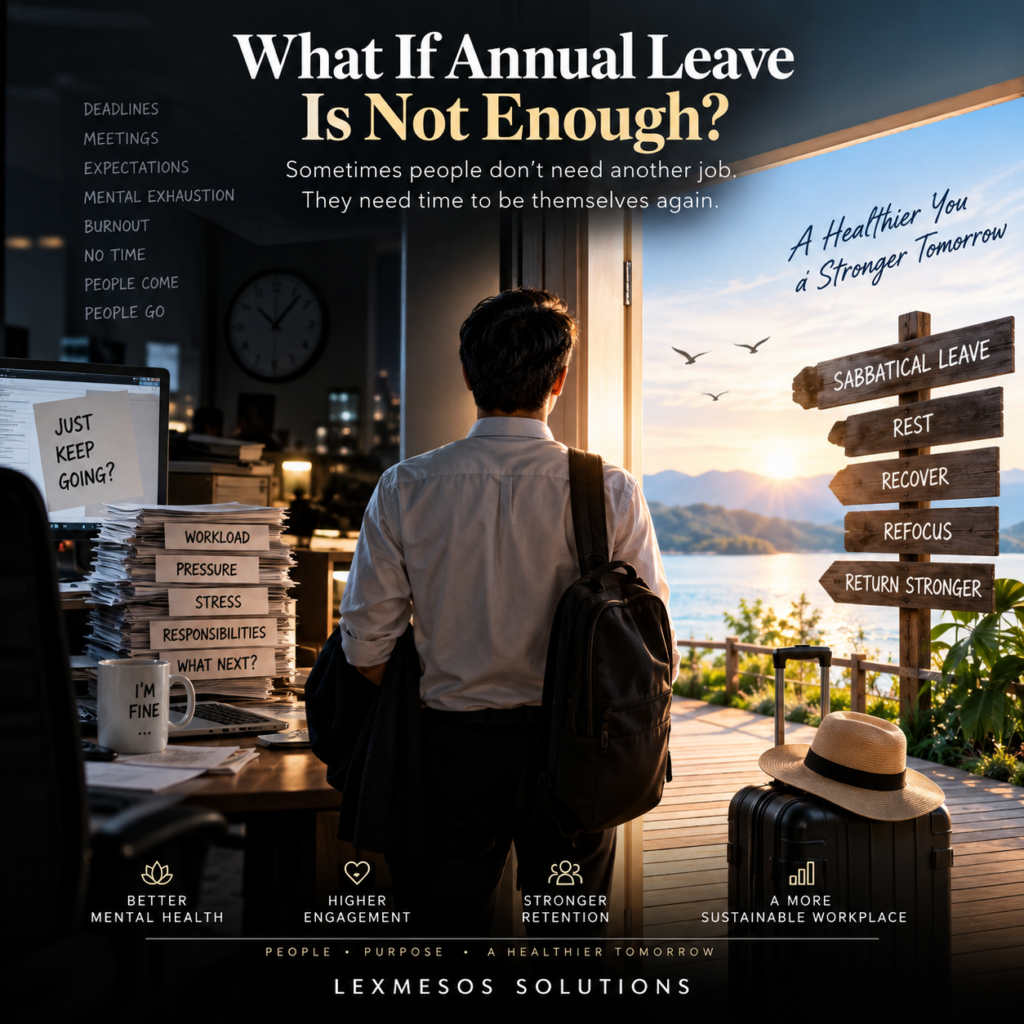
Should Sabbatical Leave Be Part of the Mental Health and Employee Retention Conversation?
We often talk about burnout only after something has already gone wrong.
An employee who was once engaged starts losing concentration. Their performance drops. They become quieter, less motivated or more irritable. Eventually, they take prolonged sick leave, resign or are labelled as someone who simply cannot cope with the job.
But what if there were another option?
What if some employees do not actually want to leave their jobs?
What if they simply need enough time away from work to recover properly?
In our earlier article, Some Employees Are Not Lazy. They’re Mentally Exhausted, we discussed how declining performance or disengagement can sometimes be a sign of mental exhaustion rather than laziness.
But recognising the problem is only the beginning.
This Is Not a Small Workplace Problem
In 2025, 29% of workers across the EU reported experiencing stress, depression or anxiety caused or made worse by their work, according to EU-OSHA’s OSH Pulse survey.
In some countries, the numbers were considerably higher. The rate reached 49% in Greece, 45% in Finland, 41% in Cyprus and Poland, and 40% in Spain.
These figures do not mean that work was the sole cause of every person’s mental-health difficulties. They measure workers who reported that stress, depression or anxiety had been caused or made worse by work.
But when almost three in ten workers across the EU report this experience, mental health at work can no longer be dismissed as an individual employee’s inability to “handle pressure”.
It becomes a workplace and organisational issue.
And that brings us to an uncomfortable question:
If annual leave is supposed to give employees time to rest, why are so many workers still reaching the point of mental exhaustion?
When a Holiday Is Not the Same as Recovery
Annual leave is important. But one or two weeks away from work may not undo months or even years of accumulated exhaustion.
Sometimes the first few days of a holiday are spent simply trying to switch off.
Then comes a short period of genuine rest.
And before long, thoughts about returning begin.
The emails are still there.
The deadlines are still there.
The workload is still there.
And whatever caused the exhaustion may still be waiting when the employee returns.
Research has long suggested that the positive effects of ordinary vacations can fade after employees return to work. Sabbaticals are different because they provide something that a short holiday often cannot: a meaningful period of separation from work.
A sabbatical might last one month, three months, six months or even longer. Depending on the organisation, it may be paid, partly paid or unpaid.
The important point is not simply the length of leave.
It is the opportunity to genuinely disconnect without necessarily ending the employment relationship.
Why Are the Choices So Often “Keep Working” or “Resign”?
Imagine an employee who has worked for the same organisation for eight years.
They understand its systems.
They know the clients.
They know the history behind decisions that may never have been written down.
The company has invested years in developing their experience, and they have invested years of their life in the company.
Now they are exhausted.
Yet the practical choices can sometimes become surprisingly limited:
Continue working.
Use whatever annual leave remains.
Take medical leave if their health deteriorates sufficiently.
Or resign.
But there could be another possibility:
Step away. Recover. Return.
For some organisations, allowing an experienced employee to take several months away may ultimately cause less disruption than losing that person permanently.
Sabbatical Leave Is Not a Reality Everywhere
It is also important not to romanticise the idea.
Not every company offers sabbatical leave.
Not every country has the same working culture.
And not every employee can afford to stop receiving a salary for several months.
The contrast becomes particularly visible when we look at different attitudes towards working time.
Germany provides a simple example.
Sunday is generally protected as a day of rest, and ordinary retail opening is substantially restricted, subject to exceptions and rules at state level.
For consumers accustomed to shopping whenever they want, this can initially seem inconvenient.
But look at it from the other side of the counter.
Someone gets to go home.
Compare this with Malaysia, where shopping malls, restaurants and many service businesses commonly remain open on Sundays and public holidays.
Consumers benefit from the convenience.
But somebody has to provide that convenience.
The cashier is working.
The restaurant employee is working.
The cleaner is working.
The security guard is working.
The retail assistant is working.
This does not mean Malaysian employees have no legal protections concerning working hours, rest days and public holidays. Nor does it mean Europeans do not work long hours or experience burnout.
Hospitals, hotels, airports, restaurants, emergency services and many other sectors cannot simply shut down every Sunday.
The comparison raises a broader question:
What does a society consider normal when it comes to work and rest?
Behind every additional hour of consumer convenience is somebody else’s working time.
This Should Not Become an “Asia vs Europe” Argument
Economic realities differ enormously.
A multinational corporation employing thousands of people may be able to accommodate a three-month sabbatical relatively easily.
A small business employing six people may genuinely struggle to do so.
A highly paid professional may be able to afford three months of unpaid leave.
A lower-paid worker living from one salary to the next may not.
This is why simply declaring that “every employee should receive a sabbatical” ignores reality.
There is also no general EU statutory right requiring every employer to provide sabbatical leave.
What Europe does provide, through working-time legislation and national systems, is a broader regulatory conversation about rest, maximum working hours, annual leave, occupational health and psychosocial risks.
The more useful question is therefore not whether every country should copy one model.
It is whether organisations should start treating meaningful rest as part of workforce sustainability rather than as an inconvenience to productivity.
Sometimes Employees Do Not Even Know They Can Ask
There is another problem.
Even where extended leave may be possible, employees may not know about it.
Their employment contract may say nothing about sabbaticals.
The employee handbook may say nothing.
HR may never mention that an extended unpaid break, career break or other arrangement could potentially be discussed.
Employees therefore assume that their options are:
Work or resign.
Then, occasionally, they see someone at Chief level disappear from the organisation for six months, perhaps even a year, and later return.
And suddenly employees discover something they did not know before:
Apparently, it was possible to leave without actually leaving.
Of course, nobody should assume that every long absence by a Chief-level executive is a sabbatical.
There may be completely different circumstances: individually negotiated contractual arrangements, family responsibilities, medical reasons, secondments, career breaks or other arrangements that colleagues neither know about nor have any right to know about.
But it still raises a legitimate organisational question.
If extended leave can sometimes be considered, should employees at least know that they can ask?
A retention option that employees do not know exists cannot retain anyone.
And Even Meeting Every Requirement May Not Be Enough
Some organisations go further and actually have an extended-leave or sabbatical policy.
The policy may establish eligibility requirements.
Perhaps the employee must have completed five years of service.
Perhaps their performance record must be satisfactory.
Perhaps they must apply several months in advance.
Perhaps they must complete a proper handover.
The employee ticks every box.
And then comes the sentence that matters most:
Approval remains subject to the company’s discretion and operational requirements.
That distinction is important.
Being eligible to apply does not necessarily mean having an entitlement to take the leave.
There are legitimate reasons for employers to retain discretion. Several employees may request leave simultaneously. A project may be approaching a critical deadline. A small team may genuinely be unable to absorb someone’s absence.
But discretion creates another important question:
How consistently and transparently is that discretion exercised?
If employees satisfy every published requirement but still have little understanding of why requests are approved or rejected, the policy may create expectations without creating meaningful access.
Companies do not have to approve every request.
But employees should ideally understand the difference between eligibility to apply and the factors that determine approval.
When the Answer Is Simply: “You Can Leave”
This is where sabbatical leave becomes a retention issue rather than simply an employee benefit.
Consider an employee who has served an organisation for years.
They meet the stated criteria.
They have a genuine reason for requesting an extended break.
Perhaps they are even prepared to take it unpaid.
The request is refused.
Again, the company may have legitimate operational reasons.
But in some workplace cultures, the underlying response goes further:
If you cannot continue, there is always the exit door. You are free to walk away.
The philosophy becomes:
People come. People go. Nobody is indispensable.
Technically, that is true.
A well-managed organisation should not become completely dependent on one employee.
But there is an important difference between saying that somebody can be replaced and saying that replacing them has no cost.
“People Come, People Go” Is Not a Retention Strategy
When an experienced employee leaves, the organisation does not simply remove one name from payroll and replace it with another.
Institutional knowledge can leave with them.
Client relationships may leave.
Experience leaves.
Knowledge of internal processes leaves.
Understanding of previous mistakes and why certain decisions were made leaves.
Then somebody has to recruit the replacement.
Someone has to interview them.
Someone has to train them.
The new employee needs time to understand the organisation and become productive.
And sometimes, after all of that, the replacement leaves too.
Yet organisations can become strangely comfortable with this cycle.
People leave.
Recruitment begins.
New employees arrive.
More people leave.
Then management discusses the retention rate.
At some point, the question should not simply be:
“Why are employees leaving?”
It should also be:
“What could we reasonably have done to make some of them stay?”
Retention Cannot Be an HR KPI Alone
Companies frequently measure employee engagement, turnover and retention.
But HR cannot create a retention culture on its own if the philosophy at the top is simply:
“If they want to leave, let them leave.”
That does not mean an organisation should desperately retain every employee.
People leave for perfectly normal reasons. They relocate. They change careers. They receive better opportunities. Their personal circumstances change. Sometimes the employment relationship has simply run its course.
But when a good employee says:
“I need three months away, otherwise I may have to resign.”
There is another question worth asking:
What costs the organisation more: accommodating a temporary absence or losing that employee permanently?
That is not charity.
It is workforce planning.
And this is where organisations should distinguish between what they can legally or contractually do and what makes sense from a retention perspective.
A company can satisfy its policy while still failing its retention strategy.
Some Things Cannot Be Replaced With Money
When retention problems arise, companies often return to compensation.
Would a salary increase help?
Would a bonus make the employee stay?
What about a promotion?
Sometimes the answer is yes.
But there comes a point when money may no longer be what the employee is asking for.
When prolonged stress has started affecting someone’s physical or mental health, a higher salary does not automatically restore sleep.
A bonus does not remove exhaustion.
A promotion does not necessarily reverse burnout.
And money cannot guarantee recovery from depression or other health problems.
There is therefore a fundamental difference between replacing someone’s income and restoring someone’s health.
The company may eventually replace the employee.
The employee cannot simply replace their health.
This is why mental-health-related retention cannot always be solved by increasing compensation.
Sometimes the employee is not saying:
“Pay me more.”
They are saying:
“I need time to recover.”
Those are completely different requests.
Sabbatical Leave Will Not Fix a Bad Workplace
There is also a danger in presenting sabbaticals as the solution to burnout.
They are not.
If one employee is doing the work of three, sending them away for three months and returning them to exactly the same workload solves very little.
If bullying is causing the problem, leave does not remove the bully.
If poor management is causing the problem, a career break does not improve management.
If employees are expected to answer messages late at night, a temporary break does not change that culture.
And if chronic understaffing is the underlying problem, organisations cannot solve it by periodically sending exhausted employees away to recover.
Mental-health protection therefore needs to address prevention as well as recovery.
A sabbatical should be one possible tool within a much broader approach to workload, working time, staffing, management, flexibility and psychosocial risk.
Perhaps We Need to Stop Treating Rest as Laziness
There may be an even deeper cultural issue.
We often admire the employee who is always available.
The person answering emails at 11 p.m.
The manager who never takes annual leave.
The employee who comes to work despite being unwell.
The person who proudly says:
“I haven’t taken a proper holiday in three years.”
But should that really be our measure of commitment?
At what point did exhaustion become evidence of dedication?
A sustainable workplace should not require employees to reach breaking point before stopping becomes acceptable.
Rest is not necessarily the opposite of productivity.
Sometimes rest is what makes continued productivity possible.
Let Me Leave for a While Without Making Me Leave Forever
Not every employee needs a sabbatical.
Not every employee who asks for one should automatically receive it.
Not every employer can afford to offer one.
And sabbatical leave should never become a substitute for fair pay, reasonable workloads, adequate staffing, respectful management and genuine time away from work.
But perhaps it deserves a more serious place in the mental-health and employee-retention conversation.
Because when an experienced employee says:
“I cannot continue like this,”
it does not necessarily mean:
“I never want to work here again.”
Sometimes it means:
“I cannot continue like this right now.”
There is a significant difference between the two.
Before years of experience walk permanently out of the door, perhaps there is one more question worth asking:
“Would some genuine time away allow you to come back?”
Sometimes an employee does not need another job.
Sometimes they need enough time away from their current one to recover, reset and return in a better state of mind.
Perhaps the real value of a sabbatical is therefore not the time an employee spends away from the organisation.
It is the possibility that they come back.
And if an organisation refuses even to consider temporary separation, the employee may eventually take a much longer break from the company:
permanently.
The future of employee wellbeing should therefore not be discussed only in terms of how much leave the law requires.
Perhaps we should also be asking:
How much genuine rest do people need to remain healthy enough to keep working?
Because jobs can be replaced.
Employees can be replaced.
Money can be earned again.
Health is much harder to get back once it has been lost.
Keywords: Sabbatical leave, annual leave, employee mental health, mental exhaustion, burnout, employee wellbeing, employee retention, staff turnover, workplace mental health, career break, extended leave, right to disconnect, HR policy, workplace culture, employee engagement, retention strategy, psychosocial risks, work-life balance, mental health at work and workforce planning
15 September 2026