 Skip to content

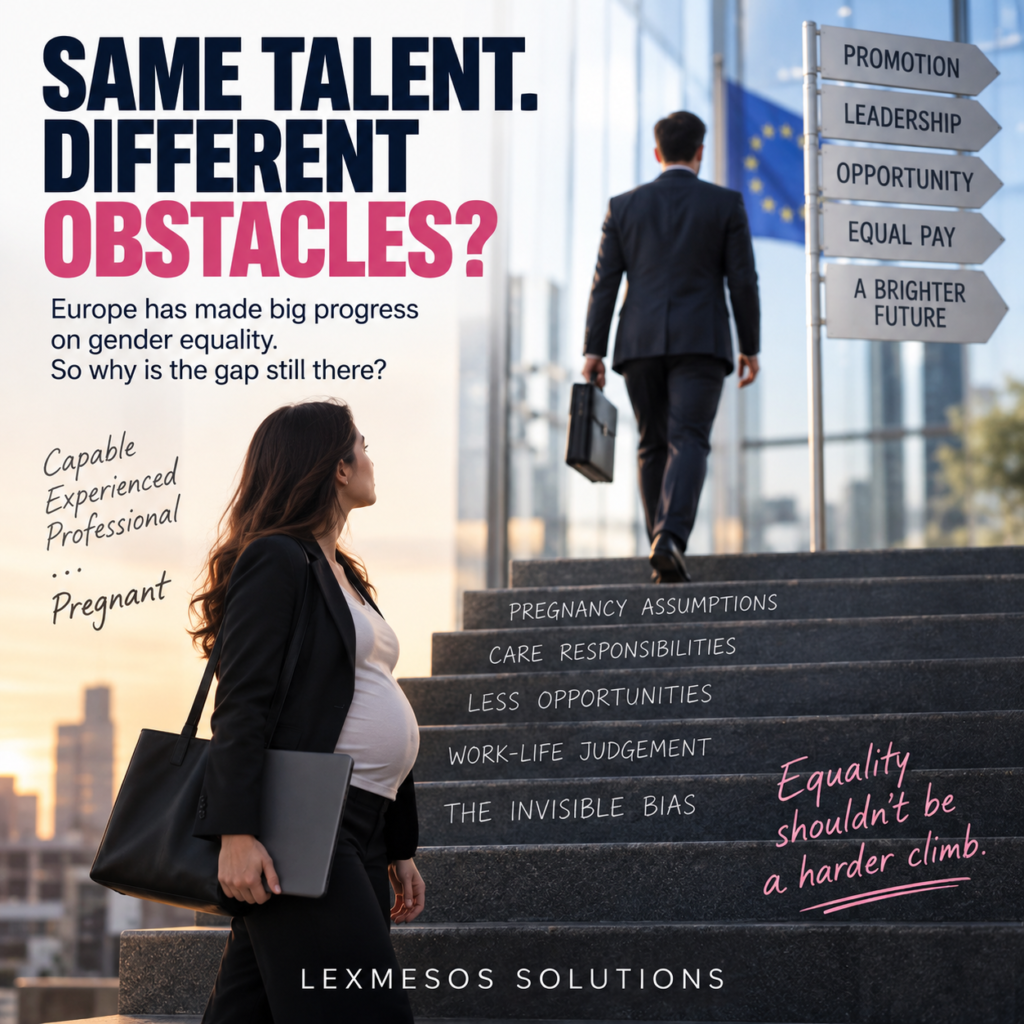
Europe has spent decades building laws around equal treatment, equal pay and protection against discrimination.
And if we look at the latest global rankings, Europe appears to be doing remarkably well.
The World Economic Forum’s Global Gender Gap Report 2026 published in September, ranks Finland second in the world, Norway third, Sweden seventh and Germany ninth. Seven of the global top 10 are European countries. The index looks beyond salary, measuring gender gaps across economic participation and opportunity, education, health and political empowerment. (World Economic Forum)
Then look at the pay figures.
The EU’s unadjusted gender pay gap was around 11% in 2024. Germany was around 16%, while Estonia recorded the largest gap in the EU at around 19%. (Destatis Germany)
So how can countries that rank among the world’s leaders in gender equality still have sizeable differences in what men and women earn?
The answer is more complicated than simply saying employers pay women less.
And when I saw these numbers, they reminded me of a meeting from years ago.
A Meeting I Still Remember Years Ago…
I was working for my former company and was involved in selecting a law firm to assist one of our subsidiaries with a construction dispute.
We met lawyers from established firms to discuss the matter and determine who would be suitable to handle it.
One of the lawyers who came to our office was a female partner specialising in construction matters.
She was pregnant.
After the meeting, I remember the discussion turning to that fact.
People from the subsidiary said they did not want to appoint a woman, particularly a pregnant woman.
From their perspective, the concern was practical.
She would soon have a baby. Would she still have enough time to handle the matter? Would she be available when something urgent happened? Could it affect the progress of the dispute and ultimately the project?
Eventually, a male construction lawyer from another well-known firm was appointed.
I am not suggesting that he was unqualified. He was an experienced construction lawyer. There were different lawyers and firms under consideration, and many factors can go into choosing external counsel.
But one part of that discussion stayed with me.
Nobody had said that the female partner lacked the knowledge or experience to handle the dispute. Her pregnancy itself had become part of the discussion about whether she should get the opportunity.
Years later, when I see statistics about gender inequality, I think about that meeting.
Because perhaps the gender gap does not always begin with salary.
Sometimes it begins much earlier.
What If She Might Have a Baby?
There is an uncomfortable question behind that experience.
Would we have had the same discussion if the lawyer sitting across the table had been a man expecting a child?
Would anyone have wondered whether becoming a father would make him less available?
Would we have discussed whether childcare might interfere with an urgent meeting or whether having a newborn could affect his ability to manage the case?
This is where gender inequality becomes much harder to see in statistics.
It does not always arrive as somebody openly saying:
“Pay the woman less.”
Sometimes it sounds much more reasonable:
“The project cannot wait.”
“We need someone available all the time.”
“She is going to have a baby.”
“What if she becomes pregnant?”
From a business perspective, these can sound like practical concerns.
But if those concerns are disproportionately attached to women, they can affect who receives the client, who gets the major assignment, who is promoted and who is considered the safer choice.
One missed opportunity might not change an entire career.
But careers are built from opportunities.
Finland Can Rank No. 2 and Still Have a Pay Gap
This is where the latest World Economic Forum ranking becomes particularly interesting.
Finland ranks second in the world in the 2026 Global Gender Gap Index, having closed 87.2% of its overall gender gap. Sweden ranks seventh and Germany ninth. (Wolrd Economic Forum)
Yet being near the top of that ranking does not mean every gender difference has disappeared.
Take Germany.
Germany’s overall gender-parity score is 81.7%, putting it ninth globally. But when the World Economic Forum looks specifically at Economic Participation and Opportunity, Germany’s score is 69.6%, placing it 80th globally on that particular dimension.
That difference is revealing.
Germany can perform strongly in areas such as political empowerment and education while still having much further to go in economic outcomes.
Finland presents another interesting example. It ranks second overall and has achieved full parity in educational attainment, but its Economic Participation and Opportunity score is 79.1%.
There is no contradiction.
The measurements are simply asking different questions.
And that is exactly why saying “Country X is more gender equal than Country Y” based on one number can be misleading.
The Pay Gap Does Not Mean Women Receive 11% Less for Doing the Same Job
This distinction is important.
The gender pay gap normally quoted in the EU data is unadjusted.
It compares average gross hourly earnings between male and female employees. It does not tell us that a woman with the same qualifications, performing the same work under the same circumstances, is necessarily being paid that percentage less than a man.
Germany’s Federal Statistical Office specifically warns against interpreting the figure that way. (Destatis Germany)
The labour market is far more complicated.
Men and women are distributed differently across occupations and industries. They do not necessarily follow the same career paths. Working patterns differ too.
Across the EU in 2024, 27.8% of employed women worked part-time compared with just 7.7% of employed men.
There was also a substantial employment difference: 70.8% of women aged 20–64 were employed compared with 80.8% of men.
That means the headline pay-gap figure tells us something important.
But it does not tell us everything.
A Small Pay Gap Does Not Automatically Mean Greater Equality Either
The reverse is also true.
A country can have a relatively small hourly pay gap while having substantial gender differences elsewhere in its labour market.
Italy illustrates this particularly well.
In 2024, Italy had the largest gender employment gap in the EU at 19.4 percentage points. Greece followed at 18.8 points and Romania at 18.1. (Eurostat)
So if we only compare hourly pay, we can miss another question entirely:
How many women are participating in employment in the first place?
That is why gender equality cannot be reduced to a league table.
The pay gap, employment gap, seniority, working hours, political representation and access to opportunities measure different parts of the same much larger picture.
Sometimes the Gap Begins Before the Payslip
This brings me back to that pregnant lawyer.
Her story would never appear in a gender pay-gap statistic.
There is no payslip showing the client she did not receive.
There is no salary record showing an assignment that went to somebody else.
And there is no Eurostat column recording a meeting where pregnancy became part of a professional discussion.
Yet opportunities matter.
A major case can lead to another client.
A difficult project can become the experience that qualifies someone for a more senior position.
A promotion at 35 can affect earnings at 40, 50 and beyond.
If women are sometimes assessed not only on what they can do today, but also on assumptions about pregnancy, motherhood and future caring responsibilities, then the consequences may only become visible much later.
That does not mean every difference in career progression is discrimination.
It means we should be careful about assuming that equal opportunity can be measured simply by comparing two salaries.
Pregnancy Should Not Become a Prediction About a Woman’s Career
EU equality law has long recognised the particular position of pregnancy and maternity in the workplace.
But the cultural question goes beyond legislation.
When we look at a pregnant professional, are we assessing the person sitting in front of us?
Or are we already imagining her future availability?
Will she take maternity leave?
Will she have to leave early?
What if her child is sick?
Will she still want the demanding cases?
And there is an obvious follow-up question:
How often do we make the same predictions about a man when he becomes a father?
My own experience involved the selection of an external law firm rather than an employment decision concerning the female partner. It should therefore not be treated as a conclusion about whether any particular employment law was breached.
That is not why I am telling the story.
What stayed with me was the assumption.
We Already Have Equal Pay Laws. So Why Are We Still Talking About This?
Europe is certainly not starting from zero.
Equal-pay and equal-treatment protections have existed for decades.
Now the EU has gone further with the Pay Transparency Directive.
In an earlier LexMesos Solutions article, “The Salary Question Employers Love Asking But Hate Answering,” we looked at an imbalance familiar to many jobseekers: employers asking candidates what they currently earn or what salary they expect while sometimes being reluctant to disclose the salary range themselves.
The Pay Transparency Directive is intended to make pay structures more transparent and strengthen enforcement of equal pay for equal work or work of equal value.
The deadline for Member States to transpose the Directive was 7 June 2026. The European Commission has since said that attention will be given to assessing whether national legislation conforms with the Directive’s requirements.
Pay transparency matters.
If two people perform equal work but there is an unjustifiable difference in pay, transparency can make that difference much harder to hide.
But transparency cannot reveal every opportunity that never happened.
Perhaps We Have Been Asking Too Narrow a Question
The World Economic Forum says global gender parity has advanced over the 20 years it has been measuring it. Yet its 2026 report also says women remain underrepresented in some of the positions carrying the greatest economic influence; women hold only 19.1% of CEO roles in the data it reports.
So perhaps asking:
“Are men and women paid equally?”
comes too late in the story.
We should also ask:
Who had the opportunity to reach the position in the first place?
Who received the important assignment?
Who was trusted with the client?
Who was promoted?
Who was considered leadership material?
And when somebody was passed over, was the decision really about capability, or had assumptions about gender, pregnancy, motherhood or caring responsibilities quietly entered the room?
Finland can rank second in the world for gender parity and still have areas where inequality remains.
Germany can rank ninth globally while still showing a sizeable unadjusted pay gap and a much weaker position specifically on economic participation and opportunity.
Both things can be true.
And perhaps that is the most important message hidden behind all these rankings and percentages.
Gender equality is not achieved when a country reaches the top of a table.
It is achieved in thousands of ordinary decisions about pay, promotion, opportunity and trust.
I still remember that meeting because nobody questioned whether the pregnant lawyer knew construction law.
The question was whether becoming a mother might affect her ability to do the work.
That happened years ago.
The statistics have changed since then. The laws have developed. Pay transparency has moved forward.
But the harder question remains:
Have the assumptions changed with them?
Keywords: Gender pay gap in Europe, gender equality, EU gender pay gap, equal pay, workplace discrimination, pregnancy discrimination, women at work, pay transparency, EU Pay Transparency Directive, career opportunities, gender employment gap, Eurostat
18 September 2026