 Skip to content

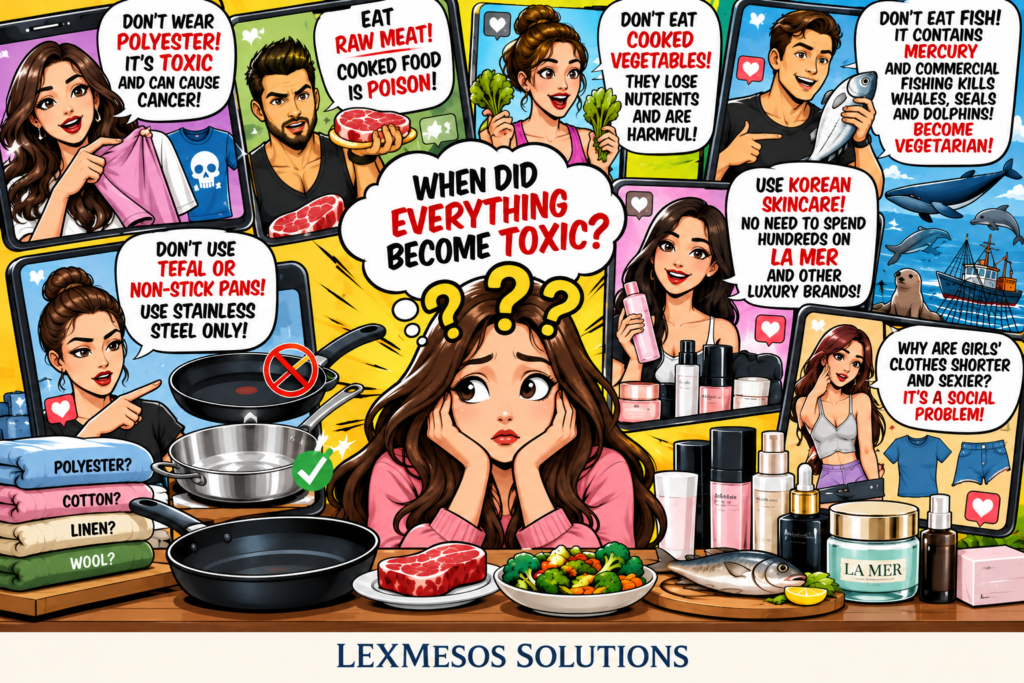
From the food we eat to the clothes we wear, the pans we cook with and the skincare products we buy, social media seems determined to convince us that almost everything is harmful. But how much of this advice is supported by science and how much is simply creating unnecessary fear?
Yesterday It Was Normal. Today It Is Dangerous.
Think about how much ordinary life has changed.
For decades, people wore polyester clothing, cooked with non-stick frying pans, ate meat and vegetables, used supermarket shampoos and bought whatever skincare products suited them.
Today, open Facebook, Instagram, TikTok or YouTube, and someone will tell you that you have been doing everything wrong.
Polyester is supposedly toxic. Non-stick pans are dangerous. Certain vegetables should not be cooked. Fish contains mercury. Expensive skincare is a waste of money. Commercial fishing harms marine animals, so everyone should stop eating fish.
Some even recommend eating raw meat while warning people against ordinary cooked meals.
And these claims often come from individuals who introduce themselves as health science graduates, nutrition specialists, skincare experts or people who have spent years researching a particular subject.
The message is familiar: “We are more educated now. We understand the risks that previous generations didn’t.”
But does having more information necessarily mean having a better understanding?
When Everyone Becomes a Health Expert
There is nothing wrong with sharing knowledge or encouraging healthier choices.
The problem begins when personal opinions are presented as established scientific facts.
Someone might have studied health science, nutrition or biology. That qualification deserves consideration, but it does not mean every statement they make is correct.
A degree is not proof that a particular claim is supported by reliable research. Even qualified professionals can disagree, misunderstand evidence or speak outside their areas of expertise.
Yet social media audiences frequently accept advice because the person sounds confident, uses scientific terminology or claims to have discovered something the public does not know.
Consider the growing number of videos discussing diet.
One person says cooked food destroys nutrients and should be avoided. Another promotes raw meat as the natural way humans should eat. Someone else insists that fish should be eliminated because of mercury contamination.
But the World Health Organization recommends cooking meat thoroughly to reduce foodborne illness. Raw meat can carry harmful bacteria and parasites. Cooking vegetables may reduce certain nutrients, but it can also improve the availability of others. (World Health Organization)
Mercury in fish is a genuine concern, particularly for certain species and vulnerable groups. However, that does not mean every fish is unsafe. Many lower-mercury fish remain nutritious choices. (FDA)
There is a difference between explaining a risk and frightening people into abandoning an entire food group.
Are Our Clothes and Cooking Pans Really Poisoning Us?
Polyester has become another favourite target.
Social media posts describe it as plastic, garbage or toxic material that people should never allow near their skin.
Polyester is indeed a synthetic fibre and concerns about microplastic pollution and textile chemicals deserve scientific attention.
But being synthetic does not automatically mean a material causes cancer through ordinary use.
The same applies to cookware.
Consumers are increasingly told to throw away their Tefal or other non-stick frying pans and replace them with stainless steel.
Stainless steel is an excellent option. It is durable and does not require a non-stick coating.
However, properly used modern non-stick cookware is not automatically dangerous simply because it contains a synthetic coating. Overheating, damaged coatings and certain chemicals used historically in manufacturing are separate issues that require proper explanation.
Why must every discussion become a choice between something supposedly poisonous and something completely safe?
Good consumer advice should explain the actual risks, not make people afraid of everything they own.
Even Fashion Has Become an Argument
The criticism does not stop at health.
Social media discussions also question why girls’ clothing is often shorter, tighter or more revealing than boys’ clothing.
That is a reasonable subject for discussion. Fashion, social expectations, comfort, age-appropriate design and personal choice all matter.
But it is another example of how ordinary consumer products can become part of wider arguments about how people should live, dress and behave.
People should be able to discuss clothing choices without automatically judging the intelligence, values or responsibility of those who dress differently.
Save the Ocean. Stop Eating Fish.
Commercial fishing is another example.
Fishing operations can accidentally catch dolphins, whales, seals, turtles and seabirds. Overfishing and damage to marine ecosystems are serious environmental concerns.
Yet some online messages turn these concerns into a simple instruction: stop eating fish and become vegetarian.
Choosing a vegetarian diet for environmental or ethical reasons is entirely legitimate.
But agriculture also affects ecosystems, consumes water, changes land use and can harm wildlife.
No food production system is completely free of environmental consequences.
Instead of suggesting that one dietary choice makes someone morally superior, discussions should consider fishing methods, sustainable production, consumption patterns and environmental impact.
Protecting the environment requires more than telling people what they must stop eating.
Korean Skincare Versus Luxury Brands: Who Decides What Is Better?
Beauty products provide another interesting example.
Social media is full of influencers recommending affordable Korean skincare while questioning why consumers spend hundreds on luxury brands such as Lamer.
Some suggest that expensive products are unnecessary because cheaper alternatives contain similar ingredients.
There is some truth here. Higher prices do not automatically mean better results. Affordable skincare can be effective and consumers should not assume that luxury products are scientifically superior. (Cleveland Clinic)
But the reverse is equally important.
A Korean skincare product is not automatically better simply because it is Korean, affordable or popular online.
Different products have different formulations, concentrations, textures and suitability for different skin types.
Some consumers enjoy luxury skincare because of its formulation, experience, packaging or personal preference. Others prefer affordable products that work well for them.
Neither choice automatically makes someone more educated or financially sensible.
The American Academy of Dermatology also advises that effective skincare products exist across different price ranges. (AAD)
So why do we increasingly allow strangers on social media to decide what we should buy, what is worth our money and what makes us intelligent consumers?
Previous Generations Lived Differently. Were They Less Informed?
Many of us know older people who lived into their 80s, 90s or even beyond 100.
They did not spend their lives checking every ingredient in their shampoo, questioning every frying pan or worrying about whether their clothes contained synthetic fibres.
But that does not prove everything they used was harmless.
Previous generations also faced serious health risks that modern science has helped us understand, including tobacco exposure, asbestos, lead and unsafe working conditions.
And although some people lived exceptionally long lives, many others died much younger.
Modern healthcare, sanitation, vaccines and medical knowledge have helped improve life expectancy.
We should appreciate scientific progress rather than dismiss it.
However, there is something worth questioning about modern attitudes.
Have we reached a point where people have access to more health information than ever before, yet feel increasingly frightened of ordinary life?
Being informed should help people understand risks and make sensible decisions.
It should not mean constantly worrying that every meal, fabric, cosmetic product or household item is shortening their lives.
Fear Has Become a Powerful Marketing Tool
There is another side to these discussions that deserves attention.
Social media is not simply a place where people exchange information. It is also a business environment.
Attention creates opportunities for advertising, sponsorships, product sales, affiliate commissions and personal branding.
Consider how often a frightening message is followed by a product recommendation.
Your skincare is supposedly damaging your skin. Here is a better serum.
Your cooking pan is supposedly toxic. Here is the safer alternative.
Your usual diet is supposedly harmful. Here is a meal plan, supplement or online programme.
Not every creator is dishonest, and not every recommendation is commercially motivated.
But audiences should recognise that frightening claims can attract attention and influence purchasing decisions.
A person can sound knowledgeable, have impressive qualifications and still be promoting a product.
The question is not simply whether someone has studied science. It is whether the evidence supports what they are telling the public.
Being Educated Means Knowing How to Question Information
Education is valuable. Scientific awareness is valuable. Protecting our health and environment is important.
But education should encourage critical thinking, not blind acceptance.
Before believing a dramatic health claim, we should ask whether it comes from reliable research, whether the risk applies to normal everyday exposure and whether the person making the claim has considered the full evidence.
We should also distinguish between personal preferences and medical advice.
Someone choosing stainless steel over non-stick cookware does not prove that everyone else is putting their health at risk.
Someone preferring natural fabrics does not prove polyester causes cancer.
Someone following a vegetarian diet does not mean everyone eating fish is irresponsible.
And someone using affordable Korean skincare does not mean people purchasing Estée Lauder are wasting their money.
Different people have different needs, budgets, priorities and preferences.
Not every personal choice requires a scientific justification, and not every alternative must be presented as dangerous.
Perhaps We Need Less Fear and More Common Sense
We should continue learning about health, nutrition, environmental protection and consumer safety.
Scientific discoveries have genuinely improved our lives, and credible warnings should never be ignored.
But there is a difference between understanding a potential danger and assuming that danger exists everywhere.
Social media has made it easy for almost anyone to present themselves as an authority, turn complex research into a short video and influence thousands of purchasing and lifestyle decisions.
That places greater responsibility on both content creators and audiences.
The next time someone tells us that our clothes are toxic, our food is poisonous, our skincare is useless or our cooking pans are slowly killing us, perhaps we should ask one simple question:
Where is the evidence, and does it actually support what you are claiming?
Because being educated is not about believing every new warning.
It is about knowing when to question one.
We should be using knowledge to live better, not allowing fear to control how we live.
Keywords: Social media health misinformation, fear-based marketing, toxic product claims, health influencers, consumer awareness, health science misinformation, polyester clothing safety, non-stick cookware safety, Tefal pans, stainless steel cookware, raw meat diet risks, cooked food myths, mercury in fish, commercial fishing environmental impact, vegetarian diet claims, Korean skincare versus luxury skincare, Estée Lauder skincare, beauty influencer marketing, misleading health advice, social media influence on consumer behaviour, scientific evidence versus personal opinion, critical thinking, digital misinformation, consumer protection and responsible marketing
This article provides general commentary on consumer awareness, scientific information and social media communication. It is not individual medical or nutritional advice.
8 October 2026